


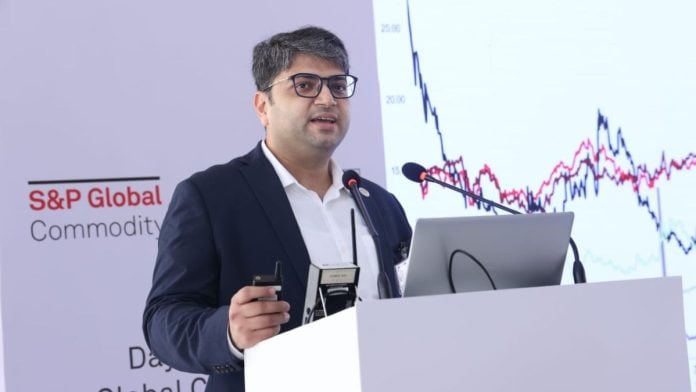
New Delhi: The policy direction of the US administration following the midterm elections could have significant implications for global energy markets, particularly Iran and the Strait of Hormuz, Pulkit Agarwal, Global Director, India Content at S&P Global Energy, told ThePrint in an exclusive interview. He cautioned that Gulf oil supplies could remain unpredictable in 2027 if the West Asia conflict and attacks on ships transiting the critical waterway continue.
“The policy direction that you would see coming out of the US is something that would really shape up quite a lot, specifically in terms of the geopolitics related to Iran, and the status of the Strait of Hormuz,” Agarwal said, referring to the implications of the outcome of the US midterm elections.
He said the US stance on the waiver allowing purchases of Russian oil would also be important to watch. The current waiver, he said, was “very much revocable” and came without an expiry date.
Agarwal said the global oil market outlook would also depend on how quickly countries begin replenishing inventories depleted during the crisis. The world has drawn down more than 600 million barrels from strategic and commercial stocks this year owing to West Asia conflict, as consumption exceeded production.
Once the crisis eases, countries are likely to rebuild at least part of these reserves. India, too, has announced plans to increase its storage capacity. However, the scale and timing of this additional demand will depend on whether buyers find prices attractive enough to purchase oil for storage.
“The world would need to refill at least some of it, if not all of it,” Agarwal said, adding that it would be important to watch how soon countries return to the market to buy oil for their reserves.
India’s crude sourcing has changed significantly since the Russia-Ukraine war began in 2022, when discounted Russian barrels became economically attractive. However, the Middle East has continued to remain a major source of crude for Indian refiners.
Agarwal said India’s crude purchases were driven by price and availability, rather than loyalty to any particular supplier. When the West Asia crisis disrupted traditional supply routes, Indian refiners turned to available cargoes, including those from parts of the Middle East outside the conflict zone, such as Saudi oil ports in the Red Sea.
The availability of these supplies has since varied. India has bought more Middle Eastern crude when shipments were available and reduced purchases when flows weakened.
“If the crisis continues and the attacks on ships keep on happening, it is difficult to think flows out of the Strait of Hormuz will be consistent and predictable,” he said.
He clarified that this did not mean oil shipments would stop altogether. Buyers and sellers had found ways to keep supplies moving despite the risks, but these arrangements involved higher shipping costs and greater uncertainty.
“The flows [from Middle-East] are going to be there. But the stability of those flows is something that we have to consider,” Agarwal said.
LPG dependence exposes a different vulnerability
India’s dependence on the Middle East is particularly significant in the case of liquefied petroleum gas (LPG), which is widely used for household cooking. Before the crisis, nearly 90 percent of India’s LPG imports came from the region, Agarwal said.
He said India’s LPG requirements made it difficult to replace Middle Eastern supplies quickly. LPG consists of hydrocarbon molecules of propane and butane, and India typically requires a mix of the two in proportions that Middle Eastern suppliers are better placed to provide. India’s import terminals, pipelines, tank trucks and bottling plants are configured around this supply mix.
The US, another major LPG producer, exports a more propane-heavy mix and has limitations on the amount of butane it can supply, Agarwal said. Shipments from the US also take considerably longer to reach India, with voyages taking around one-and-a-half months compared with shorter journeys from the Gulf.
India increased purchases from the US after the West Asia conflict began and also raised LPG production at domestic refineries. However, producing more LPG at refineries means diverting some lighter feedstock away from other products, including petrochemicals.
Over the last few months Middle Eastern LPG supplies have resumed, but Agarwal said their flows remained irregular. India has continued buying from the US, although purchases have eased somewhat because of high freight costs.
He said India needed to diversify not only the countries it sourced LPG from but also the routes and logistics used to bring it into the country.
“If the Strait of Hormuz is closed, that takes away four or five of your primary options to buy LPG,” he said, referring to the concentration of suppliers in the region. However, he cautioned that there were no easy alternatives because the number of global suppliers and export ports was limited.
PNG transition will take time
The expansion of piped natural gas (PNG) connections could help reduce dependence on imported LPG over time, but Agarwal said it would not be a quick solution.
Liquefied natural gas (LNG) is available from a wider range of countries and is more homogeneous than LPG. India also has import terminal capacity to receive LNG. However, expanding PNG use requires both a national gas grid connecting cities to ports and distribution pipelines reaching individual households.
“It’s really a mammoth task,” Agarwal said, adding that replacing a significant share of LPG demand with PNG would take a long time and could not be achieved in a matter of months or even a few years.
Meanwhile, India’s demand for petrol and diesel is expected to remain strong despite the growing adoption of electric vehicles. S&P Global Energy expects combined petrol and diesel demand to grow by more than 4 percent next year.
Agarwal said electric mobility was taking away some incremental demand growth but was not replacing conventional fuel consumption. Rising car ownership continued to support petrol demand, while goods transportation, industrial activity and mining were driving diesel consumption.
More storage needed to cushion future disruptions
Pulkit Agarwal also said India had improved its ability to source crude from different suppliers, but needed to strengthen its storage infrastructure to manage future disruptions.
Energy supplies have to be procured and delivered continuously, making storage important not just for strategic reserves but also for day-to-day operations. He pointed out that if the Strait of Hormuz were to close, India could stop receiving oil from the region by the fourth day. Replacing those supplies with cargoes from West Africa or other distant markets would take considerably longer because of shipping distances.
“An operational storage sort of gives you those temporary stopgap arrangements so that you can be agile in terms of your procurement strategy,” he said.
Agarwal added that additional storage would give refiners and importers time to adjust their sourcing and shipping arrangements when a major supply route is disrupted.
(Edited by Amrtansh Arora)