


New Delhi: Faculty members from Scheduled Caste (SC), Scheduled Tribe (ST) and Other Backward Class (OBC) communities in India’s engineering colleges are less likely to hold PhDs or become full professors than their general-category colleagues. Yet, students taught by them perform just as well—and in some cases marginally better—in examinations, a new study has found.
The research study, ‘Affirmative Action, Faculty Productivity and Caste Interactions: Evidence from Engineering Colleges in India,’ was authored by four researchers: Robert W. Fairlie of the University of California, Los Angeles (UCLA) and the National Bureau of Economic Research (NBER); Saurabh Khanna of the University of Amsterdam; Prashant Loyalka of Stanford University; and Gagandeep S. Sachdeva of the University of California, Santa Cruz (UC Santa Cruz).
It has been published as a working paper last month by the NBER, a US-based non-profit organisation that conducts and publishes economic research.
The study will also be published in the Journal of Political Economy Microeconomics. It examines whether faculty recruited under caste-based reservation policies differ from general-category faculty in teaching, research and other academic responsibilities.
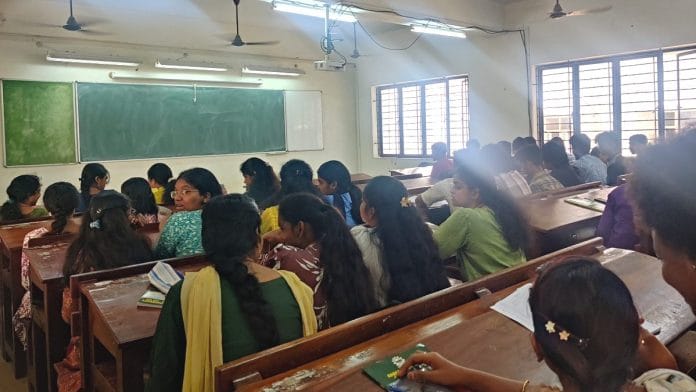
The researchers collected survey and administrative data from a nationally representative sample of 50 engineering and technology colleges across India, covering 2,710 faculty members and 20,239 students. The study focused on computer science and electrical engineering.
Although the data used in the study go only up to 2019, its findings remain relevant amid the ongoing debate over caste representation and discrimination in premier institutions such as the Indian Institutes of Technology (IITs), where a large number of faculty positions reserved for SC, ST and OBC candidates remain vacant.
Also Read: UNESCO flags cracks in India’s reservation system as legal challenges mount; cites 30% vacant posts
Lower qualifications don’t mean poorer teaching outcomes
The study found that reservation-category faculty were seven percentage points less likely to hold a PhD than general-category faculty, with 14 percent having doctorates against 21 percent.
It says that they were also less likely to occupy senior positions: only 3 percent were full professors, compared with 8 percent of general-category faculty. Their average academic experience was also lower at 8.91 years, against 10.06 years.
However, these differences did not translate into poorer classroom performance. “These lower observable qualifications do not translate into lower quality teaching,” the authors wrote.
In colleges where students were randomly assigned to classrooms, those taught by reservation-category faculty scored 1.44 percentile points higher in course examinations. The improvement was small but statistically significant, the study says.
The researchers also examined the “teacher-like-me” phenomenon — the idea that students benefit academically from being taught by faculty from similar social backgrounds. However, they found no significant advantage for reservation-category students taught by faculty from their own social groups.
“We do not detect meaningful ‘teacher-like-me’ effects. There is no statistically significant difference between the performance of reservation category students taught by reservation category faculty, and reservation category students taught by general category faculty,” the authors wrote.
The study also tested whether general-category students performed worse under reservation-category faculty amid concerns about possible resentment or discrimination. Instead, these students scored slightly better when taught by reservation-category faculty. The authors noted that this was the case “even in the face of resentment and possible discrimination”.
“Taken together, these findings have implications for the heated debates over affirmative action programmes in many countries around the world,” they added.
In a separate analysis using National Sample Survey data from 2011-12, the researchers found that college-educated people from reserved categories faced a larger wage disadvantage in the private sector than in the public sector. They suggested that this disparity could influence career choices, with some highly qualified candidates from these communities potentially opting for government or academic jobs, where reservation policies apply. However, the analysis points to a possible explanation; it does not establish that private-sector discrimination directly leads candidates to take up teaching jobs.
No gap in research output either
The researchers also examined whether the differences in qualifications and seniority translated into differences in research output. And, they found no statistically significant gap between reservation-category and general-category faculty in the number of research papers published.
While engineering and technology faculty produced an average of 2.4 publications annually, even when the researchers considered only international journal publications, the findings remained similar, with faculty publishing an average of 0.98 papers a year.
The authors said they did not find “meaningful differences” between the two groups in the number of research articles published. They also found no significant differences in publications in journals indexed by the Science Citation Index, Engineering Index and Social Sciences Citation Index.
The study also found no significant differences between the two groups in research funding or administrative responsibilities, such as holding positions within departments and colleges. Overall, the differences in research output and administrative work were “small in magnitude and not statistically different from zero”, the authors wrote.
The findings add to the debate over whether reservation-based recruitment compromises institutional productivity. The authors argue that concerns about affirmative action should be assessed against actual workplace outcomes rather than academic credentials alone.
(Edited by Nardeep Singh Dahiya)
Also Read: Why affirmative action for Pasmanda Muslims shouldn’t be labelled ‘Muslim reservation’