



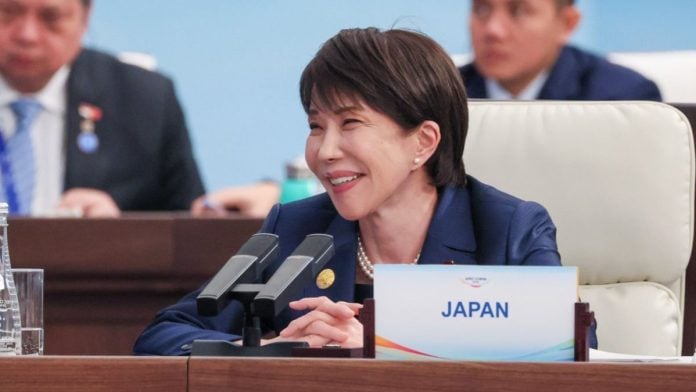
Last week, Japan’s Prime Minister Sanae Takaichi became a talking point on Chinese social media, where her low-key airport welcome in Shenzhen was read as a sign of diplomatic isolation and strained bilateral ties. One commentator described the moment as an exhibit of a deeper rupture in security perceptions and political trust between the two countries. Others saw it as further evidence that Takaichi had miscalculated the costs of taking a hardline towards Beijing.
Since taking office, Takaichi’s remarks on Taiwan and calls for a more active Japanese role in the Indo-Pacific have drawn sustained criticism in Chinese online discussions. The Asia-Pacific Economic Cooperation (APEC) summit in Shenzhen gave commentators another occasion to argue that her approach was leaving Japan diplomatically exposed. A column in Guancha, for instance, portrayed Takaichi as struggling to navigate shifting great-power relations, with Japan increasingly isolated on the international stage.
Some Chinese commentators went further, describing Japan as having received the cold shoulder from both China and the United States at APEC. But not everyone accepted the account of being snubbed. Chen Xiang, an associate researcher with the Institute of Japanese Studies at the Chinese Academy of Social Sciences, argued that Tokyo should stop manufacturing narratives of a “cold reception” and instead confront the consequences of its own policies. If Japan wants to improve ties and pursue meaningful cooperation with China, Chen said, it should demonstrate genuine sincerity and return to the principles set out in the four political documents governing bilateral relations.
Debate over Japan’s changing security posture
Chinese commentary on Takaichi’s lacklustre reception in Shenzhen has also fed into a wider debate about Japan’s security policy and its role in the Indo-Pacific. One commentator argued that Takaichi had misjudged China’s position and overestimated Japan’s leverage. The commentator questioned whether her hardline approach could be sustained amid domestic economic pressures and declining public confidence, and urged Beijing to prioritise its core interests rather than accommodate Tokyo’s calls for dialogue.
Other commentators focused less on the immediate diplomatic tensions and more on the direction of Japan’s defence policy. Wang Guangtao, an associate research fellow at the Center for Japanese Studies at Fudan University, examined Japan’s expanding space and cyber capabilities, the establishment of a National Intelligence Service, relaxed arms export restrictions and plans to raise defence spending beyond 2 per cent of GDP, potentially reaching 3-3.5 per cent. He also raised the possibility of Japan moving away from its ‘Three Non-Nuclear Principles’ and pursuing nuclear-powered submarines, while arguing that Tokyo has shifted from strategic ambiguity to greater clarity on Taiwan.
In an article titled “Japan’s ‘new type of militarism’ poses endless dangers”, Huang Bing, affiliated with the Tianjin Municipal Party School, interpreted these developments through the lens of historical memory and Japanese ‘remilitarisation’. He argued that Takaichi’s policies mark a departure from Japan’s post-war pacifist principles, attributing the shift to the country’s incomplete reckoning with its wartime past, the growing influence of Right-wing conservatives, domestic economic pressures, and the interests of the defence industry.
The historical argument also appeared in Liu Lanchang’s commentary. A Hong Kong media professional, Liu described Japan’s pacifist constitution as more than a legal document, presenting it as a reminder of the suffering Japan inflicted across Asia and a safeguard against a return to militarism.
Also read: Beijing is bringing Trump and Putin together. The Chinese say it’s a major diplomatic milestone
Questions over returns from Takaichi’s China policy
A recurring theme in Chinese commentary is that Takaichi’s hardline approach towards China has yet to deliver the diplomatic gains her supporters might have expected. Commentators have questioned whether it has improved Japan’s diplomatic standing, secured firm backing from Washington or retained support at home.
Some have cited Japanese opinion polls as evidence of waning support for her China policy and that she has failed to convince the Japanese public of its merits. A 16 November Yomiuri Shimbun poll put approval at 44 per cent, down from 62 per cent a year earlier. An Asahi Shimbun poll published the same day found that 67 per cent expected China-Japan relations to remain unchanged under her leadership, up from 44 per cent a year earlier.
Her interactions with Donald Trump at APEC also drew attention from Chinese commentators. Several accounts highlighted footage of Takaichi patting Trump on the back after the group photograph in Shenzhen, only for him to walk past her. Chinese users mocked the exchange as an awkward display of Japan’s efforts to cultivate closeness with Washington, arguing that alignment with the US had not secured reciprocal warmth or equal treatment.
Chinese criticism of Takaichi extends beyond her policy towards Beijing or her stance on Taiwan to Japan’s growing military role in the Indo-Pacific. By invoking the pacifist constitution and Japan’s post-war commitments, commentators link its current security ambitions to its wartime history. They portray Takaichi’s agenda as a departure from the post-war restraints that have shaped Japan’s identity and regional role, and thereby, perceive it as ‘anti-China’.
Sana Hashmi, PhD, is a fellow at the Taiwan-Asia Exchange Foundation. She tweets @sanahashmi1. Views are personal.
(Edited by Aamaan Alam Khan)