



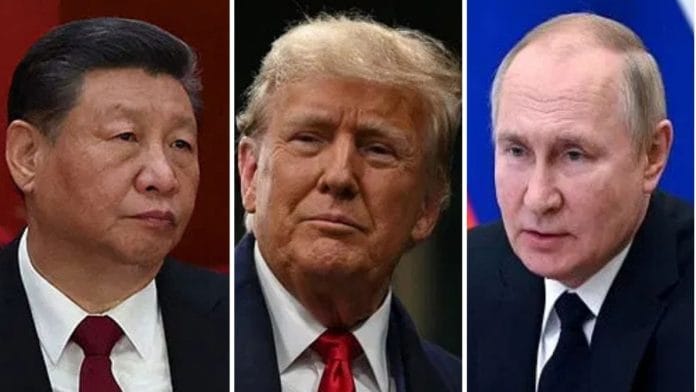
A meeting between Donald Trump, Xi Jinping and Vladimir Putin is being hailed as historic in China. The first-ever trilateral meeting between the three leaders is scheduled for 19 November in Shenzhen. Washington, Beijing and Moscow are coming together at a time when their interests remain far from aligned.
On Weibo, hashtags such as ‘Trump looks forward to attending China-Russia-US leaders’ meeting’, ‘China-Russia-US leaders’ meeting to be held in Shenzhen’ and ‘China-Russia-US leaders to meet face-to-face for the first time’ are trending.
There is, however, a broader recognition in China that the meeting’s importance goes beyond the spectacle. The more pressing question is what the leaders are willing to discuss and the outcome of such a meeting.
Beyond the symbolism
A Global Times editorial called the summit a milestone in China’s major-power diplomacy. It presents dialogue among three countries as essential to global stability, while arguing against bloc confrontation and the division of the world into competing spheres of influence.
Instead, it advocates peaceful coexistence, managed competition and a more cooperative multipolar order. The editorial also mirrors Beijing’s ambition to have a greater say in shaping the international order.
Wu Xinbo, Dean of the Institute of International Studies and Director of the Center for American Studies at Fudan University, took a more measured view of what the meeting can deliver. He identified strategic communication, mutual understanding and consensus-building as its immediate objectives. Rather than expecting major breakthroughs, he sees the summit as the start of a longer political process, with future exchanges potentially helping to address regional conflicts. He also rejected comparisons with the Yalta Conference, arguing that the three leaders are not gathering to settle major international questions or divide the world into spheres of influence.
Ukraine illustrates the limits of what the meeting can achieve. One Weibo post argued that Trump cannot strike a deal with Putin while bypassing Ukraine and Europe. The post suggests that Trump’s immediate aim may actually be not to secure a peace deal but to reopen dialogue with Moscow.
Another commentary is equally skeptical about the prospects for a breakthrough, pointing to the different priorities of Trump and Putin: the US President wants to demonstrate his influence through a major diplomatic achievement. And Putin is more interested in testing Washington’s intentions and securing concessions on sanctions, Ukraine and military deployments in Europe.
Trump, the commentator noted, also faces domestic constraints, with congressional scrutiny and opposition to his Russia policy potentially limiting his room for manoeuvre. For Moscow, any promises made by the US president may prove difficult to sustain.
Yang Xiyu, a researcher at the China Institute of International Studies, placed the meeting in the wider context of major-power relations. He said it marks a new phase in relations among the three countries. Their differences remain substantial, but their willingness to meet suggests an acknowledgement that tensions need to be managed. For Yang, the implications extend beyond the three capitals, where relations among major powers remain central to global strategic stability.
China has no intention of being sidelined
A stable relationship between Washington and Moscow may be welcome in principle, but Beijing has little interest in seeing the two powers reach an understanding at its expense. The concern in wider Chinese commentary has been whether Putin’s efforts to repair ties with Trump could come at the cost of China’s interests.
A post on Zhihu made a broader claim about China’s ability to bring the parties together: “The war has been going on for more than four years, and looking around the world, China is actually the only country that can get all parties to sit down and have a proper negotiation… China is not a party to the Russia-Ukraine war, does not provide lethal weapons to either side.”
A commentary on Sohu offers a related argument, saying China’s ability to bring the two leaders together rests on its ties with both sides. Its strategic partnership with Russia has deepened, while relations with the US, despite persistent disputes, continue to involve trade negotiations and efforts to stabilise economic ties. This gives Beijing a position few other countries can claim: close strategic ties with Moscow and a relationship with Washington that makes it difficult to exclude China from wider discussions between the three powers.
A commentary on the Chinese platform Baijiahao contends that political trust underpins China-Russia relations. Putin may seek to ease tensions with Washington, but this does not mean Moscow will distance itself from Beijing. Their partnership, it stresses, rests on shared strategic interests and support for a multipolar order, not simply opposition to the US. Any US-Russia understanding over Ukraine must also account for China’s interests.
A second commentary raised a different concern: the US could use Chinese territory as the setting for political bargaining with Russia, while treating Ukraine’s sovereignty as a bargaining chip. It warns against major powers making deals over smaller countries without regard for their right to determine their own future.
Also read: Trump pushes AI, military cooperation at Quad summit; India pushes safety of seafarers
Beijing’s place at the table
The choice of Shenzhen, one of the Chinese special economic zones, as the venue is itself part of the message Beijing wants to project. One commentary argued that the city offers more than a setting for a meeting. Its strengths in technology, manufacturing, new energy and the digital economy allow China to showcase its industrial and technological capabilities alongside its diplomatic role.
There is also a section of Chinese social media that sees the meeting as an endorsement of China’s diplomatic standing. One Weibo user said that Russia’s announcement of a Putin-Trump meeting in China demonstrates the trust both Moscow and Washington place in Beijing.
Other users seemed more cautious about China’s role. One drew a boundary around what Beijing can realistically achieve: it can provide a platform for dialogue, but it cannot resolve the conflict on behalf of those directly involved. Ukraine and Europe’s security concerns cannot be set aside in a US-Russia deal. Nor can a meeting in Shenzhen replace direct negotiations between Moscow and Kyiv. China’s role, in this view, is to facilitate dialogue, not take responsibility for securing an agreement.
China may neither seek nor be able to broker peace, but hosting the meeting puts the country at the heart of a rare gathering of the three major powers. Bringing Trump and Putin to the same table on Chinese soil allows China to demonstrate its diplomatic standing and relevance to both, even if it has little direct influence over the eventual outcome of the war.
The meeting also reinforces China’s centrality to both Washington and Moscow. By portraying China as a neutral and responsible power capable of bringing rival leaders together, the Chinese narrative advances a more far-reaching ambition. They are projecting Beijing as a central architect of the emerging international order, with the influence to shape the rules of great-power engagement, steer debates on global security and constrain the dominance of the Washington-led order.
Sana Hashmi, PhD, is a fellow at the Taiwan-Asia Exchange Foundation. She tweets @sanahashmi1. Views are personal.
(Edited by Ratan Priya)