


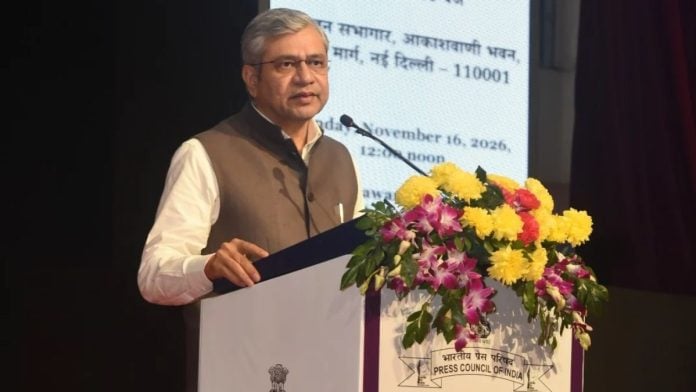
New Delhi: Self-regulation by social media platforms may not be enough, Union Information and Broadcasting Minister Ashwini Vaishnaw said Monday. “It is true that today no one has any responsibility on social media. There is no regulation in this,” he said at the National Press Day function organised by the Press Council of India (PCI) at Rang Bhawan Auditorium in Akashvani Bhawan.
He further called for a national debate on making platforms responsible for fake news, deepfakes, online fraud and content harmful to children.
Platforms currently regulate themselves through their own community guidelines, the minister said. “Is that sufficient? Should citizens get a voice?” he asked.
Speaking to an audience made up largely of journalism students, Vaishnaw asked whether a person whose “inappropriate photograph” is posted online should have a forum to seek redress. He also asked whether those spreading fake news should be made to act “according to the four walls of our Constitution”.
Referring to deepfakes, he cited the case raised earlier by India TV chairman Rajat Sharma. Fake videos of Sharma and of the Union finance minister had been used to sell medicines and mutual funds. “Should such people take any serious action or not?” Vaishnaw asked.
He also linked platforms to cyber-fraud. “The way digital arrests are happening, the way people dupe senior citizens and take their money from their bank accounts, should social media take any responsibility for it or not? Should platforms also be aware of the content on their platforms?” he said.
“Children are our next generation, our future. Should social media take any responsibility for the exposure of inappropriate content?” he asked. Governments, civil society and the media across the world are debating these questions, Vaishnaw said. “Where are we in this debate? Our society, our country, our media, our government, our legislators, we should also give a serious thought to this.”
“Empowering citizens is our responsibility. Giving citizens a voice, giving an effective forum to address their grievances, and creating a mechanism so that media and social media strengthen the society and not weaken it,” he said, calling for a ”common consensus” on the issue.
The remarks come nine months after the government tightened rules on Artificial Intelligence (AI)-generated content. Amendments to the IT Rules, notified by the Ministry of Electronics and Information Technology in February, require platforms to label synthetically generated audio and video. They also require platforms to remove deepfake sexual content and impersonation within two hours of a complaint.
Also Read: Age restrictions for social media not enough to protect children from online harm—NALSAR-IGAP report
Attack on press freedom index
Vaishnaw also hit out at the World Press Freedom Index published by the Paris-based Reporters Without Borders (RSF). He called it “a joke”, telling students not to be swayed by such rankings.
“In the press freedom index, how many places did we rank? 157. And Afghanistan came above us,” he said. He added that Peru, Syria and Pakistan had also been placed above India.
The government had asked RSF to explain how it arrived at the ranking, he said. “It was such a small and genuine request. It was such a fair request,” Vaishnaw said. “The organisation didn’t even publish their method of how they came to this ranking. Such a lack of responsibility for what they published as a press freedom index, shows the vested interests of the media.”
India was ranked 157th out of 180 countries in RSF’s 2026 index, released in April. That was down from 151st in 2025. The index placed India below Pakistan, Nepal, Sri Lanka and Bangladesh. It listed India in its “very serious” category and cited the Digital Personal Data Protection Act as a main reason for the decline. The government has previously questioned RSF’s methodology.
Vaishnaw told students that technology would change the media faster in the coming years than it had in the past two decades. “In the next 5 years, there will be so many changes that have not happened in 20 years,” he said. Those who adapt to the change would become “media leaders”, he added.
National Press Day is observed on 16 November to mark the day the PCI began functioning in 1966.
(Edited by Nardeep Singh Dahiya)
Also Read: School urges social media curbs for children, SC seeks response from govt, child rights panel