


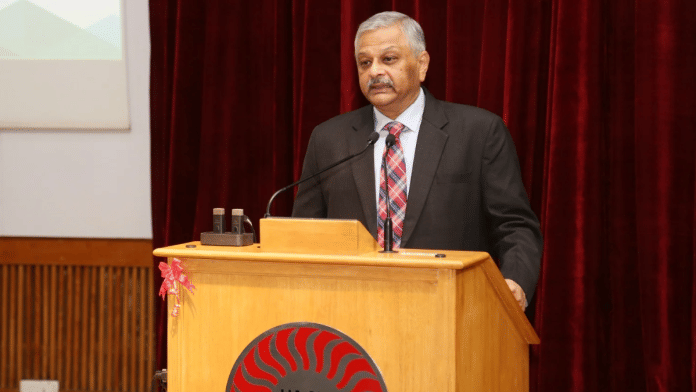
New Delhi: Former Census Commissioner and Registrar General C. Chandramouli has said that delimitation is not merely a “technical exercise”; it carries “huge political stakes” and the “potential for manipulation cannot be dismissed”. Dr Chandramouli’s caution comes at a time when the Modi government at the Centre is looking to push the Delimitation bill based on the 2011 Census.
“Whenever boundaries are redrawn, whether at the level of states, districts or Assembly constituencies, there is the risk that numerical adjustments may be manipulated to serve narrow political interests,” Chandramouli has written in his new book, Counting a Nation: The Story of the Indian Census.
“As India stands on the brink of delimitation post-Census 2027, it must guard against turning its democratic remapping into an exercise of partisan advantage,” the former census commissioner, who led the 2011 Census as India’s Registrar General and Census Commissioner between November 2009 and July 2015, has said. A 1985 batch Tamil Nadu cadre IAS officer, Chandramouli retired as DoPT secretary in September 2020.
Published by Macmillan, the book is due for release on 20 November. Chandramouli says in the book that India’s institutional design aims to avoid such “manipulation”, but the global experience shows how “even formally independent processes can be pressured if transparency and public scrutiny are weak”.
“Given these risks and opportunities, boundary-drawing must be insulated from partisan pressure,” Chandramouli writes, adding that in India, this responsibility lies with the Delimitation Commission of India, an independent statutory body set up under the Delimitation Act.
India’s Constitution requires that seats in Lok Sabha and assembly constituencies must be allocated in proportion to their population. To ensure this equal representation, the Constitution mandates that constituencies should be periodically redrawn or delimited after every census.
In 1976, however, the government, through the 42nd Constitutional Amendment, froze the total number of seats in the Lok Sabha and state assemblies based on the 1971 census. This resulted in Lok Sabha getting a fixed 543 seats while the state assemblies retained their existing strength. The freeze was initially applicable until the publication of the first census after 2000 but in 2001, the 84th Constitutional Amendment extended it further until the publication of the first census after 2026.
This long freeze, Chandramouli writes, has produced “striking distortions.” “Several populous states have seen population explosions, but their representation remains capped. States such as Uttar Pradesh and Bihar today contain far more people per Lok Sabha Member of Parliament than some southern or smaller states, a mismatch that has widened steadily since 1971.”
The Delimitation Bill 2026 that the government is pushing seeks to increase the Lok Sabha’s strength from 543 to a maximum of 845 by revising the framework governing delimitation and also enable the implementation of 33 per cent reservation for women in Parliament and state assemblies.
The Bill has been in the Opposition’s crosshairs over concerns that it could result in northern states getting greater representation in Parliament at the expense of southern states.
The government had moved the three bills—the Constitution (131st Amendment) Bill 2026, the Union Territories Laws (Amendment) Bill 2026, and the Delimitation Bill 2026 for passage during a special sitting of the Budget Session on 17 April. The bills sought to increase the number of Lok Sabha seats, enable delimitation based on the 2011 census, and pave the way for the implementation of 33 per cent reservation for women in Parliament and state legislative assemblies based on this delimitation.
The amendment Bill was defeated in the Lok Sabha after the government could not muster the required two-thirds majority of members present and voting, and it then withdrew the two companion Bills.
Impact of delayed census
Writing about the consequences of delaying the census exercise any further, the former census commissioner says it will have a cascading impact on everything that will follow. “First, the enumeration itself has been pushed to 2027. Second, the release of detailed census results, especially those at the granular level required for delimitation, will likely trail enumeration by at least one or two years. Third, only after such data is available can a new Delimitation Commission be formally constituted and begin its work, which, judging by precedent, could again span several years before completion,” Chandramouli writes.
These steps, Chandramouli writes, suggest that the constitutional moment envisaged in the 84th amendment—the lifting of the freeze and the reallocation of seats based on a post-2026 census—will, in practice, occur not in the late 2020s but potentially only in the early or even mid-2030s.
According to him, for delimitation to succeed in 2027 and beyond, certain additional procedural and institutional reforms are essential. These include “transparent publication of proposed maps, public consultation periods, demographic data disclosure, representation of marginalised communities and perhaps a judicial or independent review mechanism to challenge boundaries drawn on partisan or discriminatory grounds”.
He writes that Census 2027 carries a burden far more consequential than any since Independence. “For the first time in about 50 years, the first census held after 2026 will directly shape the apportionment of Lok Sabha seats among states and the redrawing of constituency boundaries within states. It will determine not only how many representatives each state sends to Parliament, but also how those representatives are distributed across rapidly growing cities, shrinking rural belts and newly urbanising regions,” he writes.
Chandramouli calls Census 2027 a “gateway to a new electoral order”. “Its figures will reset the federal balance between north and south, rural and urban, developed and less developed regions. Political parties will be compelled to recalibrate strategies, alliances, candidate selection and policy promises. The geometry of representation– who gets elected from where will be reshaped, perhaps for decades,” he writes.
(Edited by Nardeep Singh Dahiya)
Also Read: Delimitation goes beyond just votes. It is also about India’s economic future