


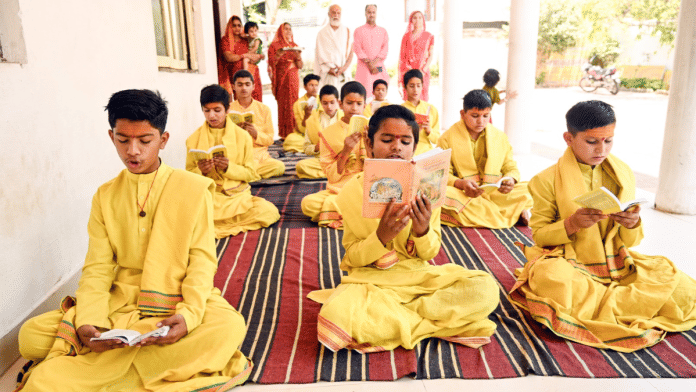
New Delhi: The Central Sanskrit University Monday launched a nationwide campaign to encourage citizens to identify Sanskrit as their mother tongue or one of the other languages they know in the upcoming Census, setting a target of reaching 10 crore people through the campaign.
According to the 2011 Census, only 24,821 people reported Sanskrit as their mother tongue. The figure does not include those who knew Sanskrit as an additional language.
The ‘Mama Bhasha Sanskritam’ campaign aims to increase awareness about the language and encourage citizens to record it in the language-related section of the upcoming Census questionnaire.
Referring to Question 14, which seeks information about respondents’ mother tongue and other known languages, vice-chancellor (VC) Prof Srinivasa Varakhedi has appealed to citizens who consider Sanskrit their mother tongue should record it as such, while those who know the language can mention it under other known languages.
Emphasising the importance of accurately recording linguistic information, Varakhedi said the Census was an opportunity for people to recognise their linguistic and cultural roots. “It is essential to record one’s actual linguistic information in the Census. This will help in understanding the country’s linguistic diversity and the social presence of Sanskrit,” he said in a statement.
To take the campaign beyond campuses, the university plans to involve its headquarters, all campuses, model colleges, model research institutions, Sanskrit schools and colleges, faculty members, students and voluntary organisations.
Teachers and students will approach schools, colleges, monasteries, temples, ashrams, religious and social organisations and community workers across different regions. Awareness activities are also planned at prominent city intersections and tourist destinations, besides door-to-door visits.
The university will use digital platforms and social media to publicise the campaign and reach a wider audience.
Calling for greater public participation, Varakhedi described Sanskrit as central to India’s cultural and intellectual heritage. “Sanskrit is the soul of India, its intellectual heritage and the mother of knowledge and science. It is not merely an ancient language, but the foundation of Indian civilisation, culture and intellectual traditions,” he said.
He pointed to the extensive body of literature available in Sanskrit across disciplines, including the Vedas, Upanishads, Ayurveda, yoga, mathematics and astronomy. “Sanskrit has enriched all Indian languages and provided a strong thread of cultural unity among them,” Varakhedi said.
(Edited by Tony Rai)
Also Read: At Radcliff, my Sanskrit professor said ‘Ravana is a fascinating fellow’: Wendy Doniger