


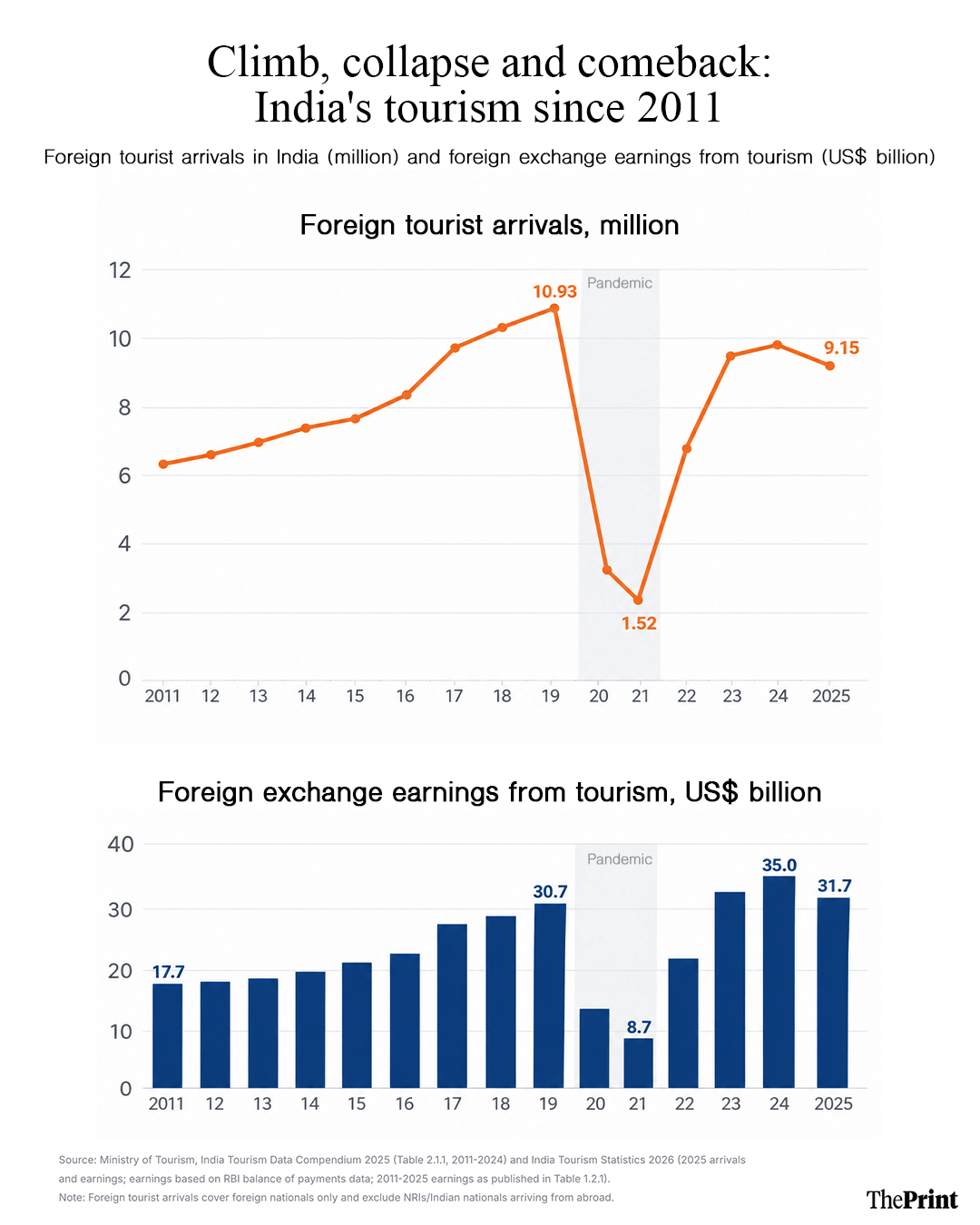
New Delhi: In 2019, India experienced an unprecedented influx of foreign tourists, totalling 1.09 crore, which generated $30.7 billion in foreign exchange. However, two years later, the pandemic reduced arrivals to 15.2 lakh, a figure lower than that of 1991, the year India liberalised its economy.
The recovery from this decline represents the true narrative of Indian tourism post-Covid. Only by examining this trajectory can the current comparisons with India’s neighbouring countries, many of which are reporting record tourism years, be fully understood.
The climb, the collapse and the comeback
In the decade preceding the pandemic, foreign tourist arrivals increased consistently, including foreign nationals but excluding Indians residing abroad. These arrivals increased from 6.31 million in 2011 to 10.9 million in 2019. At the same time, foreign exchange earnings from tourism rose from $17.7 billion to $30.7 billion.
However, this upward trend was disrupted, with arrivals plummeting to 2.74 million in 2020 and reaching a low point in 2021, when earnings decreased to $8.7 billion.
The recovery varied across metrics. By 2023, earnings had surpassed their pre-pandemic levels, achieving a record $35 billion in 2024. In contrast, tourist arrivals rebounded to 9.95 million in 2024 but declined to 9.15 million in 2025, representing 84 percent of the 2019 peak.
Despite this, earnings remained at $31.7 billion, exceeding the 2019 figures. Thus, tourism is generating more revenue for India than before the pandemic, even though the number of foreign tourists has decreased.
How the neighbours compare
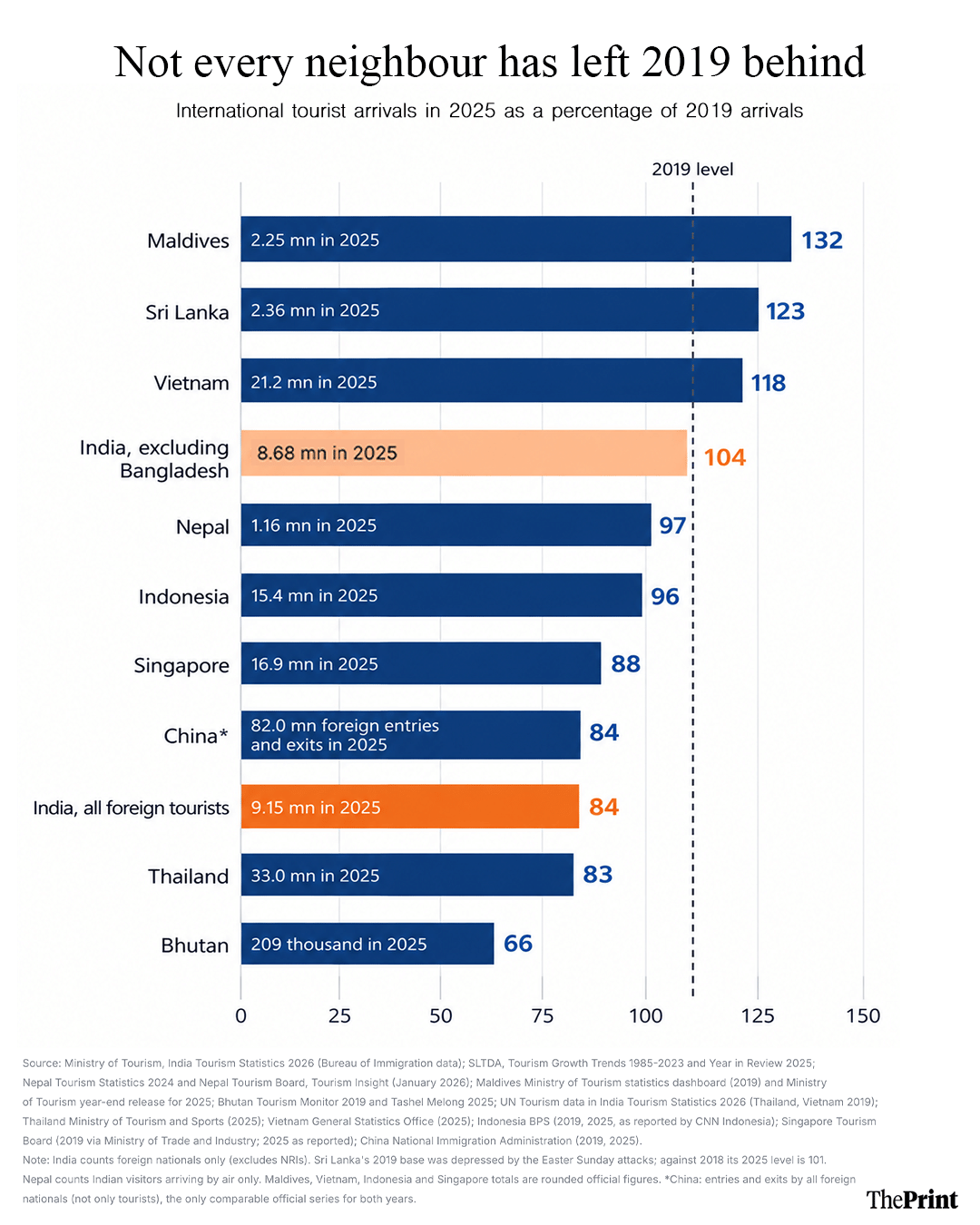
Compared with the broader region, the tourism landscape presents a varied picture. Vietnam achieved a record influx of 2.1 crore visitors in 2025, marking an 18 percent increase from 2019. Similarly, the Maldives and Sri Lanka also reported record numbers.
Conversely, Thailand, a major player in Asian tourism, reached only 83 percent of its 2019 visitor levels. In China, the entry and exit of foreign nationals recovered to 84 percent, comparable to India. Bhutan, which has strategically marketed itself as a high-value destination, attained approximately two-thirds of its previous levels.
The significant increase in tourism is primarily concentrated in a select few locations, with Indian travellers contributing substantially to this growth. In 2025, Indians constituted the largest group of visitors to Bhutan, Nepal, and Sri Lanka, and the third-largest group in Thailand. In October alone, more than a third of Sri Lanka’s 1,68,625 visitors came from India.
Why should India’s own travellers be filling its neighbours’ hotels? Economics has a neat answer. In 1962, Dutch economist Jan Tinbergen demonstrated that trade between two countries increases with the size of their economies and decreases with the distance between them.
Tourism researchers have subsequently identified that travel adheres to a similar “gravity” model. A nation whose citizens undertook 3.28 crore international trips in 2025 serves as a natural anchor market for every small economy along its borders.
This gravity model also elucidates India’s own tourism gap, as its largest natural market has always been its nearest neighbour (Bangladesh). The same gravity explains India’s own gap: Its largest natural market has always been its closest neighbour, and that is where most of the shortfall lies.
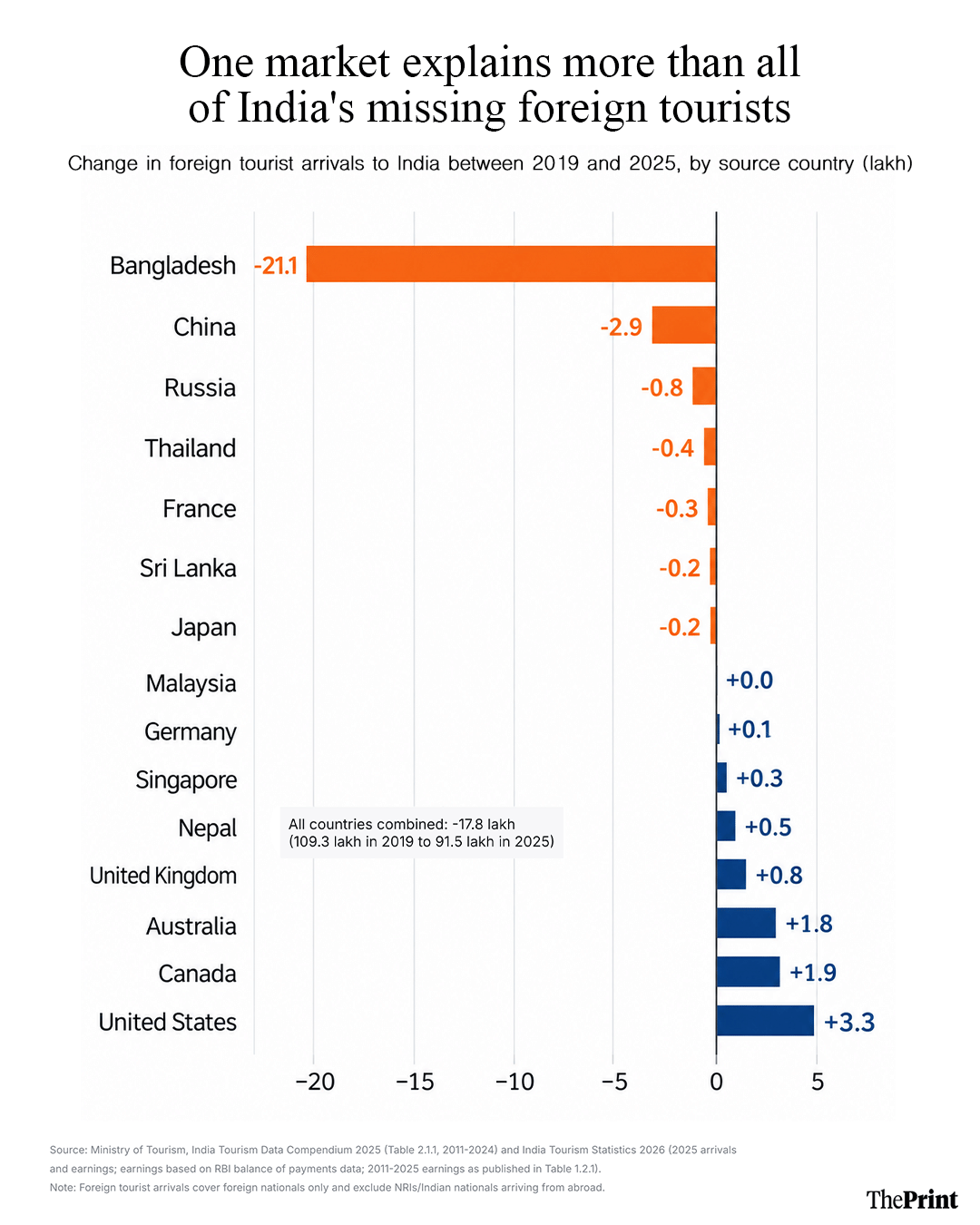
The decline observed in 2025 can be attributed to a specific cause. Bangladesh, which was India’s largest source market in 2019 with 2.58 million visitors, contributed only 4,70,000 visitors in 2025. That single fall of 21.1 lakh is larger than India’s entire decline of 17.8 lakh since 2019. The Ministry of Tourism attributes this decrease to political turmoil and social unrest in Bangladesh.
Excluding Bangladesh, India received 8.68 million foreign tourists in 2025, marking the highest number recorded on this basis and representing a 4 percent increase compared to 2019. Nearly 70 percent of visitors from Bangladesh in 2025 came for medical treatment, with families travelling to hospitals in Kolkata and Chennai rather than tourists choosing between beaches, suggesting demand that is deferred rather than lost.
The next most significant reduction was from China, with visitor numbers dropping from 3.4 lakh to approximately 51,000. In contrast, the United States, Canada, Australia, and Britain all sent more tourists than before the pandemic.
What the trajectory tells us
The trajectory of the past six years imparts some significant insights. India’s global appeal remains robust; except in one market, international arrivals have reached unprecedented levels, and revenue has surpassed pre-pandemic figures. The resurgence in visitor numbers aligns with those of Asia’s major destinations, rather than lagging behind.
However, this should not lead to complacency. Growth from long-haul markets is steady but not exceptional; Vietnam’s record-breaking year shows the rapid progress a determined destination can achieve, and the rate at which Indians travel abroad exceeds the influx of foreign visitors.
This situation suggests a practical agenda: Streamlining visa processes and medical travel for South Asian visitors, enhancing air and rail connectivity across the region, and developing joint Buddhist and Himalayan circuits to promote South Asia as a unified travel experience, with India as the focal point.
Tinbergen’s principle is applicable in both directions. The same geographical proximity that encourages Indians to visit Colombo, Kathmandu, and Paro can also attract their neighbours to Varanasi, Bodh Gaya, and Chennai, potentially transforming recovery into a new peak.
(Edited by Viny Mishra)