


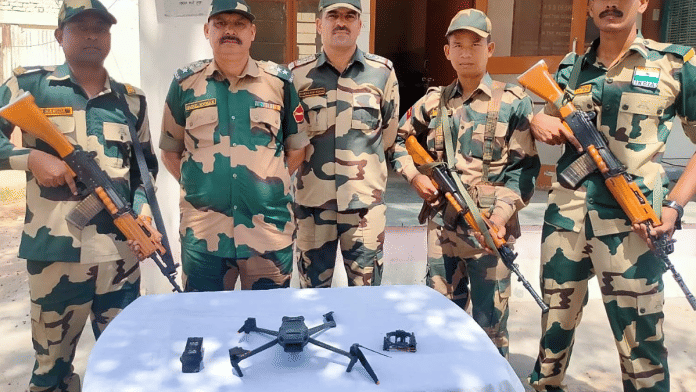
New Delhi: Nearly 98 percent of overall cases registered for drone-based drug trafficking were recorded in Punjab, the Narcotics Control Bureau (NCB) has said in its annual report. The agency documents 305 cases where drones were used for trafficking nationwide, with Punjab alone accounting for 298 of them.
Similarly, Punjab also accounted for 461 kg of drugs out of a total 468 kilograms recovered by the agency in the case of drone-droppings in Punjab, Jammu and Kashmir and Rajasthan.
Additionally, the NCB also flagged vulnerabilities in checking cross-border smuggling of heroin, with Punjab accounting for nearly 58 percent of total heroin recovered in the country last year. Of the 3,567 kg of heroin recovered across the country, Punjab alone accounted for 2,086 kg of the contraband, the NCB documented in the annual report.
These numbers have been collated by the NCB from all drug law enforcement agencies—Special Task Forces and Anti-Narcotics Task Forces—from all states.
The central agency said that drug trafficking networks are leveraging technology to evade detection, and using methods such as dead drops, darknet markets, payment in cryptocurrencies, and adopting courier services to avoid detection by the law enforcement agencies in the country.
Additionally, the report said India’s location in the Indian Ocean region continues to make it a transit hub for drugs originating from the Golden Crescent spanning across Afghanistan, Iran and Pakistan as well as the Golden Triangle, spanning across Myanmar, Laos and Thailand in South East Asia.
On the inflow of drugs from the Pakistan side, the NCB said that although opium cultivation in Afghanistan has seen a dramatic collapse—from 2,33,000 hectares in 2022 to just 10,800 hectares in 2023—following the Taliban’s crackdown, the scenario has not changed for India. “The volume decline is a supply-side phenomenon, not a demand-side one,” the NCB said in the report.
However, the collapse of Afghan supply is not an elimination of risk to India, the NCB argued, adding that the current situation suggests that stockpiles of narcotics have been used to keep the smuggling syndicates running.
Additionally, the NCB said that smuggling syndicates that historically depended on Afghan-origin heroin are now diversifying their portfolios, and some of that diversification is flowing eastward into India—via Mizoram and Manipur.
‘Rapidly escalating threat’
In addition to these adaptations by smuggling syndicates after the collapse of Afghanistan as a source, smugglers have not yet given up on the western corridors and instead have adapted drone technology to send drugs into India, particularly through Punjab.
The gravity of the threat from drone-based smuggling was underscored by the consistent surge in the number of incidents and recoveries from drones in Punjab, the NCB said. From just three incidents in 2021 that yielded 10 kg of drugs, the number of incidents has surged to 305 incidents of drones dropping contraband along the border with Pakistan, yielding a recovery of 468 kg of banned substances.
The numbers have consistently risen since 2021, except in 2023. There were 35 incidents and 148 kg recovered in 2022, 28 incidents and 103 kg recovered in 2023, then accelerating sharply to 179 incidents and 236 kg recovered in 2024—before 305 incidents and 468 kg recovered last year.
“This exponential rise reflects the growing operational maturity of trafficking networks using unmanned aerial vehicles (UAVs) to circumvent traditional border controls,” the NCB recorded in the annual report.
Punjab accounted for 298 cases and 461 kg, primarily involving heroin (449.751 kg) and methamphetamine (9.018 kg). Additional incidents were reported in Rajasthan and Jammu and Kashmir, the NCB further said.
“The India-Pakistan border, particularly through Punjab, has witnessed a marked shift toward drone-based smuggling as a countermeasure against ground-level interdiction. This represents a technological escalation in smuggling methodology that outpaces current enforcement capacity along that frontier,” the NCB said in the report.
(Edited by Viny Mishra)
Also read: Punjab constable tasked with watching for drug drones at border caught with heroin worth Rs 50 crore