



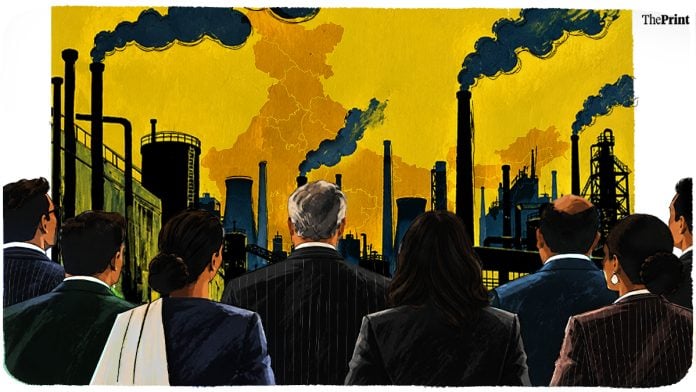
Humble Jamnagar dominated headlines and airtime this week. The visit by US Secretary of State Marco Rubio and Ambassador Sergio Gor to the Reliance refinery township painted on the political radar screen and stood out in domestic debate.
That they were hosted by the Ambanis became a key talking point. Why are the Americans taking such interest in Indian refining? Why are they asking the Ambanis to buy Venezuelan oil? Why are they calling India a refining superpower and asking us to increase capacities? Or to sum up, why were Rubio and Gor in Jamnagar and not in Delhi or Bengaluru as visiting dignitaries did in the past?
Go back to the UPA era. There was zero controversy over Western heads of state being shown around the Infosys or other tech campuses. The reaction was unanimous: national pride. This also cut across political divides. Even the Left put its anti-corporate instincts aside.
Why, then, are we now seeing such suspicion, scepticism, even paranoia?
Why are the Ambanis (and India) being forced to buy oil from the most distant point possible (Venezuela) when Russia is so much closer? Of course, it must be arm-twisting to sell Venezuelan oil the Americans control, and a ploy to wean us away from Russia to squeeze Putin.
None of this passes the most cursory fact-check, but why let that confuse you out of a delicious outrage. India’s crude purchases from Russia haven’t dramatically declined and are unlikely to. To call India a refining superpower isn’t just a great compliment, but also reminds us of a marvellous new element in our Comprehensive National Power (CNP). Late Dhirubhai Ambani’s foresight has given his nation a workaround for the curse of not having energy resources.
What does a nation of our size do when it’s blessed with almost no hydrocarbons? It starts refining at a global scale what others pump out of their soil or seabed. Without refining, crude is nothing. The global refining capacities were not keeping pace with rising energy consumption. India filled in that gap. The Ambani foresight also lies in recognising the peculiar Venezuelan heavy crude challenge, and opportunity.
If this made India a refining superpower, isn’t that something to be as proud of as tech and outsourcing in Bengaluru?
Also Read: India has always been a hard state under Gandhian cover. Nehru to Modi, leaders have reinforced it
Let’s understand some realities. Today, the American need for global refining capacities, especially for the waxy Venezuelan crude, is strategic, political and economic—in that order.
Strategic, because the Americans have just forced a regime change in Venezuela, which holds the largest crude reserves in the world. They have to consummate their success commercially as they set about redesigning the Western hemisphere to align with their interests. India has no dog in that fight.
Politically, more crude in global markets moderates prices. The Iran situation isn’t settling down. If anything, it might get worse after the US midterms.
And economically, the US gets a commercial take or cut in Venezuelan crude sales. And the more refined products come into global markets, the more fuel prices in the US decline.
It may be too late for the midterms now. But in the American system, jockeying for the next presidential election begins just after the midterms, especially if the incumbent is finishing the second term. The Republicans, not exactly topping the charts at this point, want inflation, and gasoline prices to go down.
This needs more crude, and more refining. America is among the largest importers of Venezuelan oil. But over the past decades, many of its heavy-crude refineries shut down as its economy moved to the softer, wealthier and less resource-dependent avenues: tech, finance, rocketry and now AI. Generally, you can say, as Texas, Detroit and the rust belt have yielded to Silicon Valley, Seattle and New York.
In this situation, which country can play refiner to the world but India? Europe has minimal refining capacity that survived its Greta Thunbergs. West Asia wouldn’t dare expand while there’s the Iranian threat and its proxies stalk the peninsula with ballistic missiles and drones.
It’s been said often that if Bengaluru were to suffer a catastrophic power or internet outage, a lot of the world would come to a standstill. If that’s leverage, an element in our CNP, why shouldn’t refining be so? India should, if anything, add more refineries, and at scale. Even Reliance should build another Jamnagar, preferably along the eastern seaboard. Some of these could be built in conjunction with Small Modular Reactors (SMRs).
The fears come from all sides. The Left, you’d expect. But also the Right and the Centre. That is, if you could describe today’s Congress as centrist, though I’d think their current Left tilt is for product-differentiation rather than a de-canonisation of Manmohan Singh.
The Right is also bemused. Why America? And why the Ambanis? It doesn’t even matter to them that Rubio also met N. Chandrasekaran of Tata Sons and Gautam Adani. Because then, why only the oligarchs?
Also Read: Let’s keep Pakistan, Bangladesh out of our politics. It undermines India’s strategic interests
Broadly, all are knee-jerked because of the twin factor of America and Ambani. Anti-Americanism is chronic, deep and instinctive in India. If America suggests you do something, or says thank-you for doing it, be very afraid. Hide. There must be a terrifying hidden motive. This cuts across party-lines and the BJP or its base isn’t immune either. Add to this that oldest Indian fear, even contempt for the “evil corporate”.
In the Nehru-Indira era “Birla-Tata” was a cuss word. Now, it’s “Ambani-Adani”. After all, that’s what the socialist brainwashing from our politics, literature and movies scarred us with. The standout line that conditioned generations comes from Dilip Kumar in the 1957 Naya Daur on behalf of labour, saying: “jhagda toh haath aur machine ka hai (it’s a tussle between human labour and machinery).” The capitalist has rarely been portrayed even as a half-decent character in our popular culture.
Flip the card. Aren’t we so happy when our prime ministers, even chief ministers, visit the US, Japan, France with key industrial plants and tech campuses on their itinerary? Or when PM Narendra Modi goes to meet Mark Zuckerberg at Menlo Park, invites Elon Musk, kids and all, for a private meeting, and generously meets visiting CEOs?
As for the Congress, they should remember how Rajiv Gandhi brought the tech revolution to India. On his first visit to the US in June 1985, he reached out to Mark Shepherd Jr of Texas Instruments and persuaded him to set up his offshore unit in Bengaluru. Subsequently, he invited Jack Welch of GE. Welch was told that if he wanted India to buy his engines, he must buy software from our companies. Wipro and GE set up a joint venture. Some detail on how GE was wooed by Sam Pitroda, Montek Singh Ahluwalia and Jairam Ramesh is found in DLF founder K.P. Singh’s sequel memoir ‘Why the Heck Not?’
We undermine our national interest first, by not shedding our permanent anti-Americanism, still rooted in 1971. And second, by dismissing our entrepreneurs as exploiters, not builders of India. The first needs to be seen in the perspective of the day. Nations relate to each other after weighing self-interest and not protocol. In any case, what’s protocol in Trump’s times? And a society that doesn’t respect its own entrepreneurial successes is condemned to falling behind.
The only thing wrong with the fact that India has the Ambanis, Tatas, Adanis, Birlas, Jindals and Bhartis is that there are so few of them. India needs some more. Let them build more refineries, steel plants, smelt copper and aluminium for the world, write software, build Global Capability Centres (GCCs), set up power plants. India has to learn to celebrate its entrepreneurs. Jamnagar is only a symbol and reminder of what India can become.
Also Read: 20% ethanol, 80% anger: BJP’s core voter is furious and looking for answers