






The debate, over whether India’s GDP grew by 7.8 percent or 2.6 percent in the first quarter has made our prime time angrier than usual. Sergio Gor must have enjoyed the spectacle of competitive name-calling, as studio warriors turned into economists overnight. Great fun till it lasts. But politically, this is the wrong debate. In any case, it will be over soon since we’re already well past two-thirds of the second fiscal quarter.
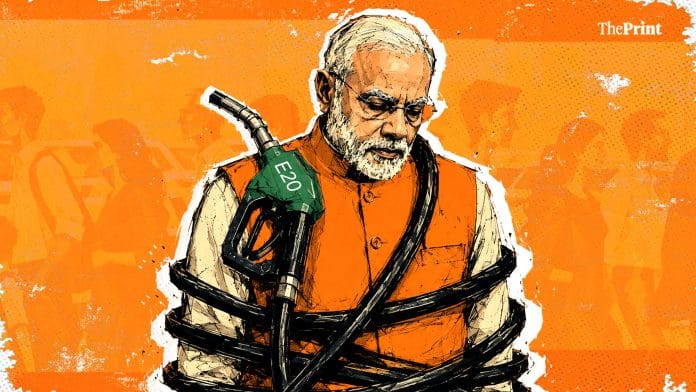
It’s the wrong debate not just because it’s transient but also because, in this polarised environment, people will passionately believe what their politics dictates. No voter will change their mind on account of GDP data. The debate that matters, is entirely different: the anger over ethanol blending.
A lot of the vehicle-owning class, mostly the Hindu middle class, is a committed Modi-Shah BJP vote bank. They’re furious. We haven’t seen any polls on this, but over the past several months now I’ve met scores of people, complete strangers at airports, weddings, hotel lobbies, visitors, Uber drivers, all united in anger. Their gripe: How the hell can they force ethanol-blended petrol (EBP) down my throat?
A large majority would’ve defended the Modi government’s growth numbers with equal passion. Translated, it means that the “base” this BJP takes so seriously is furious with it over just this one issue. Of course, they all believe we won Op Sindoor, and that their leader is held in awe by the world, including Putin and Xi “as we just saw at Bishkek”. Then, why punish me with this “adulterated” petrol? Broadly speaking, here are their questions:
● What benefit do I get? I pay the same price, but get less mileage, as the government admits. Further, it might damage the engine while I’m still paying EMIs.
● What benefit does my country get? If there’s any, why am I not being told?
● Why am I not given a choice? First, nobody tells me why I should use EBP. Then, I’m told to use it, or take a walk. Literally.
● Who’s benefiting from my suffering or sacrifice?
These are good, important questions and the government probably has the answers. It’s surprising how it didn’t care enough to take its voters into confidence. Nobody prepared the consumer for this change. Just a panoply of ministers now being lined up to explain the benefits—to the farmer, in foreign exchange savings, and in emission reduction—makes no impact. If there’s one thing the BJP’s base is angry about, besides the repeated examination scams, it’s EBP.
Also Read: Three destroyers of Brand India. It’s all in our cities
Since 2014, the middle class, with a vast Hindu majority, has been the Modi government’s most steadfast vote bank. It’s been so loyal that it voted for Modi even as it fretted and fumed over high fuel prices. It was forgiving even when crude was at its lowest and the government kept on taking the cream by raising excise duties. That windfall was efficiently distributed among the poor as free grain and other direct benefits. It helped the BJP keep winning elections.
This is what I once described as ‘hybridised Robin Hood’. Take from the loyal middle class, distribute to the poor, and don’t bother the rich. Check out this National Interest from January 2025. It was cheeky, yes. But the point is, just as the “secular” parties take the Muslim vote for granted, the BJP can presume the massive Hindu middle class as theirs. They accepted high fuel prices because they bought into Modi’s promise of Hinduised nationalism. The same voters are now angry.
Nobody ever prepared them for it. Odd for a party that takes pride in its leader’s ability to sell the toughest decisions to its voters, demonetisation and the sudden nationwide COVID-19 lockdown included. Intellectually, the Modi government has been promoting the idea of “nudge” economics. For EBM, there was neither a call to action, nor a nudge.
It’s as if the idea caught somebody’s fancy and we serendipitously moved from 1.56 percent blending in 2013-14 to almost 20 percent now. And there’s heady talk of 30 percent.
There are two problems, however. One, the buyers are furious and have the numbers. Second, more ethanol isn’t available. There isn’t even enough to sustain current blending unless you start dipping deep into grain (rice) reserves. Moreover, people won’t accept any more blending.
On paper, replacing imported crude with homegrown ethanol looks good. It’s just that you aren’t sitting on an ethanol reserve, in which case you can ‘drill, baby, drill’ and start pumping. Your farmer has to grow it, as sugarcane, maize or paddy.
This was an idea conjured up through years of sugar surplus. The sugar mills could recover their money and pay farmers their dues. So heady was this that sugar mills were even allowed to divert sugarcane juice to ethanol. The markets were already awash with sugar.
This was neat, except nobody gamed in the vagaries of farming: commodity markets, rains and for heaven’s sake, pests. Sugarcane dramatically went from surplus to scarcity within a single cropping year, particularly as red rot (fungus) and top borer (insect) sucked away the yields.
Also Read: 2026 is like 1973 Indira-era oil shock plus youth anger. Modi has space, but not immunity
This season began with opening sugar stocks lower by five million tonnes, over a base of 34.3 MT; and they’re trending towards 28 MT. The result is a nearly 50 percent increase in sugar prices. Expectedly, the old script is playing out: stock controls, attack on “hoarding and profiteering”, ban on exports and opening up duty-free imports. Can we let sugar prices shoot up with the festive season upon us? Are you serious?
Over time, as ethanol procurement was hiked breathlessly, from 38 crore litres in 2013-14 to 1,200 crore litres this year, refiners turned to maize. And then, maize prices went up nearly 50 percent too. This presages higher dairy, poultry and meat prices as maize goes into the feed. Now, came the turn of paddy. First, broken rice, and then any surplus rice. This is being sold by a government desperate to keep the blending on, with 7.2 million tonnes of rice allocated for fuel this year, at about half the market price. I pick much of this data from Harish Damodaran and Ashok Gulati’s fine insights in The Indian Express.
Let me sum it up for you. While EBP may be a great idea, since it depended on agriculture, it needed three to four years of preparation—to persuade the farmer to change crop choice, create a market, ensure we don’t fall short of any essential commodity and walk into the food versus fuel trap and, finally, convince the consumer of blended petrol. Ideally, give them a choice, with blended petrol significantly cheaper. That’s easily done by adjusting excise duties.
The result now: there’s a sugar shortage, foreign exchange is bleeding, prices are up, with the festive season upon us, and you’re diverting rice buffer stocks at nearly half the price for EBP. Of course, the “influencer” community is monetising this as the angry and confused millions watch.
In so many ways, this underlines the Modi government approach on several key issues. In the past, especially after demonetisation and farm bills (which I supported editorially), we compared Modi government’s shock-and-awe decision-making to a paratrooper who jumps without checking the parachute. Once the government’s mind is made up, there’s no patience for boring old ‘staff work’ or some war-gaming. It’s dismissed as bureaucratic nonsense and ‘Congress-style’ analysis-paralysis.
Something similar has happened with EBP. We’re short of sugar, ethanol, and prices of everything involved are going up, including crude oil. Another rollback should be on the cards, even if partial. Either reduce blending to 10 percent or offer consumers a choice. Remember, this anger comes from committed BJP voters.
Also Read: The world’s in a flux. India must reform, consolidate & build a strong economy