


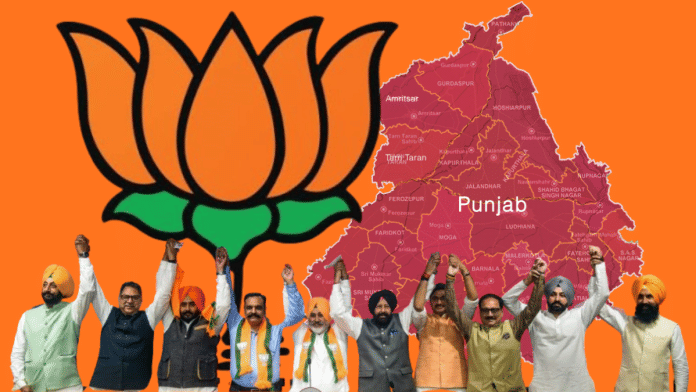
Chandigarh: It’s election season in Punjab, and all roads continue to lead to the party that has never won the state on its own, the BJP.
Three sitting legislators of the ruling Aam Aadmi Party (AAP) joined the BJP on Tuesday. In April, Raghav Chadha and the five other Punjab Rajya Sabha MPs of AAP had joined the BJP. The same month senior advocate, former AAP legislator and Leader of Opposition H.S. Phoolka had joined the BJP. In January, former Member of Parliament Jagmeet Brar joined the saffron party.
In March, three Akali leaders, including a Shiromani Gurdwara Prabhandhak Committee member Charanjit Singh Kalewal had joined BJP. In August, AAP leader and former Shiromani Akai Dal Member of Legislative Assembly (MLA) Darshan Singh Kotfatta joined the BJP.
These are just recent joinings; the list of politicians from other parties who have joined the BJP ever since it decided to break away from the Shiromani Akali Dal in 2021 is substantial.
Despite having never come to power on its own and with only a limited base in the state the BJP has emerged as the preferred destination for disgruntled politicians over the Congress, which is traditionally seen as the principal alternative to the AAP and SAD in the state.
The lure of saffron
Experts explain that there are multiple reasons why these politicians feel that they have a brighter future in the Punjab BJP than the Congress. “BJP in Punjab needs leaders and, along with the leaders, the BJP gains their workers and followers. Those joining the party are also happy because there is not too much of a crowd here. BJP is also more welcoming,” Professor Ashutosh Kumar of the Department of Political Science at Panjab University, Chandigarh, told ThePrint.
He added: “It is a part of the party’s strategy to broaden its base that had remained limited to the 23 Assembly seats it was contesting in alliance with the Akali Dal. The exodus from AAP has only just begun after the first list has been announced. After the second list is announced there will be many more MLAs who will join the BJP.”
The professor further said that for the BJP, winning Punjab is an extremely important goal. “It is a minority state and to be in power here sends a larger message. They want to project themselves as secular and that also explains why anyone and everyone from other parties with even a small following is welcome.”
The three AAP legislators who left the party on Monday—Chetan Singh Jouramajra from Samana, Harmeet Singh Pathanmajra from Sanour and former IPS officer Kunwar Vijay Pratap Singh from Amritsar North — have had varying degrees of disagreement with the AAP leadership. While Kunwar Vijay Pratap’s differences with the party go back almost three years, Pathanmajra and Jouramajra have had more recent disagreements with the government and the party leadership.
All three resigned from AAP and joined the BJP in Delhi on Monday, a day after two of them quit the party and just days after AAP announced its first list of 40 candidates for the 2027 Assembly elections.
Their leaving the party, however, was not unexpected. There had been growing indications that neither Pathanmajra nor Jouramajra was likely to be renominated by AAP. The party had appointed new constituency in-charges in both their seats — Ranjod Hadana in Sanour and former Akali leader Surjit Singh Rakhra in Samana — signalling a possible change in its electoral calculations.
For Jouramajra, the resentment was also rooted in his removal from the Cabinet in September 2024. The former minister had earlier held several important portfolios, including Health, Public Relations, Mining and Geology, and Water Resources.
Pathanmajra’s differences with the party leadership became particularly public during the floods in Punjab in 2025. He openly criticised the functioning of the irrigation department and senior bureaucrats for allegedly ignoring his requests for desilting rivers and undertaking preventive work. He also accused the AAP’s Delhi leadership of suppressing Punjab MLAs.
His public criticism was followed by the withdrawal of his security cover and the registration of a criminal case against him. The MLA subsequently evaded arrest in September 2025 and remained on the run until his arrest near Gwalior in March 2026. He was later granted regular bail by the Punjab and Haryana High Court in a rape case and walked out of Bathinda jail on 31 May. He also secured bail in a separate illegal mining case.
Kunwar Vijay Pratap, meanwhile, has been a rebel for much longer. The former IPS officer, who joined the party after taking premature retirement in 2021, had initially been projected as one of its prominent faces, particularly because of his role in the investigations into the 2015 sacrilege-related incidents at Kotkapura and Bargari.
His differences with the government over the handling of these cases surfaced in September 2023; the relationship with the party leadership deteriorated considerably. He was eventually suspended from AAP for five years in June 2025 after questioning the vigilance bureau’s handling of the disproportionate assets case against Akali leader Bikram Singh Majithia.
Also Read: Diljit Dosanjh’s Satluj is Punjab’s biggest controversy. How it got here
Congress not shining
Political experts also point to the crowded leadership landscape within the Congress as the reason why dissenters from other parties are not joining them. “Several senior leaders have their own political ambitions and established support bases. For a politician moving from another party, finding space in such an arrangement may be difficult,” added Kumar.
The Congress has several prominent leaders in Punjab, including former chief minister Charanjit Singh Channi, former deputy chief minister Sukhjinder Singh Randhawa, Leader of Opposition Partap Singh Bajwa and former minister and parliamentarian Vijay Inder Singla.
The party has also had a change of leadership, with Jalandhar Cantonment MLA Pargat Singh replacing Amarinder Singh Raja Warring as Punjab Pradesh Congress Committee president. Pargat himself is a senior political figure and a former minister.
Professor Harjeshwar Singh of the department of history at Sri Guru Gobind Singh College in Sector 26, Chandigarh, told ThePrint that Congress is already heavily laden with leaders, each with an established constituency, political ambitions and a claim to a larger role in the party. “A new entrant, particularly one who has been a legislator and minister in another government, may find it difficult to negotiate an independent political space. On the other hand, the BJP has vacancies in all such places where they are likely to fight. There is no guarantee of a seat from Congress because of their complex, tortuous and delayed decision-making compared to BJP,” he said.
There is also the question of the Congress’s organisational uncertainty. “The party has struggled to present a united front despite repeated interventions by its central leadership. For politicians looking for an immediate political platform ahead of the elections, this could make the BJP appear a more attractive and decisive alternative,” added Dr Kanwalpreet Kaur of the department of political science, DAV College, Sector 10, Chandigarh.
“The BJP is attempting to expand its political footprint in Punjab beyond its traditional urban and Hindu support base. Its organisational strength has historically been concentrated in urban constituencies, while its alliance with the Shiromani Akali Dal provided it access to a much wider rural and Sikh electorate,” added Kaur.
The entry of leaders such as Jouramajra, Pathanmajra and Kunwar Vijay Pratap could help the party address some of these limitations. BJP calculations are also linked to a possible alliance with the Akali Dal. Under their previous arrangement, the BJP contested 23 of Punjab’s 117 Assembly seats, while the Akali Dal contested 94. That formula is unlikely to be repeated if the two parties come together for the 2027 elections.
Sources point out that the BJP is seeking a substantially larger share, with figures of around 35-40 seats being discussed. A larger electoral share would mean the BJP would need a substantially bigger pool of candidates, particularly those who can bring their own constituency-level support. The induction of sitting or recently resigned MLAs from AAP could therefore serve an immediate electoral purpose.
“All three who have joined BJP are likely to be given tickets. Even if not, with the party being under the absolute tight grip of the Delhi leadership, especially Union Home minister Amit Shah, they will ensure that there are no surprises for the BJP ahead of these elections,” added Kaur.
(Edited by Nardeep Singh Dahiya)
Also Read: Punjab’s tree protection law has a 35 cm loophole