




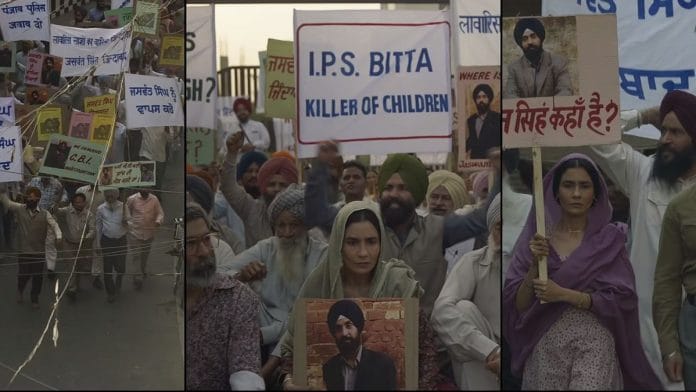

Few films in recent memory have generated as much political, legal, and public debates in Punjab as Diljit Dosanjh’s Satluj. What began as a long wait for the release of a film based on the life of human rights activist Jaswant Singh Khalra has now snowballed into the state’s central political issue.
In fact, the controversy surrounding Satluj only deepened after it was removed from the OTT platform ZEE5 within about 48 hours of its release. The move spawned community screenings of the film, introducing an unusual new dimension to the debate on censorship and free expression. And that is why the row over Satluj is ThePrint’s Newsmaker of the Week.
Rather than limiting the film’s reach, its removal from OTT led to the creation of an alternative — a volunteer-driven exhibition network that has taken the film into village squares and gurdwara courtyards in Punjab.
These community screenings, though initially inspired by the first such screening in a village in Rajasthan, are now being encouraged by political parties, with the Shiromani Akali Dal announcing that it will fund the screening of the film in all villages across Punjab. Punjab Assembly speaker and senior AAP MLA Kultar Singh Sandhwan has also announced that the film will be shown at the community level in his constituency.
The film’s journey has been anything but ordinary. Directed by Honey Trehan and starring Diljit Dosanjh, Satluj — originally titled Punjab ’95 — is based on the life of Jaswant Singh Khalra, who documented alleged illegal cremations and disappearances during Punjab’s militancy years before he was abducted and murdered in 1995. The project remained in limbo for years after the Central Board of Film Certification (CBFC) sought extensive changes, including a change of the title and even Khalra’s name. The makers refused to dilute the narrative, leading to a prolonged certification battle that delayed its release by almost four years.
When the film finally appeared on ZEE5 on 3 July, many believed the long chapter of uncertainty had ended. Instead, a new controversy began. Within two days, the film was made unavailable for viewers in India. ZEE5 said the decision had been taken in light of “current developments” while legal options were being explored. Government sources later indicated that the Centre had sought the film’s removal citing security concerns, and planned to refer it to an Inter-Departmental Committee under the Information Technology Rules, 2021 for further examination.
A political battlefield
The removal of the film also triggered a sharp political blame game. Although political leaders, cutting across ideological lines, criticised the move, they differed sharply on who was responsible and what the controversy represented.
The Shiromani Akali Dal was among the first to attack the decision, describing it as an assault on freedom of expression and questioning why a film that had already reached viewers was withdrawn. The Shiromani Gurdwara Parbandhak Committee (SGPC) also came out in support of the film, arguing that Khalra’s story deserved to reach the public.
The ruling Aam Aadmi Party sought to turn the controversy into a political attack on both the BJP and the Congress. Senior AAP leaders alleged that the removal reflected an attempt to erase one of Punjab’s darkest chapters and accused both the parties of trying to prevent younger generations from learning about the militancy era and the allegations of human rights violations.
Even as it sharpened its political criticism of the Centre, the AAP government also sought to distance itself from the controversy over the community screenings that have sprung up across Punjab. Punjab AAP president Aman Arora said the state government would not interfere with private screenings organised by citizens, maintaining that any decision regarding the film’s formal availability rested with the Centre.
The BJP, meanwhile, has found itself navigating a more complex political terrain. Punjab BJP president Kewal Singh Dhillon claimed he had taken up the issue with the Union government, following which the Ministry of Information and Broadcasting constituted a three-member committee to review the circumstances surrounding the film’s removal. The move has been projected by the Punjab BJP as evidence that the Centre is willing to revisit the matter through an institutional process rather than allow the controversy to escalate further.
The content of the film also reignited the debate about the role played by the police during the dark days of militancy in Punjab. While one side focused on the competence and bravery of the Punjab police in ending decades of violence and terrorism, highlighting that the film projects a one–sided exaggerated view, others supported the film’s story of “25,000” extra judicial killings by the police during the period.
Union Minister Ravneet Singh Bittu, whose grandfather, former Punjab CM Beant Singh, was assassinated by Sikh militants in 1995, said he was not against the film’s choice of subject, but added that it showed a “one-sided narrative” of those days. He called Dosanjh an “imposter” who was misleading the people of Punjab in order to earn money. Bittu challenged Dosanjh and Trehan to also make a film that depicted the killing police officers at the hands of militants during those days. “These people are trying to spoil the peaceful atmosphere in Punjab,” said Bittu, talking to mediapersons in Ludhiana on Thursday.
The controversy has also revived public attention on the Jaswant Singh Khalra abduction and murder case itself, with fresh political sparring over one of the convicted police officers. Akali leader Bikram Singh Majithia has questioned the circumstances surrounding the grant of bail to former Punjab Police Deputy Commissioner of Police (DCP) Jaspal Singh, convicted of Khalra’s murder, in 2023. Majithia alleged that the AAP government under Chief Minister Bhagwant Mann sought to shorten his sentence from the Centre.
Majithia also raised questions over reports that the convict could not be traced at the address in prison records while on interim bail, arguing that the episode reflected serious lapses in monitoring and accountability.
The allegations have been rejected by the AAP. Its Punjab general secretary, Baltej Pannu, accused Majithia of politicising the issue, pointing out that any application for premature release in a CBI case is decided by the Ministry of Home Affairs, and not the Punjab government.
Also read: DSGMC cancels Satluj screening at Gurdwara Rakab Ganj, cites alcohol scenes and abusive language
Religion and legality
The issue also has a strong religious dimension. The Secretariat of Sri Akal Takht Sahib issued a strongly worded statement in which Jathedar Giani Kuldeep Singh Gargajj condemned the blocking of Satluj, describing it as an attempt to suppress freedom of expression and prevent the truth about the alleged atrocities against Sikhs during the militancy years from reaching the public.
Referring to Jaswant Singh Khalra’s documentation of alleged illegal cremations and fake encounters, the Jathedar said the truth could not be permanently suppressed, and argued that if films depicting the suffering of other communities could be screened freely, there was no justification for preventing the screening of a film portraying what Sikhs faced. He also referred to convictions secured by the CBI court in Mohali in fake encounter cases and urged the government to adopt a more sincere approach toward justice for victims of that period. On Friday, the SGPC organised a protest march from the Golden Temple to the deputy commissioner’s office in Amritsar demanding the release of the film.
The controversy has also moved beyond politics into the legal arena. A Public Interest Litigation was filed before the Punjab and Haryana High Court on Wednesday, seeking restoration of the film on the OTT platform. The petition argues that removing the film after its release violates the constitutional guarantee of free speech under Article 19 and questions the absence of a publicly disclosed legal basis for the decision.
Views are personal.
(Edited by Aamaan Alam Khan)