



For months now a question has been brewing with me: what’s India’s biggest brand destroyer? Why has the wheel turned, more than three decades since the economic reform began and India became the darling of the developed world?
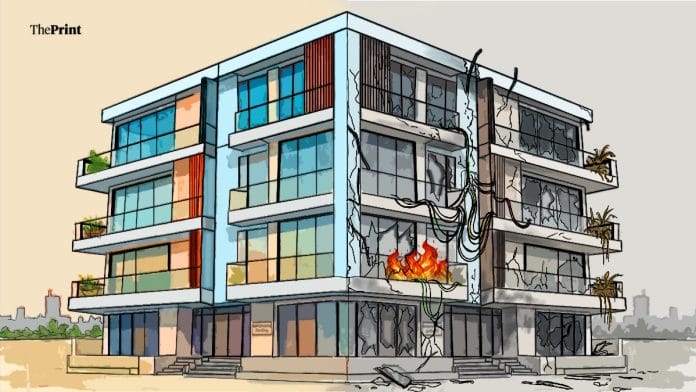
Investors have pulled out their money and left, while foreign tourist arrivals aren’t consistently back at 2019 levels. I’ve been searching for a thread to weave a cohesive argument. Until the epiphany arrived with the fire in the unauthorised Bed & Breakfast in New Delhi’s Malviya Nagar that killed 21 as we write this.
India has many individual factors as brand destroyers, with the three most damaging being garbage, air quality, and safety of women in public places. For now, all of this combines into that larger disaster, the Indian city. Add to this threat individual survival from the elements. Or let’s be truthful and call it the scandal of urban misgovernance.
You come from remote villages, or run-down small towns to India’s most pampered city, where everybody who matters lives, from the President and Prime Minister to the Chief Justice of India, and of course the most prominent journalists and activists, supposedly the conscience keepers of civil society. And you can’t be sure as you go to sleep that a fire or a building collapse won’t kill you.
Just a week earlier (30 May), six of the brightest young Indians who were in Delhi to prepare for competitive examinations died slumming it out near another unauthorised multi-storey building near Saket metro station, just a few kilometres from the B&B that caught fire. Add to this another spate of paper leaks and cancelled examinations and you don’t need to ask why are India’s young so furious.
Also Read: DDA turned into Delhi Destruction Authority & why we applaud the market taking revenge
But, let’s stay with our epiphany: the state of our cities being India’s greatest brand destroyers. Lousy air, filthy water, traffic snarls, poor policing, harassment of women is all there, and unfortunately us natives are resigned to it. It’s just that when global rankings consistently list our cities among the least liveable our thin nationalist skin breaks out in rashes. Personal safety, however, tops all of that, especially for those of us for whom there’s no home other than an Indian city.
Let’s just check the Capital’s fire safety record. In 2019, 17 died in a fire at a six-storey hotel in Karol Bagh. In the same year the Anaj Mandi (grain market) fire took 45 lives including nine minors. We’re only counting major fires for now. Switch to 2022. In Mundka, a fire in a four-storey ‘commercial building’ asphyxiated 27 to death. Two years later, a blaze tore through a neonatal care unit in Vivek Vihar in eastern Delhi, killing 8 newborns.
This was just a listing of prominent incidents that made headlines for a day or two. If you check Delhi Fire Service (DFS) data, it would shock you, or probably won’t, given how inured we’ve become to living in this dangerous chaos, sort of walking on a deck perpetually smouldering somewhere. In 2019-20, fire took 308 lives in Delhi, 346 the next year despite the Covid lockdown, then 591 in 2021-22, nearly doubling to 1,029 in 2022-23 and rising to 1,303 in 2023-24.
All of this as India’s economy has grown, billions (in dollar equivalent) have been poured into Delhi, many areas have been developed, and connectivity has improved. A deeper analysis will tell you that most of these disasters took place in what might be described variously as unauthorised, illegal or irregular buildings and areas.
That last factor, ‘areas’, is important. It’s because Delhi’s original villages are notionally cordoned off on the map with a red string (hence the description Lal Dora) and most urban laws or regulations don’t apply there. How would they? These are after all villages. Almost all major incidents have occurred in these, including the Malviya Nagar fire and Saket building collapse. While the Malviya Nagar B&B was situated in Hauz Rani, the Saket building was in Said-Ul-Ajaib in Mehrauli. They’re both urban villages. You might need to get some licenses to run a hotel or B&B here. But, in an urban village, or what’s generally called a Lal Dora area, you can construct what you wish. It’s a village after all.
If you live in any of the Capital’s regular colonies, Malviya Nagar and Saket included, there are several limitations on how much you can build, and how high you can go. In a Lal Dora area, you can build mini skyscrapers, often single-brick structures without any columns. These will turn into rubble even in a magnitude-6 earthquake.
Also Read: Coaching centres are a sign of broken-window economics. See how China crushed it all overnight
The central curse of our urban governance isn’t that more voters live in these slummified villages, or unauthorised colonies, than in municipally governed areas. The tragedy is that the political class panders to them instead of improving their quality of life. In the Capital, in every election, one important priority for all political parties is to regularise illegal colonies. No political party sees value in promising a renewal, not even on the lines of the by now established slum rehabilitation programme—shift people to transit accommodation, redevelop where they lived illegally and create modern, secure accommodation for them in situ with ownership rights. This is too much work, and what’s unlikely to be achieved in one election cycle won’t interest any politician.
Our cities, in the process, have become divided among the ‘gated colony’ classes and the rest who live mostly illegally. The latter have the voting power but you can buy them with freebies or simply the promise to regularise their illegal existence. This vast urban majority has been fooled into nursing minimal expectations.
Mumbai is an interesting example. Under the NDA it has seen a massive infrastructure and connectivity upgrade. Among these is the brilliant new Coastal Road. It’s just that in so many visits to Mumbai since it became operational I haven’t seen one commuter bus on it. And we thought a separate bus lane, convenience for the working-class commuter was among its promises. The new Metro is great but expensive for the poorer working classes. The cheapest commute is still the local train or the bus. It’s just that there’s no money for buses.
I’ve written multiple times in the past that the one reason our politicians treat the cities so badly is that their voters live in the villages. So they win power with their votes and then come to the cities to ravage them for wealth. Further, there’s a cynical and fake pro-village bias in our politics. You can find the roots of this in our Constituent Assembly debates where Babasaheb Ambedkar fought the idea of a Gandhian constitution based on the concept of Gram Swaraj, the village as a republic. What is the village, Ambedkar asked in the Constituent Assembly on 4 November 1948, “but a sink of localism, a den of ignorance, narrow-mindedness and communalism?” He won that argument only partly.
The upshot is, our politics has been shy of planned urbanisation. This, despite the fact that 35 percent of India (according to the World Bank) now lives in urban areas, and the Economic Survey predicts it will cross the 40-percent mark by 2030. Like any aspirational country India’s objective is to move more people from farming to industry and services, or in other words, from villages to cities. For this, our cities have to be reimagined and new ones built with transit space for the new arrivals. Then they will move up the value chain in the course of time. It’s challenging, but business as usual won’t work. It will continue to be the grand destroyer of Brand India.
Also Read: As bulldozers target the poor again, let’s also remember Delhi’s ‘Republic of Sainik Farms’
over 10 years back, when I was living in London to roll out a software program for a bank, the Grenfell tower tragedy happened. It was awful, mostly working class people living in council houses (government subsidised). Everyone, from PM to mayor to civil servants were on the ground overseeing rescue and recovery.
I have come back to India since but followed the consequences.
A public enquiry where people responsible were subjected to difficult, uncomfortable questions in public followed. Heads rolled and it became an election issue.
More importantly, the cladding which was responsible for the fury of the fire, became the main focal point.
The cladding rules across the country changed and apartments across the country were given deadlines to change the cladding or insurance turned down.
That is called a proper action and follow up.
We can only dream that in India, whether this government or any other.
Public’s life has no value.
In college, read a column which explained that there are really two Indias. This was before the reforms of 1991 which further widened disparities. One, which conforms to say the less developed parts of Europe, in terms of living standards. The difficult to answer question of exactly how large is the middle class. The other, not very much better than sub Saharan Africa. This same cleavage plays out in urban India. As if citizens of the same country are occupying two very different spaces in terms of economic development. Reflected, very visibly in their housing and level of civic amenities. 2. When the government announces its plans to make Delhi a world class city, appoints a retired diplomat as LG to helm that transition, it is really not thinking beyond LBZ and the gated communities. The Lal Doras will always remain with us. In my heart, the deepest love, respect, empathy for fellow citizens who reside in them. When a glitzy G 20 style event is organised, they will be shielded from the gaze of the foreign dignitaries.
Is it enough to describe the curses of urban governance?
100000% Agree with the Article
Planned urbanisation. Much needed. The high cost of urban land – all land in India, in fact – is an insurmountable constraint. Hence for about one half of the urban population, slums, or some variant, is the only viable option. The island city of Bombay has the long standing issue of dilapidated, tenanted buildings.
Who opposes village modernization and laws implementation The rich and powerful villagers. They are the one who in connivance with builders and realtors let all noncompliant constructions.
However, I feel that citizens specially city educated folks including government and nongovernment servants are also not very law abiding and safety conscious. We as Indians believe in shortcuts, in bypassing safety norms and in bribing to get certificates for compliance.