






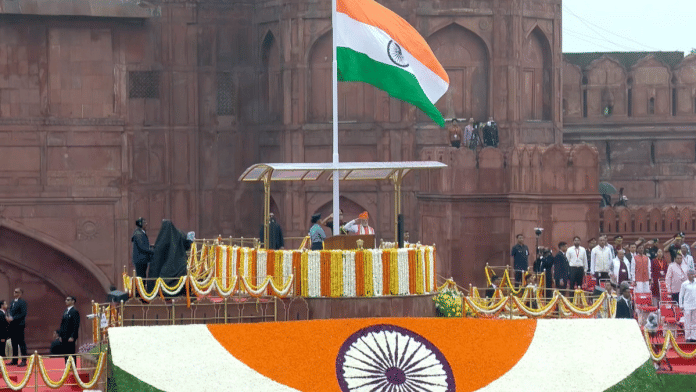


Vande Mataram will now precede the National Anthem at the Independence Day ceremony at the Red Fort, a first in the history of the event. More than 27,000 people expected to attend the ceremony will stand while the song is played. The government has also pushed for the full version of the song at official events; Parliament has passed a law giving it legal protection on par with the National Anthem, and the Lok Sabha this week opened its proceedings with it for the first time.
The Sanskritised Bangla poem by Bankim Chandra Chattopadhyay was adopted as India’s National Song in 1950, and while it has long commanded reverence as a symbol of the freedom struggle, it never carried the same public decorum as the National Anthem. It functioned more as a cultural and patriotic anthem than a ceremonial one; its versions were sung by generations of Indians and reinterpreted by musicians from Lata Mangeshkar to AR Rahman.
The public version historically used for national occasions has generally been the first two stanzas of the song. The later stanzas contain more explicit religious imagery and the mention of the Hindu goddess Durga. Now, all six stanzas of the song will be played, which takes roughly three minutes and 10 seconds, along with Jana Gana Mana, which takes under a minute. Several opposition leaders have questioned whether audiences can reasonably be expected to stand through the full rendition at official functions.
When patriotism gets a prescribed tune, even a 150-year-old song can become combustible.
For taking a song that has long had a settled place in India’s national life and turning it into a live argument over patriotism, protocol, law, federal and secular identity, Vande Mataram is ThePrint’s Newsmaker of the Week.
The Narendra Modi government is in the middle of a year-long commemoration marking 150 years of Vande Mataram, launched in November 2025 and running until November 2026. The government has been promoting the full version through mass singing programmes, official events and cultural presentations across the country.
The song has also been given pride of place at this year’s national ceremonies. It was the theme of the 2026 Republic Day tableau, and now, on Independence Day, it will be sung before Jana Gana Mana, reversing the decades-long order of the two songs in the country’s most important annual ceremony.
Then came the legal change.
Parliament passed the Prevention of Insults to National Honour (Amendment) Bill, 2026, extending statutory protection to Vande Mataram two weeks ago. President Droupadi Murmu has since given her assent. The amended law makes deliberate acts of insult and disruption during the singing of the national song punishable, putting it under the same law that protects the National Anthem.
The government sent advisories to states and union territories to “strictly comply” and play the full version of Vande Mataram before the National Anthem at all state functions.
Opposition revolts
Tamil Nadu responded by passing a unanimous Assembly resolution that Tamil Thai Vazhthu, the state’s official song, will be sung first at state government functions.
Chief Minister Joseph Vijay called it a “unity in diversity” move and said it was not against the constitutional framework.
Then, senior Congress leader Shashi Tharoor questioned the decision of “zealots” to require the full rendition at official functions. He argued that asking audiences to stand through a lengthy rendition—particularly when combined with the National Anthem and other ceremonial requirements—could be impractical.
“Jana Gana Mana requires audiences to stand respectfully and focus their attention for a reasonable 52 seconds. The National Song in full takes three minutes and 10 seconds. Tamil Nadu has just decided that both will be preceded by the State Song in Tamil for another 2 minutes. Do we really expect audiences to stand still and respectfully for six minutes before and after every function, a total of 12 extra minutes?” Tharoor tweeted on Tuesday.
BJP leaders seized on the remarks, accusing him of disrespecting the national song.
In Kerala, a 6 August circular from Chief Secretary VP Sinha directing government departments to follow the Centre’s instructions and sing all six stanzas of Vande Mataram during Independence Day celebrations put the Congress-led UDF government in an awkward spot.
The Home Ministry order said that “the official version only shall be recited in mass singing” whenever the National Song is sung.
Kerala had earlier decided against the full version at the state Assembly, where only the first two stanzas were to be sung. Ministers have since pushed back, with Health Minister K Muraleedharan saying only the first two stanzas would be sung at state government functions, while Transport Minister CP John accused the BJP of “pinpricking” Kerala. Congress MP Rajmohan Unnithan went further, saying the full version would not be sung in the state “in this lifetime”.
The row has also given the Opposition, led by CPI (M)’s Pinarayi Vijayan, an opening to accuse the UDF government of surrendering to the “RSS agenda”.
Also read: Udhayanidhi vs Vijay is Tamil Nadu’s next-gen duel—Cauvery row to ‘double entendre’ arrest
The song, and the version
Chattopadhyay wrote Vande Mataram in 1875. It first appeared in the Bangla literary magazine Bangadarshan and was later incorporated into his novel Anandamath, published in 1882. The song became one of the most powerful cultural symbols of the freedom movement and was formally recognised as India’s National Song after Independence.
But earlier, in 1937, following concerns over the later stanzas’ invocation of Durga (there’s mention of bhakti, shakti, Hindu idols and mandirs as well) decided that only the first two stanzas—those without explicit religious imagery—would be used at public gatherings, a compromise supported by leaders, including MK Gandhi and Rabindranath Tagore.
“Other stanzas of the song are little known and hardly ever sung. They contain certain allusions and a religious ideology which may not be in keeping with the ideology of other religious groups in India,” the Congress Working Committee had said back then.
The Centre’s decision to foreground the full version has, therefore, reopened old fault lines that had largely remained covered by convention.
The government’s position is straightforward: the complete song is the original composition and restoring it is part of reclaiming its history. The political argument around it is debatable.
Also read: Kashmir 2010 to Delhi 2026—RAF’s pellet gun use shows crowd control measures are still failing
We have seen this movie before
There is a precedent in what happened with Jana Gana Mana in cinema halls.
In November 2016, the Supreme Court ordered every cinema hall in India to play the National Anthem before a film and required everyone present to stand. The court said the move would help instil “committed patriotism and nationalism”. Doors were to remain shut during the anthem.
The expectation may have been patriotic consensus; instead there was confrontation.
There were reports of moviegoers being abused and harassed over whether they were standing correctly, including instances involving elderly and disabled people. A judicial attempt to prescribe a moment of national respect became a national argument over vigilante patriotism and the limits of compulsion.
In January 2018, the Supreme Court modified its order. Cinema halls were no longer required to play the National Anthem; if they chose to play it, audiences were expected to show respect by standing.
Views are personal.
(Edited by Saptak Datta)