







New Delhi: For more than a decade, Punem Deve and her husband Uday Raghu remained the most-wanted couple for successive Chhattisgarh governments, including those led by former chief minister Raman Singh.
Raghu was a gunner to slain Maoist commander Madvi Hidma. For the police, the couple were an elusive target to obtain information related to Hidma.
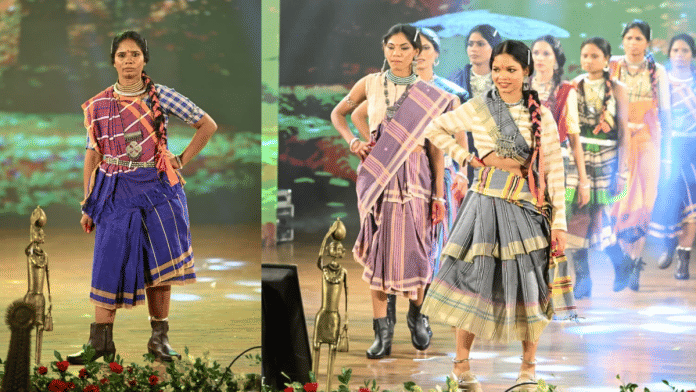
So, when Deve appeared on the ramp last week, it marked a dramatic turn in a life that had for years remained tied to the Maoist insurgency.
The 31-year-old donned a Chhattisgarhi Kosa silk garment woven by handloom workers and aced the ramp in Raipur, with Raman Singh in attendance, along with the current Chief Minister Vishnu Deo Sai.
Raghu was one of the 28 Maoist cadres arrested by the Andhra Pradesh Police, hours after the killing of Hidma in an encounter in Alluri Sitharama Raju district in November last year. The former Maoist remains in Andhra Pradesh.
Deve was one of the nine former Maoist cadres who walked the ramp during the event organised by the state’s Handloom Federation Raipur. They were brought to Raipur a week before the Handloom Day event on 7 August and were imparted training by a stylist from Mumbai.
“This is a completely different life for me,” Deve told ThePrint over the phone from Sukma.
“The person who was training us was very helpful, and he helped us to understand how we can carry the dresses we were supposed to wear during the event,” she said in broken Hindi.
From the shadow of the gun to the confidence of the ramp – Bastar’s transformation speaks for itself.
Peace is prevailing, opportunities are opening up and lives are changing – a testament to Hon’ble PM Shri Narendra Modi Ji’s vision and Union Home Minister Shri Amit Shah Ji’s… https://t.co/MOJTEs1f5h
— Vishnu Deo Sai (@vishnudsai) August 13, 2026
Apart from Deve, eight other surrendered Maoist cadres featured in the event: Podiyam Raje, Medium Gangi, Madvi Deve, Madvi Nadanni, Madvi Male, Doddi Rame, Madkam Bhime, Punem Joytti. All of them belong to Sukma and have received skills training at the rehabilitation centre there.
According to officers in the Chhattisgarh Police, all nine were active in the South Bastar region as armed cadres and surrendered their weapons to join the mainstream.
Chhattisgarh government officials said that the event was originally planned in Jagdalpur—the headquarters of Bastar district—as a symbolic move. However, the plan changed later, and these former Maoist cadres were brought to Raipur for the event.
“The most inspiring and emotional moment of the event was when surrendered Naxalite women from Bastar walked the ramp in an indigenous fashion show. These women confidently showcased Chhattisgarh’s Kosa silk and handloom garments,” a Chhattisgarh Handloom department spokesperson said in a statement.
The officer said that this presentation was not merely a fashion show. It symbolised a new identity for women moving towards self-reliance by integrating into the mainstream, as well as a positive image of a transforming Bastar.
“The audience cheered them on. During the event, the Chief Minister interacted with them and extended his best wishes. Notably, for almost all these surrendered women, it was their first visit to Raipur, and the moment became etched in their memories forever,” he said.
(Edited by Ajeet Tiwari)