





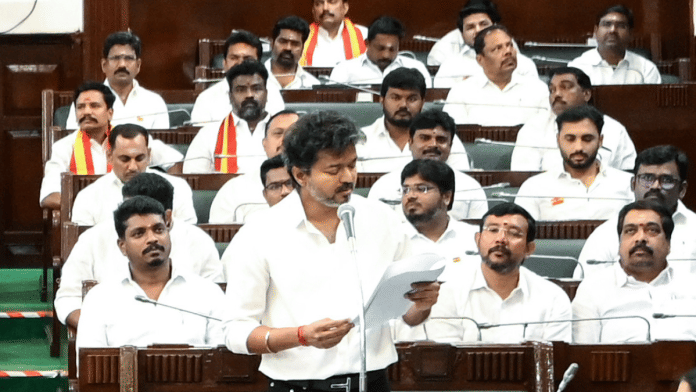


Chennai: The TVK government has passed four high-profile resolutions in the Tamil Nadu assembly in the last three days—on state song Tamizh Thai Vazhthu, NEET abolition, the FCRA Amendment Bill, and delimitation. All received substantial cross-party support, including from key opposition party DMK, and drawing criticism mainly from lone BJP MLA M. Bhojarajan.
These moves lead to the question—is the ruling TVK, under Chief Minister Vijay, is following the DMK template of asserting state rights and Tamil identity as a challenge to the Union government, or is it trying to establish itself as the new flag-bearer of federalism and regional pride?
On 10 August, CM Vijay moved a resolution making it mandatory for the Tamizh Thai Vazhthu to be sung before any events at educational institutions, universities, government offices, PSUs etc. In May, the DMK had attacked the TVK over the state song being relegated to the third position in the assembly after the Governor’s address, accusing the party of having compromised on state pride.
This week, Vijay described Tamil as “not only a language but also our life and emotions” and “as pure as our mother,” framing the issue as a matter of state rights and cultural identity amid friction with a Union Home Ministry advisory on the sequence of national and state songs.
On 11 August, Tamil Nadu Health Minister K.G. Arunraj moved another resolution urging the Centre to abolish NEET for undergraduate medical admissions and allow selection based on Class 12 marks. It cited social justice concerns, disadvantages for Tamil-medium, rural and socio-economically weaker students, coaching centre proliferation, paper leaks and student distress that have led to suicides in the state. DMK, AIADMK, Left parties and PMK supported it but the BJP MLA walked out.
In 2021, the then DMK government under MK Stalin had passed the Tamil Nadu Admission to Undergraduate Medical Degree Courses Bill in assembly, seeking Tamil Nadu’s exemption from NEET and proposing that undergraduate medical admissions be based solely on Class 12 marks. The Bill was reserved for the President’s consideration and remains without assent.
The DMK has repeatedly adopted assembly resolutions demanding NEET’s abolition, framed it as anti-federal and a driver of coaching centre commercialisation and consistently campaigned against it as a core issue of education autonomy and equity.
Also on 11 August, state School Education Minister A. Rajmohan moved a resolution opposing the Foreign Contribution (Regulation) Amendment Bill, 2026, in its current form, arguing it could undermine the autonomy of charitable, educational and minority-run social welfare institutions. It too passed with broad support in the state assembly, while the BJP opposed it.
Earlier on 8 August, DMK president M.K. Stalin held a meeting with several Christian bishops and minority organisation representatives who thanked the party for its opposition to the FCRA Amendment Bill. Stalin described its provisions as a threat to the autonomy of charitable, educational, medical and social welfare institutions, particularly those run by minorities.
DMK had written to Prime Minister Narendra Modi calling the Bill “draconian” and a “legalised assault on minority-run institutions” and urged its complete withdrawal. The party has demanded that the Centre either withdraw the Bill entirely, repeal Section 15 of the existing FCRA Act, or refer both the amendment and a full review of the 2010 law to a Joint Parliamentary Committee.
A delegation of Christian leaders headed by Rajya Sabha MP from DMK P. Wilson met Union Home Minister Amit Shah on 6 August to press these demands. In the Tamil Nadu assembly, DMK members supported the resolution moved by the TVK government opposing the FCRA Bill in its current form.
On 12 August, Vijay moved a special resolution seeking a permanent freeze on Lok Sabha strength at the existing 543 seats, retention of current inter-state allocation to protect southern states that controlled population growth, maintenance of the present Lok Sabha-Rajya Sabha ratio, and implementation of 33 percent women’s reservation in the 2029 elections on the basis of the existing 543 seats. DMK and Left parties backed it, while BJP opposed it. AIADMK and DMDK questioned the timing while supporting the women’s reservation component.
Throughout the debates, DMK leaders repeatedly said that these were long-standing positions of their party. On delimitation, Leader of the Opposition Udhayanidhi Stalin said, “The movement that first told India what the impact of delimitation would be is the DMK.” He added that the previous DMK government under M.K. Stalin had passed an assembly resolution, convened an all-party meeting, written to chief ministers of other states and formed a joint action committee.
“Our firm stand is that Tamil Nadu’s representation must not be diminished. We welcome the assembly resolution and reiterate that Tamil Nadu’s existing 7.18 per cent share of Lok Sabha seats must be protected,” he said.
A calculated move by TVK?
Political observers see a calculated approach by TVK when moving these resolutions to position itself as the one raising the classic Dravidian or state-rights issues. TVK has picked language and cultural primacy, education autonomy, federal balance in parliamentary representation, and protection of minority institutions.
Academician and political analyst Ramu Manivannan told ThePrint that TVK is fighting the DMK more than the Centre. “TVK is raising all these issues from nowhere without any reference in earlier times and without any presence in the Parliament. This is like being everywhere and ultimately nowhere. This suits their politics and their ties with all including the Congress and BJP. TVK must resist DMK and by this crossfire, TVK will diminish the cutting edge advantage of DMK on all these issues.”
Analysts also say that the broad support to the government on these issues demonstrates consensus, allowing Vijay to claim credit for “protecting Tamil Nadu” without appearing isolated. It also creates optics of a “people’s government” willing to confront Delhi on matters of principle, after being criticised for not attacking the BJP directly on state matters.
Political analyst Sunil Kumar said that the TVK’s strategy serves multiple purposes as it will help the party occupy the moral and political high ground traditionally associated with the DMK on Centre-State issues, and make it harder for the opposition to portray the TVK government as soft on federalism or Tamil identity.
“TVK is trying to replace the AIADMK completely by diminishing its role by following the DMK playbook. They want to hold the power and cultivate the political messaging as State first and the TVK versus DMK narrative. Even the usage of words while moving the resolutions says ‘Union’ instead of Centre, which was something DMK popularised. The party wants to ensure that they are seen as a State party that is also supportive of minorities, such as in the case of FCRA bill,” Sunil told ThePrint.
(Edited by Gitanjali Das)
Also Read: Udhayanidhi vs Vijay is Tamil Nadu’s next-gen duel—Cauvery row to ‘double entendre’ arrest