






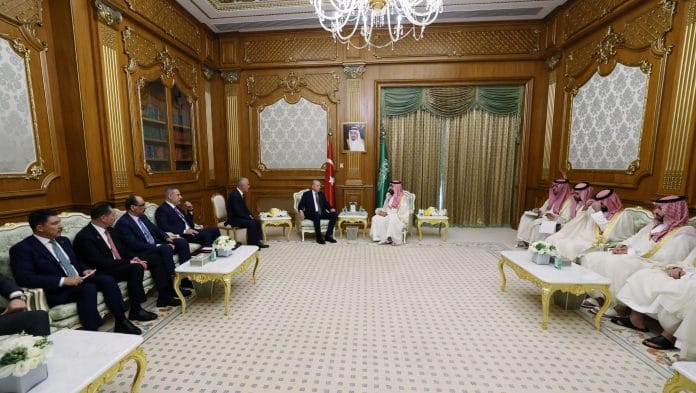


The Mecca Joint Defence Agreement, signed by Pakistan, Saudi Arabia and Turkey, has generated considerable interest on Chinese social media. One commentator described it as a “Sunni NATO,” while other discussions focused on declining United States’ influence, Iran as a target, and the implications for India, with some suggesting that New Delhi should be on high alert.
On Weibo, hashtags including “Turkey, Saudi Arabia and Pakistan sign joint defence agreement” and “Iran welcomes the defence agreement” have attracted thousands of views and generated extensive discussion.
Why the Mecca pact matters
A recurring theme in Chinese commentary is that the Meeca defence pact is a defensive and open-ended security framework rather than an offensive alliance. Strategically, it is seen as balancing Iran and Israel while allowing the three signatories to reduce their dependence on the US without directly confronting Washington.
Qin Tian, Deputy Director of the Middle East Research Institute at the China Institutes of Contemporary International Relations, argued that since the outbreak of the US-Iran conflict earlier this year, Saudi Arabia, Pakistan, Turkey, and Egypt have stepped up diplomatic coordination and held multiple foreign ministers’ meetings, with Pakistan playing a key role in efforts to advance US-Iran negotiations. The pact, in this sense, is being discussed as part of a wider push for greater coordination among regional Muslim powers.
Chinese commentary frames the Mecca pact as a “money, gun and nuclear” combination, bringing together three complementary military and strategic strengths: Saudi financial power, Turkish military capabilities, and Pakistan’s nuclear deterrent. A Weibo post similarly argued that the agreement would allow the three countries to combine their political, economic, and military capabilities and respond collectively to major geopolitical and security challenges.
The role of the US is central to these interpretations. One commentary argues that the tripartite alignment signals a shift from a US-dominated Middle Eastern security order towards greater regional self-reliance. In this reading, Iran is a key target of deterrence and containment, while Pakistan emerges as a perceivably important security partner. The pact could constrain Iran through a stronger collective defence network while also challenging aspects of the US and Israel’s strategic positions.
Chinese commentary also portrays the agreement as the beginnings of a more institutionalised regional security framework, potentially expanding to countries such as Egypt and linking the Gulf, Red Sea, Arabian Sea, and South Asia.
Commentators also attached significance to the choice of venue. One person asked, “Why choose Mecca?” The answer offered was that signing the agreement in Mecca carries profound political and symbolic significance. In this interpretation, Mecca, as the holiest site in Islam, transforms the agreement from a narrow security arrangement among three countries into a broader statement about the security of the Muslim world.
Also read: Three countries, no common enemy—why the Mecca defence pact is weaker than it looks
A regional order without the US?
The most consistent argument in Chinese commentary is that the Mecca defence pact highlights declining confidence in US security guarantees and a broader movement towards greater regional strategic autonomy.
One commentator argued that a Middle Eastern alliance could significantly weaken the US-led regional order built over decades. Another wrote that the three countries had begun constructing a security network that is firm yet flexible, and which does not depend on the US.
Li Shaoxian, head of the China-Arab States Research Institute at Ningxia University, described the pact as evidence of what he sees as the erosion of the US security umbrella in the Middle East. Yan Xuetong, Honorary Dean of the Institute of International Relations at Tsinghua University, posed a provocative question: ‘If the US military cannot even protect its own bases, how can it protect its partners?’
China Central Television (CCTV) reporter Wang Zheng similarly contended that the agreement showcases the regional demand for more diversified and effective security guarantees. More importantly, he presented it as evidence that the Middle East is moving away from an era of “Western dominance” towards a “new era of autonomous security,” in which regional powers coordinate and develop their own security frameworks.
India has attracted particular attention in Chinese commentary.
A commentary on Sina Finance argued that the pact could reshape regional strategic calculations by strengthening deterrence against Iran and raise costs for Israel, while closer Saudi-Pakistan ties could narrow India’s strategic space. Another commentator argued that for India, consequences of the pact matter more than the precise intentions behind it, which is to expand Pakistan’s strategic depth beyond South Asia.
There are, however, limits to how far Saudi Arabia can move against India. Riyadh and New Delhi have deep economic and trade ties, and India remains an important purchaser of Saudi oil. Saudi Arabia has strong incentives to preserve its relationship with India. Nevertheless, Chinese commentary suggests that the very existence of the pact has altered the regional strategic equation and is a cause of concern for India.
Another analysis identified three challenges for India. First, the pact could strengthen Pakistan through Saudi financial support and Turkish defence capabilities, potentially raising the costs of any future India-Pakistan confrontation. Second, it could contribute to a broader West Asia-South Asia security network, potentially narrowing India’s strategic space. Third, India’s Agni-4 missile test, conducted just one day before the pact, was interpreted in Chinese commentary as a deliberate signal of India’s continuing strategic deterrence and a warning to Pakistan that New Delhi retained a credible capacity to respond, and to any external power considering deeper intervention in South Asia to think twice.
A new order facing old constraints
Despite the enthusiasm surrounding the agreement, some Chinese analyses cautioned against portraying the Mecca defence agreement as a full-fledged NATO-style alliance. A Sina Finance commentary noted that the three countries have fundamentally different strategic priorities. Saudi Arabia is primarily focused on the Gulf and Red Sea; Turkey has major interests in the Mediterranean and surrounding regions; while Pakistan’s principal security concerns remain centred on India. Differences in strategic interests, political priorities and military systems could limit cohesion and interoperability.
Another commentator identified five principal limitations: unclear military commitments; limited cross-regional power projection and logistics; differences among the three countries over regional political issues; uncertainty over how far the US could pressure its partners, particularly given Saudi Arabia’s continuing security dependence on Washington; and the possibility of Israeli countermeasures.
The question of interoperability is particularly important. One analysis highlighted the difficulties that could arise during a cross-regional conflict. If Turkey, for example, were expected to support Pakistan in a conflict that conflicted with NATO interests, Ankara could face a difficult choice between its NATO obligations and commitments under the Mecca pact. The agreement may be legally compatible with existing alliances on paper while creating potentially serious political and strategic dilemmas in practice.
By and large, Chinese commentators portrayed the tripartite agreement as a momentous development that could reshape the Middle Eastern order by returning greater responsibility for regional security to the countries of the region. Interestingly, the US features far more prominently in these discussions than India, Iran, or Israel. A broad consensus appears to be emerging that the pact is a signal to Washington that regional countries are unwilling to accept US dominance. Whether this shift will produce a new security architecture remains uncertain, but in Chinese discourse, the Mecca pact is already being projected as evidence that the existing US-led order is under strain and that regional order may be shaped by the region’s own powers.
Sana Hashmi, PhD, is a fellow at the Taiwan-Asia Exchange Foundation. She tweets @sanahashm1. Views are personal.
(Edited by Prashant Dixit)