








The afternoon of 20 July had something remarkably different about it. Thousands of people often dismissed as “apolitical” and glued to social media were on the streets demanding change and systemic accountability.
The crowd, which outnumbered the forces on the ground by several thousand, was marching toward Parliament, where the monsoon session was underway, with one principal demand—the resignation of then Union Education Minister Dharmendra Pradhan.
Barricades were breached and tossed aside as protesters pushed toward the gates of the newly built Parliament complex, prompting the Central Industrial Security Force’s (CISF) Quick Response Team into emergency mode.
The crackdown was swift, as was the protesters’ withdrawal from the sensitive location. The forces and top officials may have gotten the impression they had averted a larger confrontation, but they faced far more scrutiny and criticism over what followed.
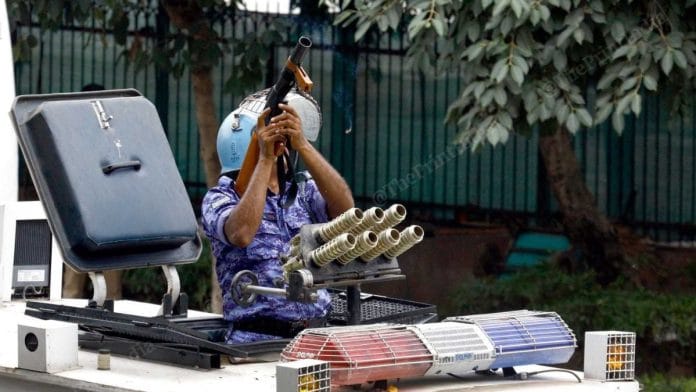
By 3 pm, the protest had spilled beyond the inner zones of Lutyens’ Delhi. Fresh groups had assembled at Connaught Place, better known for luxury brands and restaurants than mass demonstrations. It was around this time that the Rapid Action Force (RAF) fired pellets—both plastic and metallic ones—at the protesters, injuring at least four.
While the Delhi Police initially said little about allegations that pellet guns had been fired at protesters, it soon began issuing outright denials on social media in response to media reports. But medico-legal reports and the victims’ accounts became too substantial to dismiss, undermining the police’s categorical denials about using what are officially classified as “non-lethal” weapons.
For these reasons, the RAF and its use of pellet guns are ThePrint’s Newsmaker of the Week.
‘Serving Humanity with Sensitive Policing’
Formed with the objective of carving out a specialised wing of the Central Reserve Police Force (CRPF), the RAF has gone from strength to strength since its inception in October 1992. It was initially conceptualised as a quick-response force to address law-and-order situations arising from riots, communal tensions, or social unrest in the country.
Over the years, the RAF was credited with several accomplishments and was always seen as a fair and professional force, which state police officers describe as “one which acts without looking at the face and profile of the miscreants.”
However, the events of 20 July have dented the force’s image to such an extent that they have raised question marks over its very motto—“Serving Humanity with Sensitive Policing”. Videos and photographs from across the protest sites show a brutal crackdown. Some personnel appear to take pleasure in knocking down protesters or blocking the path of those fleeing the barrage of lathi-charge.
While the initial criticism of the RAF and the Delhi Police went hand in hand for using excessive and disproportionate force against unarmed protesters, criticism and scrutiny escalated dramatically as reports emerged of the use of pellet guns.
Early reports of pellet guns came as unconfirmed accounts from protesters. Over the next few days, however, victims’ testimonies and medico-legal reports began appearing one after another. Even as the Delhi Police continued to deny using pellet guns, the evidence became clinching and insurmountable to dismiss.
Then, two days after the 20 July unrest, RAF chief Inspector General Seema Dhundhia admitted that “excessive force” had been used during the protests and pulled up the personnel and officers on the ground.
While the injured have been left with lifelong trauma, the crackdown has chipped away at the reputation of the force—both the Delhi Police and the RAF.
Also read: From JNU to Jamia & now Jantar Mantar—Delhi Police faces similar questions over use of force
Courts on pellet gun use
Classified as a “non-lethal” weapon on paper, pellet guns have always been controversial for the long-lasting disability, such as blindness, that they have caused in Jammu and Kashmir. According to the RAF’s standard operating procedure (SOP), the use of bullets, including pellets, is marked as a weapon of last resort, but its usage in Delhi sparked widespread concern, including among those who once occupied important chairs in the national security apparatus.
A total of 117 demonstrators were killed in the unrest in Kashmir in 2010, drawing widespread condemnation. The “non-lethal” weapon with a lasting disability returned to the streets following the killing of Hizbul Mujahideen commander Burhan Wani in 2016. After 85 people were killed in street violence, and several permanently blinded by birdshot, the Jammu and Kashmir Bar Association moved the high court, seeking a complete ban on the 12-bore pellet gun and/or any other bore and cartridges, containing pellets as a means of crowd control.
In their PIL, the bar association alleged that more than 4,000 people were injured and submitted a list of 46 people who had been blinded. By the government’s own admission, 510 patients were shifted to hospitals across the country for treatment.
In February 2020, the high court rejected the PIL. The Supreme Court, too, heard a clutch of petitions in 2016 and observed that the forces should apply their minds before firing pellet guns and cautioned against their indiscriminate use.
Hearing a petition by the former Intelligence Bureau Special Director, Yashovardhan Jha Azad, and two victims of the pellets in Delhi, the Supreme Court Thursday ordered the preservation of the log book. However, the bench presided over by Chief Justice of India Surya Kant did not explicitly ban the use of pellet guns and noted that they are part of the force’s graded response in exceptional circumstances.
The Supreme Court, in all likelihood, will define the ambit of the “exceptional circumstances”, but the inquiries by the Delhi Police and the CRPF will decide if the situation faced by the RAF personnel who resorted to pellet guns was indeed exceptional in nature.
(Edited by Saptak Datta)