




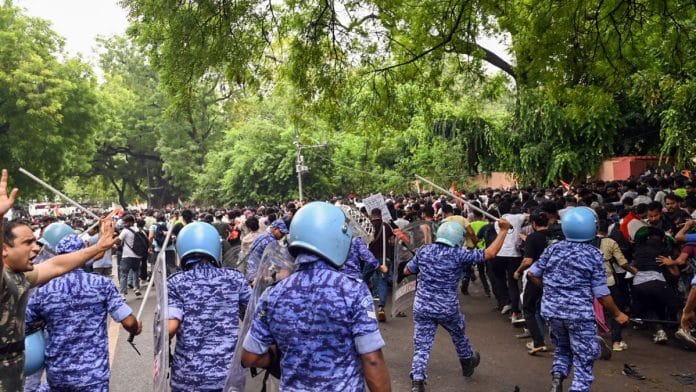

When a pressure cooker’s valves are clogged, food inside often seeps out from the rubber gasket around the rim of the lid. On 20 July, the streets of Central Delhi bore an eerie similarity to those of a clogged pressure cooker.
Student protesters gathered at Jantar Mantar began their ‘Sansad Chalo’ march to Parliament that afternoon, demanding the resignation of Education Minister Dharmendra Pradhan over the 2026 NEET paper leak and broader reforms in the conduct of public examinations.
The night before, the Delhi Police began positioning barricades around all roads leading to Parliament and disabling metal detectors and cameras. The police’s position was simple: no protester would be allowed to march to Parliament.
But much to their surprise, people began pouring into the streets from every direction. And Delhi Police failed to manage the situation and resorted to force to disperse the crowd. That is why Delhi Police is ThePrint’s Newsmaker of the Week.
The tipping point
Up until 17 July, the CJP agitation had attracted a few hundred protesters. However, as social activist Sonam Wangchuk was forcefully removed by the Delhi Police officers behind white sheets, the protesters began pouring in. By noon of 18 July, students, retired teachers, professors, activists, actors and parents began joining the protest site through the night.
By Monday morning, the protest site at Jantar Mantar was swarming with protestors. There were people on the streets, climbing on trees and police buses, behind the Delhi Police headquarters, and inside state government offices. They had outnumbered the Delhi Police and RAF personnel combined.
As the clock ticked 9 am, those near the Cockroach Janta Party (CJP) stage began moving towards the towering barricades. But beyond these barricades stood scores of Delhi police personnel wearing body cameras and civilian clothes, along with RAF squads and multiple anti-riot vehicles armed with tear gas and several private buses intended for transporting detainees.
Most of the RAF officers did not have their name tags on. When the students began to cross the barricades towards Sansad Marg, a senior Delhi Police officer ordered: “Those with gas element in front.”
The procession was halted near Kerala House, about 500 metres from Jantar Mantar, by heavy barricading, RAF contingents, water cannons and anti-riot vehicles. As protesters tried to move past the barricades, the police charged at them with lathis, tear gas and loudspeaker warnings, while some RAF personnel fired pellet guns.
In a viral video on social media, the additional DCP Sandeep Lamba was seen slapping a woman.
“Why didn’t you initiate legal action against additional DCP Sandeep Lamba. It is a cognisable offence and why is there no FIR,” Rishikesh Kumar, a lawyer, posted on X. The Delhi police later clarified that the officer had “lost his cool”. He was removed from the protest site; however, no legal or departmental action has been initiated against him.
Social Media has also been rife with allegations of Delhi Police stopping students in public spaces from moving toward the protest site. CJP Spokesperson Ratna Singh posted on X alleging that students were being detained.
“Police are detaining youth commuting by auto-rickshaw, cabs after setting up checkpoints at Lodhi Road, Nizamuddin, cops misbehaving with lawyers,” she said.
Protesters also pointed out that the Delhi Police has been using a facial recognition system to create a database of protesters.
“What law does the Delhi Police claim the power to randomly stop people, detain them for hours, photograph them, demand Aadhaar, collect social media handles, inspect phone galleries, and question them about attending #JantarMantar protests? Police are empowered to enforce the law and not to conduct fishing expeditions into citizens’ private lives and assume the role of certifying citizenship. We deserve to know exactly which provision authorises them to do what they have been doing on the ground for the past three days in Delhi,” wrote Kawalpreet Kaur, a lawyer.
Also read: Sonam Wangchuk’s hunger strike exposes the limits of moral protest in today’s India
‘Tear gas, lathicharge last resort’
Speaking to ThePrint, a former Delhi Police Commissioner said that the police officers deployed must have engaged with the crowd.
“Tear gas and coordinated lathicharge are a last resort. First, the police must have double barricaded all roads leading to the Parliament every few metres to ensure that the distance between students and protesters remained,” said the retired officer, adding that there was a serious lapse in the sharing of intelligence.
“Police can not use the baton out of irritation or in a rush to remove people from the roads. If they see a possibility of protesters regrouping, they must remove them but not use the baton without a pertinent need,” he said.
Delhi Police received a similar flak for inaction during the Delhi Riots and for using brute force against Jamia Millia Islamia students in 2019. The then Police Commissioner Amulya Patnaik was subsequently removed for being “incompetent” and replaced by SN Srivastav.
Patnaik received severe flak and was accused of not acting when mobs armed with lathis, axes, petrol bombs ran amok, vandalising property, desecrating mosques and Muslim cemeteries, setting schools and shops on fire. When “orders from the top” finally came, it was too late, and dozens of lives were lost. Similarly, he was once again under the radar after the Delhi Police entered Jamia Millia’s campus and relentlessly beat up students within the camera. The police were accused of thrashing male and female students while breaking CCTV cameras.
Also read: Diljit Dosanjh’s Satluj is Punjab’s biggest controversy. How it got here
New year, same script
Six years later, another Delhi Police Commissioner was removed for his “incompetence” in dealing with the ongoing protest at Jantar Mantar. Anurag Kumar replaced the previous Delhi Police Commissioner Satish Golcha on 17 July, a day after which Wangchuk was forcefully removed from the protest site. Two days later, under the leadership of newly minted Commissioner Kumar, the Delhi Police relentlessly lathicharghed protesters and fired tear gas canisters, with several incidents of police seen manhandling women during the protest.
Protesters were seen standing under the shade of the trees to get cover while it had begun raining. Some were sitting on the grass, some on the park benches, and others were standing. At this moment, when these protesters were recuperating, the police began to fire tear gas canisters towards them.
“My nose is burning”, “my face is burning”, “I can’t see anything”, “my throat is burning”, rang in the air as the police began firing tear gas shells from all directions. When the protesters began running in all directions, the police began lathicharging. If the protesters stepped behind shrubs and trees, the police and RAF pulled them out and hit them.
“Please tell us where to exit this lane from. Please sir. Please uncle,” asked several college and school-going protesters. Instead of responses, they received more lathis.
Even in those moments of state brutality, the protesters handed each other cloth masks, while strangers handed out water to ease the burning sensation. Strangers shielded each other from lathicharge, picked up people who had been injured and stopped moving vehicles to take them to hospitals. In all the spots ThePrint visited, the sites of state violence had turned into sites of community care.
As the police cleared out the lanes around Jantar Mantar, dismantled the stage of the CJP, the streets held on to the remnants of the protest — a single slipper, a broken phone, some stones allegedly pelted at both the protesters and police in separate instances, and several posters expressing anger towards the present dispensation.
While an official police van crawled through the streets around Connaught Place and Jantar Mantar, asking protesters to return home, failing which would invoke criminal charges, officers of various ranks and RAF charged at protesters. The police fanned out — into private cafes, the serpentine lanes of Connaught Place, private shops — and hit people, certain that anyone in the area had assembled at Jantar Mantar in support of the protest.
In one instance, the police entered Plum cafe, in CP’s N block, pulled out several protesters seeking refuge on the stairs and lathicharged them. In another instance, a man walking on the pavement was hit without any questions or explanations.
Not long after, protesters were back on the streets — undeterred, unafraid, echoing only one spirit: “We want accountability.”
(Edited by Saptak Datta)
Another anarchy endorsing blog by a Darbaari.
Even after 200 years from now, Delhi police will do the same thing and the same questions will be asked.
I have a startling clear recollection of the assault on JNU six years ago. No lawful closure. That case certainly merited trial in a fast track court. In the heart of the national capital. On the campus of possibly India’s finest educational institution.