



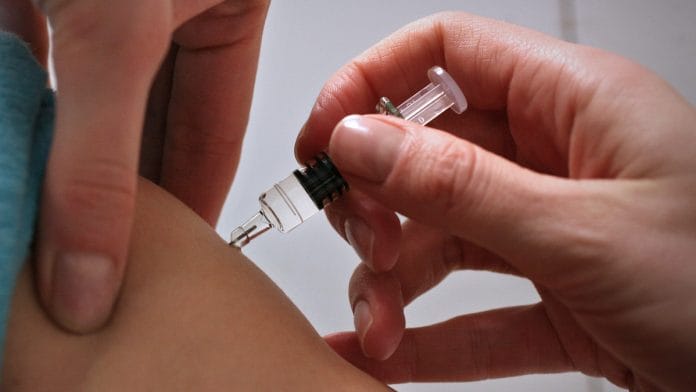

New Delhi: At a time India is seeing a rise in H1N1 cases, the flu vaccine that best matches the viruses currently circulating in the country is in short supply. The Indian Council of Medical Research (ICMR) has now said another seasonal flu vaccine, already available in India, can be used until the preferred vaccine becomes available.
The two vaccines are made for different flu seasons. The one recommended by the World Health Organisation (WHO) for the Northern Hemisphere (NH) this year has a closer match to the influenza viruses ICMR is seeing in India. The Southern Hemisphere (SH) vaccine has a different mix of flu strains, but also protects against several viruses circulating in India.
The advice comes as the H1N1 virus has become the dominant influenza strain in Delhi this year. By 20 August, Delhi had recorded 2,602 seasonal influenza cases, of which 1,777 were H1N1.
The surge has also put pressure on hospitals, with flu cases coinciding with dengue, typhoid and other seasonal illnesses.
“Since the surveillance data indicates close resemblance of the circulating influenza strains in India with the Northern Hemisphere recommendations of WHO, it would be ideal to administer the NH vaccine,” the ICMR said in its statement Wednesday.
“However, in view of non-availability of NH vaccine, the available SH vaccine may be used, and SH vaccine be replaced with NH vaccine as soon as it becomes available,” it added.
Dr Ramesh Chand Meena, associate professor of medicine at Dr Ram Manohar Lohia Hospital in New Delhi, said the shortage was also being seen at hospitals.
“There is no government supply of this vaccine in any hospital,” he told ThePrint.
The ICMR had earlier said that the virus circulating in India is A/Missouri/11/2025, which has been in circulation since 2025 and the existing NH vaccine remains effective against the currently circulating strains.
What did ICMR’s surveillance find
The recommendation is based on influenza surveillance carried out throughout the year at 73 sites across India, part of the DHR-ICMR Virus Research and Diagnostic Laboratory (VRDL) network. These sites track which flu viruses are spreading and send samples to the National Influenza Centre at ICMR’s National Institute of Virology in Pune for testing—which also functions as a WHO Collaborating Centre under the Global Influenza Surveillance and Response System (GISRS).
Since July 2025, the centre has received 73 influenza virus samples. Of these, 49 were tested in detail to understand the viruses’ genetic makeup. Of the 73 isolates overall, ICMR found 3 were Influenza A (H1N1)pdm09, 52 were Influenza A (H3N2), and 18 were Influenza B (Victoria)—meaning H3N2 accounted for the largest share of samples sequenced nationally by ICMR, even as H1N1 has driven the recent surge in Delhi specifically.
The testing showed that H1N1, H3N2 and influenza B viruses were all circulating in India. ICMR also found that all 73 samples tested for response to the antiviral drug oseltamivir were sensitive to it.
The H1N1 virus currently spreading in India is covered by both vaccines. The difference is in the other two flu viruses they protect against, H3N2 and influenza B. The NH vaccine contains versions of these two viruses that are a closer match to the strains currently being seen in India.
Flu vaccines are updated every year because the viruses keep changing. The WHO recommends a different combination of strains for the Northern and Southern Hemisphere each year, based on the viruses expected to spread during the coming flu season.
This year, ICMR found that the viruses circulating in India are a closer match to the strains included in the Northern Hemisphere vaccine. That is why it has said this vaccine would be the better choice for India.
But being in the Northern Hemisphere does not automatically mean India should always use that vaccine, said Dr Tarun Kumar, Director and Head, Medanta Moolchand Heart Centre in New Delhi.
“India is geographically in the Northern Hemisphere, but influenza circulation in India does not always follow the classic European/North American winter pattern,” he said.
Dr Raj Shankar Ghosh, senior physician and public health expert, Public Health Foundation of India (PHFI), said the ICMR recommendation was a practical response to the shortage of the preferred vaccine.
“The Southern Hemisphere vaccines work very well in India also,” he said.
Typically, both Northern and Southern Hemisphere vaccines are available and used in India.
Which flu shot to take?
For most people, the immediate question is whether they should wait for the preferred vaccine or take the one that is currently available.
Doctors say people at higher risk of severe influenza should not necessarily wait if the preferred vaccine is unavailable.
“If the recommended Northern Hemisphere vaccine is temporarily unavailable, a Southern Hemisphere vaccine may be considered rather than leaving a high-risk person unvaccinated,” Kumar said.
This includes older adults, young children, pregnant women and people with chronic illnesses or weakened immunity. Influenza is usually self-limiting in healthy people, but it can cause pneumonia, worsen existing illnesses and lead to hospitalisation for vulnerable people.
India does not currently provide annual influenza vaccination to the general population through its Universal Immunisation Programme. People who need the vaccine generally have to obtain it privately.
Traditionally, uptake has been low, with a flu shot costing around Rs 2,000-2,500 in the private market. But doctors say this has changed this year as more people have sought protection amid the H1N1 surge.
Public health expert Dr Chandrakant Lahariya said vaccine uptake had increased two to three fold this year compared with previous years.
“Production is based on estimates,” Lahariya said, explaining that manufacturers plan supplies based on expected demand.
Lahariya said GSK is among the biggest suppliers, but limited imports and delays in supply have left some distributors without stocks. He said supplies of the Southern Hemisphere vaccine were expected to reach the market by the end of this week.
However, Ghosh said the shortage should not be blamed only on the sudden increase in demand. He pointed to a combination of manufacturing timelines and what he described as global redistribution of vaccines.
He also said manufacturers were taking time to follow the required production processes for the updated seasonal vaccine.
“It is a mix of delays in production and the redistribution of vaccines, with some countries getting priority,” Ghosh said.
(Edited by Viny Mishra)
Also read: No new H1N1 strain in India, but children & elderly at higher risk, say ICMR scientists