



New Delhi: Sparked into existence by a remark from Chief Justice of India Surya Kant in May, the Cockroach Janata Party in early June began a protest at Jantar Mantar in the Capital, seeking the resignation of Union Education Minister Dharmendra Pradhan over the National Eligibility cum Entrance Test (NEET) leak and broad reforms in the public examination system. Joining the protest on 28 June, education and climate activist Sonam Wangchuk electrified the movement by beginning a fast in support of the demands. His removal from the site on 18 July, and the call for a march on Parliament on Monday, the first day of its Monsoon Session, brought matters to a head.
Here’s Monday’s Top 10 events, as they unfolded:
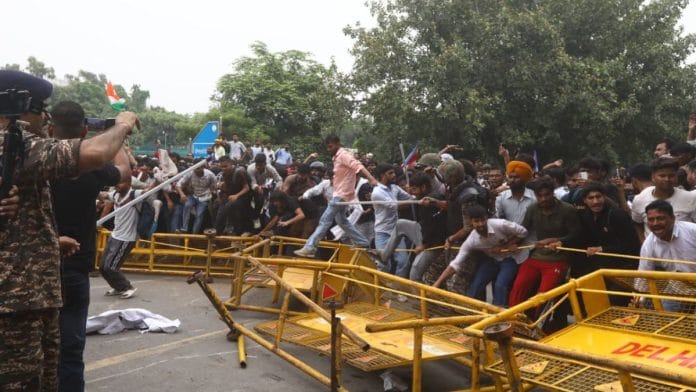
Battleground Jantar Mantar: The 18th-century monument in the heart of the capital turned into a khaki zone, with hundreds of police personnel in uniform (and civvies too), 8-foot barricades welded together, and riot-control vehicles sealing off the site amid heightened security throughout New Delhi district and the rest of the Capital. As day dawned, it was clear that the march—declared unauthorised by the police— would not be allowed. Protesters, mostly young men and women, continued to pour in through the rainy night.
Read this report by Alisha Dutta
Lathi therapy: At 7.30 am, the first of many baton-charges by security personnel began, near Park Hotel adjoining Jantar Mantar. This first charge targeted a swelling crowd that had begun to slowly churn towards Parliament. Ten minutes before the action, CJP leaders were saying that a lakh supporters had gathered, they would not leave, and that their protest would stay peaceful. After the charge, the police announced that gathering outside designated protest site was in violation of Section 163 of the Bharatiya Nagarik Suraksha Sanhita (BNSS). Protesters continued to evade the police and make their way towards Parliament, however. The Delhi Police denied use of force, saying the protest had been ‘handled professionally’.
Watch ThePrint report from Ground Zero
Dipke speaks: Less than an hour after the first lathi-charge, CJP founder Abhijeet Dipke urged followers and supporters to stay strong. “The biggest march in India’s history is about to take place. For the past 10-12 years, attempts have been made to destroy democracy in this country. By sitting at Jantar Mantar for a month, you have revived democracy. People are arriving from all over the country,” he told the crowd.
Dipke, who had begun a fast when Wangchuk was picked up on Saturday, later broke his fast, as did three other students.
Back to court: Wangchuk’s wife approached the Delhi Court again, challenging a single bench order rejecting an earlier plea to shift her husband to a private hospital. Gitanjali Angmo said Wangchuk and his family are being deprived of the right to decide on his medical treatment. She also contended that the principles of informed consent, and bodily autonomy under Article 21, are being overlooked, and that there is no order of arrest or detention. Angmo told reporters later that a “graceful govt would have allowed this protest.”
Das connects: CJP spokesperson Saurav Das said the door for talks with the government was open. “The administration is trying to open talks with the government. They have come very late, but we have opened our hearts and said that we are willing to talk to them. There has been no clarity from their side as of now. The ball is in their court.” Das would soon meet Deputy Commissioner of Police (New Delhi) Sachin Sharma after the group was informed of the government’s willingness to hold a dialogue.
“Ashutosh Ranka and I, on behalf of the Cockroach Janta Party are on our way to meet J.P. Nadda. The government had reached out for talks in the morning. Our demands are clear. The youth has gathered in huge number. We Shall win! (sic),” Das wrote on X.
Spillover: With protesters continuing to stream in, the protest spilled over beyond Jantar Mantar. The police parked vehicles across key roads to prevent movement towards Parliament; security was beefed up at Parliament House too with the gates to the complex being closed. Warnings were issued constantly over loudspeakers even as video footage was recorded from atop practically every police vehicle. By mid-afternoon, protesters had reached the Raisina Road roundabout and Constitution Club where the police used teargas to stop them. Patel Chowk metro station saw one of the heaviest lathi-charges.
Read this report by Ananya Bhardwaj and Mayank Kumar
Watch ThePrint report from Ground Zero
Sonam’s list: Even as doctors at Safdarjung Hospital issued an ‘all-good’ health bulletin on Sonam Wangchuk at 10 am, a letter from the activist detailing conditions for breaking his fast began doing the rounds. Mainly, Wangchuk said he seeks accountability from the government.
Another handwritten letter appeared a little later, seeking permission to join the march.
Read this report from Samridhi Tewari
Monsoon Session: The first day of Parliament’s Monsoon session saw repeated adjournments as the Opposition staged protests in both the Rajya Sabha and Lok Sabha demanding a discussion on several issues, including the NEET paper leaks, Ram Mandir donation theft and the ongoing protest at Jantar Mantar. In the Lok Sabha, Opposition MPs started raising slogans soon after the obituary references, demanding discussions on alleged irregularities in the NEET examination and Ayodhya’s Shri Ram Janmabhoomi Teerth Kshetra Trust donation row. In the Rajya Sabha, Leader of Opposition Mallikarjun Kharge accused the government of using force on students protesting against the alleged NEET paper leak at Jantar Mantar.
Read this report from Udit Bubna and Neelam Pandey
Metro Flooded: Early in the day, the Delhi Metro Rail Corporation said that Janpath, Rajiv Chowk, Patel Chowk, Central Secretariat and Seva Teerth metro stations were closed till further instructions. Later, it was announced that interchange facilities and gates were open at Rajiv Chowk and Central Secretariat metro stations.
By early afternoon, protesters has gathered in the Rajiv Chowk Metro Station, a major interchange venue. Samajwadi Party MP Dimple Yadav led a march of party MPs to Jantar Mantar from Parliament. “The situation across the country is such that the youth want to voice their concerns, yet the government refuses to listen or engage in dialogue. Students have repeatedly stated this, and Sonam Wangchuk has also urged the government to open a dialogue. However, the government is so rigid and callous that it refuses to heed anyone else’s views,” she said.
Talks begin: By early afternoon, CJP leaders Saurav Das and Ashutosh Ranka had reached the residence of Union Health Minister J.P. Nadda to begin dialogue with the government. Their list of ministers suitable for the purpose was not accepted, and they had to wait two hours before Nadda gave them an audience.
In the meantime, Union Home Minister Amit Shah was reported by PTI to have met Education Minister Dharmendra Pradhan in the Parliament premises.
The CJP demands include Pradhan’s resignation, compensation to families of NEET examinees who committed suicide, and Sonam Wangchuk’s release from hospital.
Read this report by Samridhi Tewari
(Edited by Nardeep Singh Dahiya)
Also Read: Protesters narrate horror stories of broken bones, bruises & being ‘trapped’ in tear gas chambers