



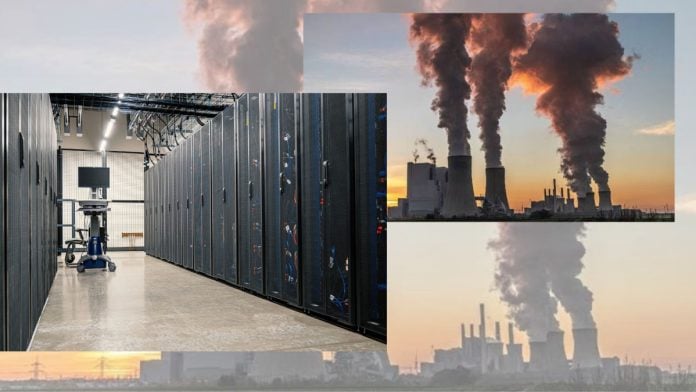
New Delhi: India’s AI push is primarily geared towards setting up data centres, with the government saying it will prioritise green sources to power their energy-intensive infrastructure. But is India’s energy framework ready to sustainably service the country’s data centre ambitions? An analysis of India’s energy policy, and the steps taken by AI pioneers, highlights the need for a deep shift to stave off the potential environmental consequences of unregulated data centre development. At stake is India’s ambitious target to go net zero by 2070.
Data centres, the nerve centres of AI applications, are massive physical facilities built to house the infrastructure that powers the technology. With AI being trained to perform increasingly complex tasks and the use of these applications growing at an intense pace, the energy demands of data centres are soaring. According to the International Energy Agency (IEA), electricity consumption from data centres is currently estimated at around 415 terawatt hours (TWh), or about 1.5 per cent of the global electricity consumption in 2024. The energy consumption, the IEA states, has grown at a rate of 12 per cent per year over the last five years.
India currently has approximately 150 operational data centres, with an equivalent number estimated to be in planning. Energy insights platform RE24 pegged India’s data centre electricity consumption at approximately 13 TWh in 2024, accounting for about 0.8 per cent of national demand.
The pursuit of AI advancements, however, comes as countries around the world face critical sustainability challenges and targets in their quest to stave off some of the worst impacts of a warming world. With coal currently accounting for 70 per cent of India’s power generation, India has its task cut out to balance technological and economic progress with environmental goals.
Also Read: Indian states are in a race for power grid dominance. The prize: data centre expansion
Push for growth
India has been making a big push to boost its heft in the data centre space. This monsoon session of Parliament, for example, saw the passage of amendments in India’s taxation framework to simplify investment in the sector. Industry players seem to be excited about it too. In a report released this May, commercial real estate major CBRE India estimated that leading industry players had committed ~USD 178 billion in Q1 2026 alone (“expected to be deployed in the coming years”), and emphasised the role played by India’s “supportive policy framework” in “encouraging the development of secure, energy-efficient campuses”.
However, for all the enthusiasm surrounding them, AI data centres court more than a little scepticism and disdain given their environmental costs. Not only are AI data centres energy intensive, their cooling requirements make them water guzzlers of a troublesome scale.
Compared to the AI data centres of yore that stored emails and streamed videos, those for generative AI mark a massive step-up in power consumption. An average traditional cloud rack draws 5 to 10 kilowatts (kW) of power, whereas its AI counterpart can draw up to 120+ kW.
A June report by the United Nations University (UNU) Institute for Water, Environment and Health painted a grim picture about the costs of data centres: “By 2030, the global data centres powering artificial intelligence are projected to consume 945 terawatt-hours of electricity. This is nearly triple the combined annual electricity use of Pakistan, Bangladesh, and Nigeria—countries collectively home to more than 650 million people. Their associated water footprint will equal the basic annual domestic water needs of all 1.3 billion people in Sub-Saharan Africa, and their land footprint will exceed 14,500 square kilometers, roughly twice the Jakarta metropolitan area, home to more than 32 million people.”
There’s more than one precedent globally where the development of data centres without a precise roadmap for its consequences has triggered protests.
In Dublin, the “Silicon Valley of Europe”, AI data centres “accounted for 21 per cent of total metered electricity in 2023, exceeding all urban households”, the UNU report noted. This caused electricity prices to soar for consumers. A June report in ABC News, quoting research from environmental organisations Friends of The Earth and Beyond Fossil Fuels, said “the average Irish household might have paid an estimated 360 euros ($589, approx. INR 39,000) in additional electricity costs between 2015 and 2023 due to the ‘intensity of data centre presence’ on Ireland’s Single Electricity Market grid”.
Amid local protests, the “national grid operator… paused new approvals around Dublin until 2028”, the UNU report said, adding that this makes “Ireland a concrete, documented example of what happens when AI infrastructure growth outpaces energy planning — and a preview of what other countries are heading toward”.
The UNU report cited other cautionary tales too. “In Querétaro, Mexico, expanding compute infrastructure is drawing on water supplies amid prolonged droughts. In Uruguay, plans for a water-intensive data centre coincided with a 2023 drought that depleted Montevideo’s freshwater reserves, making tap water unsafe to drink,” it added.
Similar stories have emerged from the US’ Northern Virginia, the world’s largest hub of data centres. US-based think tank Roosevelt Institute noted in a July report how data centres seemed to be reversing local environmental gains. “One would initially think that Virginia was the ideal geographic home for data centres because it is comparatively decarbonised, with a nontrivial share of electricity coming from nuclear power,” it said. “However, due to the sharp increases in demand for energy spurred by data centre development, Virginia is importing energy from more carbon-intensive states like West Virginia and has delayed the decommissioning of dirtier power plants.”
Making them sustainable
Their environmental costs notwithstanding, data centres are the power backbones of AI services like Google’s Gemini and Microsoft Copilot, and are thus here to stay. Balancing the costs of AI with its market potential requires policy that arranges lots of energy and helps set up dedicated high-voltage infrastructure in a sustainable manner, and provides for advanced cooling solutions that don’t drain local resources.
The US and China, the two major pioneers of AI, are among the countries taking steps to build a sustainable framework for the growth of data centres. The United States has a market-driven model where tech giants are using the strength of their corporate capital. They have signed direct power purchase agreements with legacy nuclear plants and are funding startups pushing small modular reactors (SMR), small nuclear reactors that can generate up to a third of a conventional plant’s output.
China, with its state-supported model, has the ‘East Data West Computing’ initiative, under which Beijing is shifting heavy compute for data from the advanced eastern regions to the cooler western regions, which are also the hub of renewable energy infrastructure being set up to meet the country’s carbon-reduction goals. On the eastern side, meanwhile, China is setting up energy storage infrastructure like the commercial ACP100 Linglong One SMR and Datang’s Qianjiang sodium-ion battery storage plant.
Among other examples, Singapore, a hot and humid country like India, this year launched the world’s first standard to outline more sustainable and efficient cooling solutions for data centres in tropical climates.
Also Read: Water backlash is hitting India’s data centre boom. Learn from paper mills and the Dutch
The energy situation
Data centres in India are primarily located in Mumbai, Navi Mumbai, Chennai, Hyderabad, Bengaluru, Delhi-NCR, and Jamnagar. According to government estimates released in August, the installed capacity of data centres—the resources they need to power their infrastructure—in India has grown from 375 MW in 2020 to about 1,575 MW.
The Central Electricity Authority (CEA) and the Union Ministry of Power (MoP) estimate that the power demand of data centres will be about 17 GW by 2031-32.
The Ministry of Power has stated that the country will support this growth with cheap and abundant green energy, but it seems like a tall order at present. India has some of the world’s lowest solar generation tariffs and vast potential for this energy. However, solar energy stops at sundown and AI data centres demand a 99.9995% uptime for top-tier reliability certification. The CEA estimates that India will have 41.6 GW/208 GWh of Battery Energy Storage Systems (BESS) capacity—BESS helps store power for later use—by 2030 but it will at best add 5-6 hours of peak support.
Now, considering the price of BYD Chess Plus, which is one of the cheaper BESSes, at around $80/kWh, a conservative estimate of $17 billion would be required for the hardware alone. The main Viability Gap Funding (VGF) scheme that would fund the projected battery storage has a planned budget of ~$0.56 billion (₹5,400 Crore) to support an amount of $6.8 billion (the scheme promises financial support of up to 40 per cent of capital costs, as promised in the scheme. So, the main source of energy is likely to remain coal for now. As things stand, India might also have to rely on high-speed diesel (HSD) backup to guarantee continuous 24/7 power.
Among other sources of energy to build a clean power ecosystem, India is also pushing nuclear energy. Last year, India passed the landmark Sustainable Harnessing and Advancement of Nuclear Energy for Transforming India (SHANTI) Act, which attempts to remove legacy state monopolies and civil liability bottlenecks. The legislation also clears the legal path for up to 49 per cent private co-investment, and enables future deployment of SMRs and micro nuclear reactors.
Meanwhile, India is also upgrading its grids. AI data centres cannot draw power from standard municipal utility distribution lines (33 kV) or directly from the national grid (765 kV). They need off-ramps to 220 kV or 400 kV, and that would need dedicated high-voltage infrastructure.
In 2026, the CEA reported 100 per cent target achievement for 220 kV substations. This progress is driven entirely by state transmission utilities, led by Karnataka and Uttar Pradesh. The development of the 400 kV substations, on the other hand, is completely private sector-driven and currently faces an approximately 60 per cent execution lag against official targets.
Beyond energy
Apart from the energy needs, however, India also needs to manoeuvre its requirements to build data centres around a surge in global demand for transformer components like copper, silicon, steel, and battery minerals through KABIL, India’s flagship vehicle for mineral diplomacy.
Then there is the question of the facilities’ immense water needs for cooling. Recently, Singapore legally mandated a PUE (power usage effectiveness) of 1.3, which in plain language means that no more than 30 per cent of the energy spent on compute may be spent on cooling, which essentially mandates investment in energy-efficient infrastructure by law. In India, the Ministry of Electronics and Information Technology (MeitY) has introduced a PUE benchmark of 1.35, but it is not a legally mandated limit.
In traditional data centres, evaporative cooling towers consume millions of litres of water daily, which is not an acceptable scenario for a water-stressed country like India. As a result, operators are turning towards next-generation direct-to-chip and closed-loop liquid cooling. But since they increase net costs by hiking baseline energy demand and upfront infrastructure costs, the scale of their uptake remains to be seen.
Edited by Sunanda Ranjan
Also Read: One AI data centre generates more heat than 2 lakh households, US university study finds