








In the summer of 1592, just outside London, a group of local farmers crept through the marshlands with lanterns, iron crowbars, and heavy axes. Their target was a water-guzzling monstrosity: a recently built multi-storey industrial mill that was drying up their fields. The farmers didn’t understand the fuss around the printing press. It wasn’t the machine putting food on their tables, and they were angry. The paper mill was eventually burned, and the fury of farmers continued to grow for decades as water was spilled, diverted, and wasted. Nearly a century later, the Dutch introduced a new secret weapon: the Hollander Beater. It slashed paper production costs, saved water, and made the Netherlands a global leader in paper production.
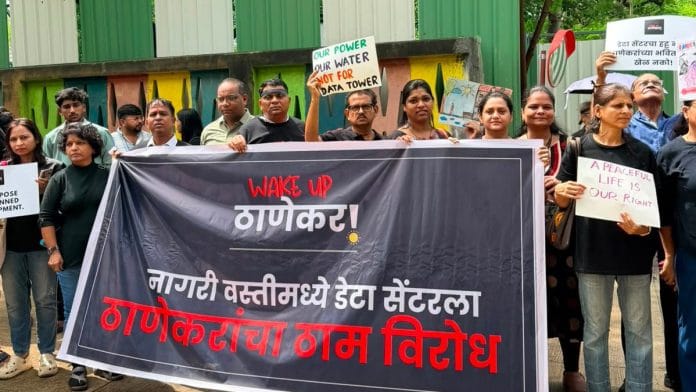
On another hot day in July 2026, hundreds of local residents in Thane, Maharashtra, formed a human chain outside a proposed data centre in the Balkum neighbourhood. Anxious that the facility could consume 12 million litres of water a day, citizens gave speeches, chanted slogans, and pressed the local municipality to intervene. While Amazon claimed its Thane facility would not use water for cooling, the project is now under state-level review following residents’ objections.
Whether it is the printing press or the AI surge, technological breakthroughs come at a massive infrastructure cost—one that is often borne by the most vulnerable. What can we learn from past technological booms? How do we prepare better so that more paper mills aren’t burned? Or is public backlash an inevitable tax on progress? We argue that India can turn the data centre boom into an opportunity to build water-efficient technology.
Also Read: Indian states are in a race for power grid dominance. The prize: data centre expansion
A new digital backbone
The AI revolution marks the largest infrastructure boom in human history, with total global investment in physical infrastructure expected to reach around $1 trillion annually. But data centres don’t just gobble financial resources; they guzzle water and power unlike almost any other commercial facilities. A single 100-megawatt facility can consume approximately two million litres of water per day for cooling. Even a 1-megawatt draw can lose around 18,400 gallons daily to evaporation and blowdown alone.
As data centre bans emerge in parts of the US and East Asia, it is inevitable that businesses will shift their footprint to developing economies. Early signals of this boom are already evident. For instance, after Singapore imposed a moratorium on new data centres until 2022, Malaysia saw a surge in investment, especially in Johor. The region now has 65 data-centre projects, of which 20 are operational. Johor’s planned data centres could require around 440 million litres of water a day. For Selangor’s 52 data centres (of which 39 are operational), it’s about 79 million litres, or roughly 30 Olympic-sized pools.
In India, Maharashtra and Andhra Pradesh have seen a similar surge. In Navi Mumbai, a 100 MW data centre can use water equivalent to the daily needs of 15,000 people. In South Africa’s Cape Town, which nearly ran out of water during the 2018 drought, a proposed hyperscale hub was alleged to require 12 million litres of water a day, enough for more than 10,000 households.
But as the world’s digital backbone shifts to emerging economies, it is in the direct economic interest of countries like India to pioneer sustainable solutions—just as the Dutch turned their resource crisis into a competitive advantage.
Solutions already exist. Liquid cooling technologies and direct-to-chip systems have been tested and shown to cut water consumption. But they remain economically unviable for many operators. Why would a business retrofit a facility with liquid-cooling chips if municipal water remains cheap? For businesses and shareholders, the financial decision is intuitive; but for communities and governments, the true cost of water is far more personal.
The Dutch masterclass lay in thinking far beyond simple resource conservation. Unlike France, Germany, or the UK, the Netherlands lacked fast-flowing rivers to power heavy, water-driven timber hammers. Instead of forcing a vertical pounding mechanism onto flat terrain, they engineered a continuous shearing machine powered by windmills—a hardware leap tailor-made for their geography that processed pulp in a fraction of the time.
It wasn’t just the machine, either. Even before the Hollander Beater was invented, the Dutch Republic designed patent protections (octrooien) to shield innovators and de-risk early hardware. The government ensured businesses had a captive, time-limited monopoly for 5 to 12 years to recoup their heavy capital investments, paired with state-backed public procurement contracts for local infrastructure. By creating guaranteed domestic demand and funding deeper hardware thinking, the Netherlands acted less like a rigid government and more like an industrial venture fund.
Also Read: Sam Altman totally gets it. Data centres are the new public enemy no. 1
India should go Dutch
Today, if India wants to capture economic value from the AI race, state governments must build a policy ecosystem focused on material and hardware efficiency. They must create the market case for liquid cooling. A state should use its purchasing power to act as an anchor market—much like the Dutch Republic did for its millwrights.
Under national initiatives such as the IndiaAI Mission, public GPU tenders and state-subsidised data centre parks should require closed-loop liquid cooling as a condition for land and power concessions. When the government guarantees that public compute contracts will only flow to zero-water facilities, it de-risks the supply chain and forces local manufacturers to scale green hardware domestically.
Where local manufacturing lags, we should flip the problem and play to our structural strengths by fast-tracking greywater recycling—as Telangana and São Paulo are now pioneering. Today, states like Telangana recycle less than 5 per cent of their wastewater. The influx of data centres offers a financial anchor to build municipal recycling pipelines.
Finally, states should adopt the 17th-century Dutch “venture state” approach by making innovators feel safe to build high-risk hardware locally. Rather than subsidising routine operations, state governments should offer matching equity grants for domestic thermal and microfluidics startups, paired with 10-year exclusive public procurement guarantees for zero-potable-water cooling technologies. When the state de-risks the domestic market and fiercely protects local IP, talented engineers stay home to build hardware tailored to local climate constraints.
It took decades after the printing press expanded before the Hollander Beater was invented. A lot of water was spilled, and a significant economic opportunity was lost. We cannot wait decades for AI hardware to adapt. Rather than halting innovation, governments have an opportunity to bring all hands on deck and turn resource constraints into lasting economic opportunities.
Rwitwika Bhattacharya is the CEO of Swaniti – Meridian Initiative. Kiran Kumar Reddy is a Member of Parliament from Telangana. Views are personal.
(Edited by Asavari Singh)