



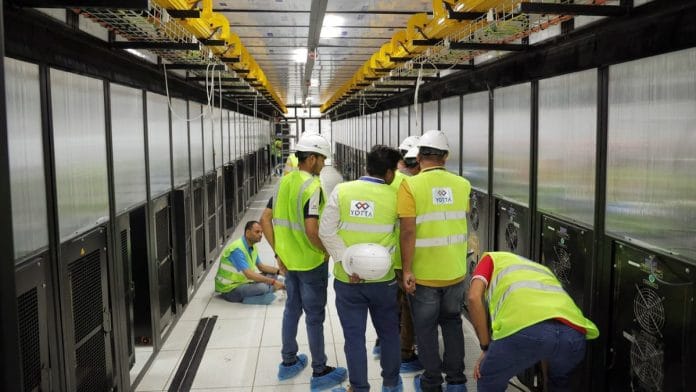
Hyderabad/Bangalore: India’s data centre boom is currently facing a massive paradox. The country hosts a fifth of the world’s digital data, and more companies are calling, but it lacks sufficient power to run this artificial intelligence (AI) ecosystem.
With more than 250 data centres expected to be in the pipeline in the next four years, they will demand a staggering 26.3 GW of power by 2032, triggering a fierce tussle between states for power grid dominance. Power, therefore, will be the biggest value driver, said a report by real estate research and consultancy firm Square Yards.
“Availability of reliable power is rewriting real estate dynamics. Power access has officially become a primary value driver, with digital clusters actively competing for electricity access rather than traditional location-based office demand,” it added.
Andhra Pradesh, Maharashtra, Tamil Nadu, Telangana, and Uttar Pradesh currently lead in terms of data centre deployment.
Power sector experts told ThePrint that the challenge ahead is urgent: rapidly rewrite zoning laws, decentralise energy networks, and build massive power corridors, or risk being completely left in the dark by global tech investors.
In line with this colossal power requirement, states gearing up to host these data centres are investing in power generation. For instance, data made available by the Andhra Pradesh Industrial and Infrastructure Corporation shows that Adani group’s pumped storage projects are expected to generate 1,500 MW, and Ecoren Energy India Ltd is setting up solar and wind energy power plants in the state to generate another 1,700 MW.
Heavy power concentration is emerging in other states as well, with Maharashtra leading the charge.
By 2030, additional power generation capability emerging across specific pipelines is expected to look like this: Maharashtra (2,000 MW), Tamil Nadu (700 MW), Uttar Pradesh (300–900 MW), and Telangana (600 MW).
Also Read: House panel led by BJP’s Dubey red-flags data centre tax holiday, warns of power & water strain
How states must gear up
Based on Square Yards’ findings, the traditional race to offer cheap land or tax breaks is officially over. In this new digital gold rush, institutional capital is flowing exclusively to states that can guarantee uninterrupted, high-voltage utility lines.
To successfully absorb the upcoming 26.3 GW load without fracturing local grids, the report suggests a three-pronged preparation strategy.
First, states must transition from an “employment-led” to a “utility-first” infrastructure approach. It suggests urban planners create dedicated infrastructure buffer zones, and that fast-track high-voltage substations be directly tied to data centre clusters.
Second, it says state planning boards must change land laws to allow industrial liquid cooling systems, essential for high-density AI workloads, to ensure the surrounding environment does not heat up.
Its third suggestion corresponds to decentralising the power grid to peripheral corridors. Because power availability drives land value, states should steer development away from congested Tier-1 city centers and toward peripheral growth corridors or Tier-2 edge nodes (for instance, Visakhapatnam, Jamnagar, or specialised industrial zones) where large-scale power infrastructure can be built out more efficiently.
What states are doing
According to the Maharashtra Industrial Development Corporation (MIDC), the state has introduced several policy measures to support its green data centre ambition, including developing Green Integrated Data Centre Parks and amendments to its IT and ITES Policy (2023). These data centre parks will focus on eco-friendly building practices, energy-efficient infrastructure, and prioritising renewable energy sources for power consumption.
If Mumbai in Maharashtra accounts for more than half of all data centres in the country (53 percent), the Square Yards report indicates that Karnataka, particularly Bengaluru, accounts for about 6 percent. Chennai and Hyderabad account for 16 percent and 10 percent respectively, while Delhi-NCR (Noida) and Pune account for 7 percent each.
The report said Karnataka, which is home to some of India’s largest IT companies and startups, will need to more than double its power output to deal with the estimated influx of data centre investments effectively.
Karnataka also has a state-owned data centre with a capacity of 1 MW, which it plans to expand to 2.5 MW with new infrastructure in the next few years. “We have to go to 5 MW eventually, but in the meantime we are increasing it to 2.5 MW from the existing 1 MW,” a senior Karnataka government official told ThePrint, requesting anonymity.
In July, the C-DAC (Centre for Development of Advanced Computing) made a presentation before Karnataka Chief Minister D.K. Shivakumar, proposing to increase the state’s data centre capabilities.
On its part, the state government plans to formulate a data centre policy by the end of the year. Existing proposals entail setting up data centre infrastructure in Bengaluru, Mangaluru and Mysuru, among other regions of the state, which will require more power generation.
In Bengaluru, for instance, the state government has proposed that data centres use treated water for cooling towers in order to manage expectations of a city that, ever so frequently, grapples with drinking water shortages. The official said that from the 35 GW that Karnataka currently produces, the state aims to double this to 60 GW by 2030.
“We need to more than double our transmission capacity. We have to also transfer power generated from wind and solar from the hinterland, Haveri, Gadag and other places to Bengaluru, where these centres are proposed and where most of it is consumed,” said the government official.
Karnataka is also among the handful of states increasing their reliance on renewable energy by harnessing advantages like heavy winds and round-the-year sunlight. Excessive heat and water shortages add to the challenges of agriculture, giving an opportunity for installation of solar farms like in Tumakuru’s Pavagada, one of the biggest in Asia.
The push for renewable energy also adds to the sustainability of these investments and infrastructure, which have witnessed stiff resistance from sections of the population.
Also Read: Data centres are not remote and far away. In the US, 97% of them are in metros
MSMEs, ‘drain on resources’
On 6 August, the central government informed Parliament that AI data centres do not require a separate clearance under the 2006 Environmental Impact Assessment (EIA) notification, that data centre operations in India are governed under other existing laws, and that the Centre was ensuring “appropriate environmental safeguards” were followed.
“Artificial Intelligence (AI) Data Centres do not, per se, require Environmental Clearance (EC) under the Environmental Impact Assessment (EIA) Notification, 2006, as amended,” its response read.
In its reply, Union Ministry of Environment, Forests and Climate Change added that prior environmental clearance will be required for AI data centres if they are proposed as a part of a building and construction project, with a built-up area over 20,000 sq m, or a township and development project covering 50 hectares or more, or if it has a built-up area of 1,50,000 sq m or more.
Power sector experts, however, cautioned that if states fail to proactively plan power networks specifically for these heavy compute clusters, the sheer intensity of data centre workloads risks destabilising regional grids, creating severe resource competition between industrial infrastructure and local citizens.
Venugopal Rao, convenor of the Hyderabad-based Centre for Power Studies, said states should clearly demarcate power resources for data centres and consumers separately.
“We must not forget that our MSMEs, the real backbone of our industrial ecosystem, should get the required power. With people from the EWS and the big boys of technology being guarded by state welfare schemes and incentives, policymakers must ensure that stable power supply is allowed to MSMEs and the working-class population in the country. With the massive secondary ecosystem—residential townships, logistics hubs, and commercial spillovers also coming up in various cities, careful intervention is required by states,” he said.
With Andhra Pradesh offering extensive financial and power sector incentives to Google for its proposed data centre in Visakhapatnam, many former civil servants have written to the state regarding the systemic problems that could arise in the absence of a clear power generation roadmap. Dr E.A.S. Sarma, a retired Indian Administrative Service (IAS) officer and former Union Secretary for Power and Finance, widely known for his public advocacy on transparency, environmental protection, and governance, cautioned states like Andhra Pradesh to be wary of the rise in public expenditure to add transmission lines.
In his letter to the Andhra Pradesh Chief Minister N. Chandrababu Naidu, of which ThePrint has a copy, he pointed out that the state power utility, AP Transmission Company (APTRANSCO), is taking up dedicated construction of transmission networks and substations specifically to feed the data centre. “Under GO Ms No. 40 (dated October 2025), the state government granted a power discount of Rs 1 per unit to the Google data centre for a period of 15 years. The total financial incentive is capped at a massive Rs 4,800 crore, which effectively drains public and state resources,” he wrote.
Stating that the localised grid infrastructure is estimated to cost thousands of crores, he asked the government whether citizens would eventually be asked to bear the cost of such a high capital cost.
Deloitte, one of the ‘Big Four’ consulting firms, also called for collective action for India to scale its AI-powered infrastructure in a clean, reliable way. In its report, ‘Powering Asia Pacific’s data centre boom’, it referred to India’s electricity requirement as a “national infrastructure priority”. Refraining from classifying it as just a sectoral issue, it called for collaboration across central and state governments, grid operators, power generators, data centre operators, and institutional investors—the entire investment ecosystem. “If harnessed correctly, this moment can ensure India does not merely participate in the AI revolution but powers it sustainably,” added the report, released in February.
(Edited by Amrtansh Arora)