



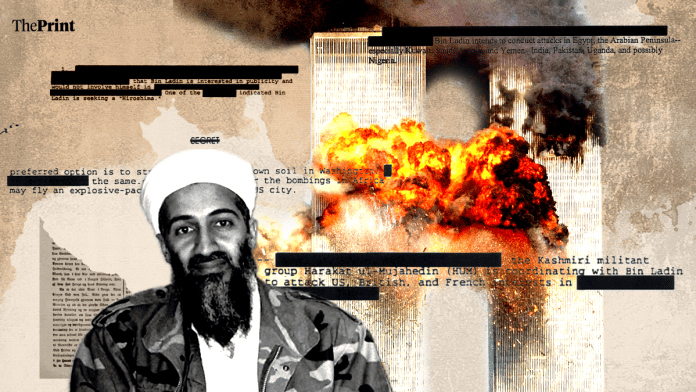

New Delhi: On the 25th anniversary of 9/11, the US Central Intelligence Agency (CIA) released 71 declassified Presidential Daily Briefs (PDBs), which ThePrint has reviewed, offering a glimpse into what American leaders were told about Osama bin Laden and the al-Qaeda in the years prior to the September 2001 attacks.
CIA Director John Ratcliffe proclaimed the release as “an act of exceptional transparency”. While nearly all pages contain redacted bits to protect intelligence sources, these files are the most consequential since The 9/11 Commission Report, published in July 2004.
The first file harkens back to 13 February 1998 with the last one dated 12 September, 2001—the day after the attacks that killed 2,977 people and injured many thousands.
The last briefing is also the longest, running four pages. It says, “Sunni extremists in Afghanistan and the Persian Gulf” were “aware” of an imminent operation, and that the “White House” and the “Capitol” may have been among the targets. The PDBs span the administrations of both President Bill Clinton and George W. Bush.
What US knew about bin Laden plans
A PDB dated 10 September 1998, three years before 9/11, said bin Laden’s preferred option was to strike the US “on its own soil in Washington” and the group responsible for bombings in Africa “may fly an explosive-packed airplane into a US city”.
A few months earlier, another brief said that bin Laden “places high priority” on conducting attacks in the US.
A month before 9/11, President Bush received one of the most crucial briefs, dated 6 August 2001, and headlined “Bin Ladin Determined To Strike in US”. It said bin Laden prepares operations “years in advance” and is “not deterred by setbacks”.
The same brief noted FBI information pointing to preparations for “hijackings” and recent surveillance of federal buildings in New York. And that, the FBI was conducting roughly “70 full-field investigations” nationwide it considered bin Laden-related.
Across these 9/11 briefs, countries like India, Pakistan, Yemen, Saudi Arabia, Kuwait, Egypt, Jordan, Bangladesh, Kyrgyzstan, Uzbekistan, Uganda, and Nigeria feature as locations where bin Laden intended to launch operations, alongside North America and Europe regions, where he sought to target American interests.
Osama bin Laden’s quest for WMDs
The first file itself details that bin Laden and his followers were interested in procuring chemical, biological, and nuclear substances from open markets. “Bin Ladin has legitimate companies, business relationships, and a financial empire that could assist his pursuit of a chemical, biological, radiological, and nuclear capability.”
A July 1998 file says bin Laden is seeking a “Hiroshima”. And that, he and his followers had allegedly tried developing cyanide gas bombs before 1995 to target US military installations in Saudi Arabia.
By May 1999, intelligence indicated bin Laden was acquiring uranium and plutonium, and his network possessed radioactive material that could be used to make a “dirty bomb”.
According to a June 1999 PDB, bin Laden operatives had experimented with adding radioactive materials to explosives to “increase their energy output”. Such recipes were being shared with other extremists via the Internet, read another document.
Another file cites a news report on Osama bin Laden having established unconventional weapons laboratories near Afghanistan’s Khost and Jalalabad. But a February 2001 assessment called the prospect of bin Laden’s organisation designing or testing an actual nuclear device the “least probable scenario”.
Alongside these efforts, bin Laden was also profiteering from narcotics trafficking, substantially investing in Taliban-linked narcotics laboratories. Intelligence also suggested he might have commissioned narcotics traffickers to move explosives. One brief states that bin Laden was using secret and commercial networks to smuggle narcotics to Central Asia, Russia, Europe, the Far East and possibly the US.
Taliban and Osama bin Laden clash?
Several 9/11 briefs shed light on the Taliban-bin Laden equation, most noting that the Taliban were reluctant to hand over bin Laden despite the diplomatic costs of sheltering him and requests from countries like Pakistan, Saudi Arabia and the United Arab Emirates (UAE).
One brief notes that Taliban leader Mullah Omar had executed a commander and some of his senior lieutenants in March 2000 because they opposed the Taliban’s policy of providing sanctuary to bin Laden. Another PDB suggests the Taliban’s restrictions on the movement of bin Laden’s followers had not curtailed his terrorist planning.
However, by August 2000, a brief noted that Omar increasingly viewed bin Laden and his organisation as becoming “too radical” and a “liability”, but still opposed expelling him, fearing it would diminish his own stature in the Islamic world. Bin Laden’s influence over foreign militants, some of whom fought for the Taliban, along with the cash and materiel he provided, also meant Omar needed his resources to fight against the Northern Alliance.
A March 2001 brief conducted a hypothetical assessment on what a Taliban crackdown against bin Laden would mean. If bin Laden were to be expelled from Afghanistan without any other Taliban interference, then al-Qaeda could still conduct much of its planning.
But if al-Qaeda lost Afghanistan as a base, then much of its membership would scatter – some relocating to areas where other senior figures resided, others joining the mujahidin fighting in Chechnya or seek asylum in the West, leaving bin Laden’s network struggling to coordinate across disparate centres and build new logistical channels, thus limiting its reach.
The final PDB noted that bin Laden had left Kandahar for Kabul to avoid conflict with Omar, and that both of them had clashed the previous month over bin Laden’s decision to mount a terror attack on the US.
The newly declassified material shows intelligence agencies had many pieces of the puzzle of the al-Qaeda threat, but did not have a coherent picture.
A bipartisan commission investigating the 9/11 had flagged a lack of information-sharing among agencies, such as the CIA and the FBI, leading to the creation of the Office of the Director of National Intelligence and the National Counterterrorism Center.
Apart from the PDBs, the US National Archives released a set of records, including interviews with national security officials in the Clinton and Bush administrations, which were produced as part of the 9/11 Commission that investigated the attacks from 2002 to 2004.
(Edited by Ajeet Tiwari)
Also read: The last ordinary news day before 9/11