



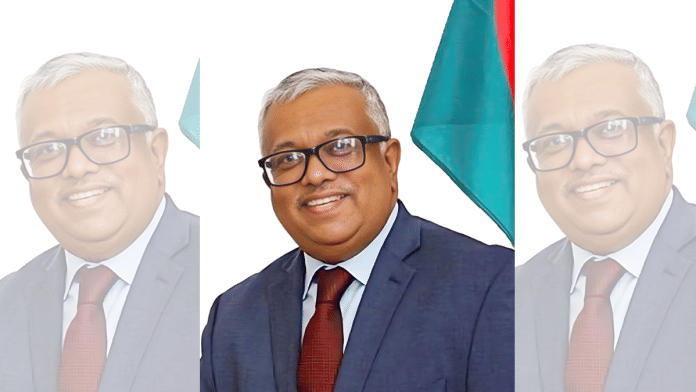
New Delhi: India has not yet given its agrément or approval to Bangladesh for the appointment of Asad Alam Siam as Dhaka’s next High Commissioner at New Delhi, ThePrint has learnt. The process to appoint new High Commissioners and Ambassadors by Dhaka for various foreign postings began in July.
It has been over a month since Dhaka sought New Delhi’s approval of Siam as its next High Commissioner. Without India’s agrément, the formal public announcement of Siam cannot happen.
Incumbent Bangladesh High Commissioner to India M. Riaz Hamidullah is expected to take up his new posting as the Permanent Representative of Bangladesh to the United Nations in Geneva around mid-October.
With India holding up the agrément, Dhaka cannot appoint a new High Commissioner to New Delhi. Article 4 of the Vienna Convention on Diplomatic Relations is clear that “the sending State must make certain that the agrément of the receiving State has been given for the person it proposes to accredit as head of the mission to that State”.
The receiving state, in this case India, is also not obliged by the Vienna Convention to state its reasons for the rejection of a person that the sending country wishes to send. This process is kept private, as it does not create a public incident, in the event that a diplomatic appointment is rejected by the receiving country.
Siam is the current Foreign Secretary of Bangladesh, and is one of the senior most career diplomats in the Ministry of Foreign Affairs. He was appointed to his current post by the interim government led by Chief Adviser Muhammad Yunus last year. Before becoming the Foreign Secretary, Siam served as Bangladesh’s Ambassador to the US.
The hold-up in the process of approving Siam’s posting comes as ties between India and Bangladesh continue to remain cold. The visit of Bangladesh Prime Minister Tarique Rahman to New Delhi was cancelled at the last minute in August.
The Bangladeshi Prime Minister did not attend the BRICS Leaders’ Summit in New Delhi over the weekend despite being invited as the Chair of the Bay of Bengal Initiative for Multi-Sectoral Technical and Economic Cooperation (BIMSTEC), as a part of India’s outreach to regional organisations.
Dhaka sent no representative. Hamidullah, in his current role as High Commissioner to India, did not attend the summit either.
Despite political tensions, New Delhi and Dhaka have continued to engage various mechanisms in an attempt to keep ties moving forward. Last week, the two-day Inter-Governmental Railway Meeting (IGRM) was held in Dhaka. The IGRM consists of rail authorities and representatives of respective ministries from both countries to discuss cross-border train operations.
Different expert groups and technical mechanisms have been reengaged by both sides in the last seven months, since Rahman assumed power in Dhaka. However, the political chill continues to impact the overall state of ties.
India extended two invitations to Rahman in the last month, one for a state visit and the other to represent BIMSTEC at the BRICS Summit. In both cases, the visits did not happen.
The state visit was complicated due to a press briefing made by former prime minister Sheikh Hasina on 5 August. She was ousted from power in August 2024 and fled to New Delhi, where she remains.
Both countries have looked at ways to engage diplomatically to allow space for discussions. India appointed Dinesh Trivedi, a politician and a former Union Minister as its High Commissioner to Bangladesh earlier this year. Trivedi assumed his post at the end of June.
His post was upgraded to that of a Cabinet Rank within the Indian system, to highlight the seriousness with which New Delhi is approaching its ties with Dhaka. The relationship between the two neighbouring countries cratered following the ouster of Hasina.
Nobel Laureate Muhammad Yunus led Bangladesh from August 2024 till February 2026. During his tenure, ties went through a difficult phase, as Dhaka looked to pivot its relationship towards China and Pakistan.
Under Rahman, ties had seen positive momentum, which has since retreated in the last month. The Bangladeshi PM was expected by New Delhi to have visited India by now, however, issues have cropped up every time the two countries were close to an understanding.
(Edited by Ajeet Tiwari)
Also read: Hasina isn’t the real reason behind Rahman’s cancelled India tour. It’s about local issues