




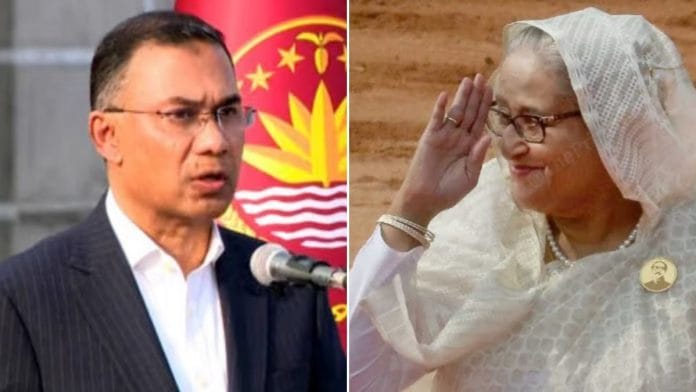

Bangladesh Prime Minister Tarique Rahman seems to be following the advice of the legendary fictional character Don Draper. The hard-drinking, chain-smoking, smooth-talking advertising guru from the hit TV series Mad Men famously said: “If you don’t like what’s being said, change the conversation.”
And what is it that’s being said today on the streets of Dhaka? Not just being said, but literally being shouted from rooftops?
Severe power crisis resulting in power outages lasting several hours every day, high inflation that continues to impact prices of daily essentials and a deteriorating law and order problem, not to talk about global concerns regarding Bangladesh’s radicalisation.
To deflect public attention from crippling domestic concerns, Rahman seems to have done one thing that brings immediate political dividends in Bangladesh ever since the fall of the Sheikh Hasina government on 5 August 2024: fan anti-India sentiment within his country.
In effect, the Bangladesh government’s cancellation of Rahman’s proposed India tour from 23 August to 25 August and non-confirmation of his New Delhi visit to attend the upcoming BRICS summit is being sold to the domestic audience as a power move against a bigger, more powerful neighbour that has given shelter to ‘dictator Hasina’. The development aims to deflect attention from a looming power crisis and other pressing domestic issues.
The cancelled tour has nothing to do with Hasina’s extradition or her first public presser on 5 August this year in New Delhi—her first since the ouster. Furthermore, deep-rooted historical anxieties have triggered caution within the Bangladesh Nationalist Party (BNP), making party members highly wary of Rahman’s proposed visit to New Delhi while Hasina is in India.
Stable government, unstable times?
Rahman, who had returned to Bangladesh on 25 December 2025 to a hero’s welcome after 17 years of self-imposed exile to lead his party, the BNP, in the February national elections, had promised the electorate good governance, law and order and public safety, and a rights-based state.
Referring to the famous quote of American civil rights activist Martin Luther King, “I have a dream”, Rahman had said, “Martin Luther King — have you heard the name? Martin Luther King has a famous dialogue: ‘I have a dream.’ Today, standing on the soil of Bangladesh, before all of you, I want to say this: I have a plan for the people of my country and for my country.”
When the results of the national polls were declared on 13 February, it appeared that the people of Bangladesh had indeed believed in Rahman and voted for a stable elected government after almost a year and a half of political instability under Muhammad Yunus. The BNP won a historic landslide victory and returned to power after nearly two decades, securing a decisive two-thirds majority in parliament.
Seven months down the line, Bangladesh is grappling with several domestic issues, including a severe energy crisis, with several parts of the country experiencing massive power outages.
“The situation has become so acute that the government has directed shopping malls, shops and markets to shut down by 8 pm to conserve electricity. Businesses, farmers and industries have also been hit by the worsening power crunch. To tide over the crisis, Bangladesh has turned to India, seeking additional diesel supplies,” states a report.
Then there are the rising prices of essential commodities that have hit households hard even after the government introduced duty and tax relief measures in the new budget to curb food inflation. Md Sayedul Hoque, vice-president of the Bangladesh Poultry Industries Association, told the local press that farmers had been incurring losses for nearly a year due to high feed prices and other rising costs.
“Moreover, diesel and transportation costs have increased, forcing many small farmers to stop production and reducing overall supply,” he was reported as saying.
Home Minister Salahuddin Ahmed came under intense questioning from the local press recently after he said his government is satisfied with the state of Bangladesh’s law and order situation.
When told by a journalist there has been recent deterioration in law and order, he replied, “Our data does not say that.” When another journalist said the prime minister’s information advisor had cited police headquarters data to acknowledge an increase in crime, Ahmed asked for the document.
Bangladeshi author and political journalist Sahidul Hasan Khokon told ThePrint the BNP government has been an abject failure in controlling crime not just on Dhaka streets but across the country. “Not just petty criminals, radical Islamist outfits and terror groups like Hizb ut-Tahrir Bangladesh, Ansarullah Bangla Team and Jamaat-ul-Mujahideen Bangladesh have been fast expanding their footprints inside Bangladesh even as the government watches helplessly,” Khokon said.
To deflect attention from such instability, Rahman has made a geopolitical move by cancelling his India trip and appealing to popular anti-India sentiment inside Bangladesh.
Also read: If Bangladesh joins the Mecca pact, India will have more to worry about
BNP’s trouble with India, and a historical scare
Domestic issues aside, the BNP government is also under tremendous pressure from the Opposition, Bangladesh Jamaat-e-Islami, and the new students’ party, the National Citizen Party, to maintain distance from India. National Citizen Party convener and Opposition chief whip Nahid Islam said people would not accept a visit to India by Rahman unless New Delhi was held accountable for sheltering Hasina and allowing her to speak from there.
Interestingly, after coming to power in February, BNP senior leader Mirza Fakhrul Islam Alamgir, the president of Bangladesh, told The Hindu in an interview that Hasina’s presence in India will not deter broader India-Bangladesh relations.
Senior journalist and Bangladesh expert Pratim Ranjan Bose told ThePrint that BNP’s ideological issues of staying away from India stem from both the opposition and its allies.
“The Tarique Rahman government has become unpopular a bit too soon. Historically, Bangladesh governments have used an anti-India stance as a sure recipe to divert attention and survive the turbulence. The Mecca pact has been whipped up for the same reason,” Bose said.
There is also a historical scare about Rahman, based on hearsay and conspiracy theories.
The last time Hasina was granted refuge in India was between 1975 and 1981 after her father Bangabandhu Sheikh Mujibur Rahman’s assassination. Rahman’s father, General Zia ur Rahman, had come to India on a bilateral state visit as President of Bangladesh in 1980 while Hasina was still in India. General Zia was assassinated soon after in 1981.
“There is superstition among many BNP leaders over this, and some of them have advised General Zia’s son Tarique Rahman not to visit India while Hasina is still here. Hasina had returned home after six years in exile on 17 May 1981. General Zia was assassinated only 13 days after, on 30 May 1981, by disgruntled officers of his own army. But many BNP leaders have, over the years, blamed Indian agencies for the killing,” Khokon told ThePrint.
Forty-five years after she went back to Bangladesh from exile in India, Hasina again plans to return home. General Zia’s son Rahman is now the prime minister and her main political rival, like his father was back in the day. This is the season of conspiracy theories and cancelled state visits.
Deep Halder is an author and a contributing editor at ThePrint. He tweets @deepscribble. Views are personal.
(Edited by Saptak Datta)