



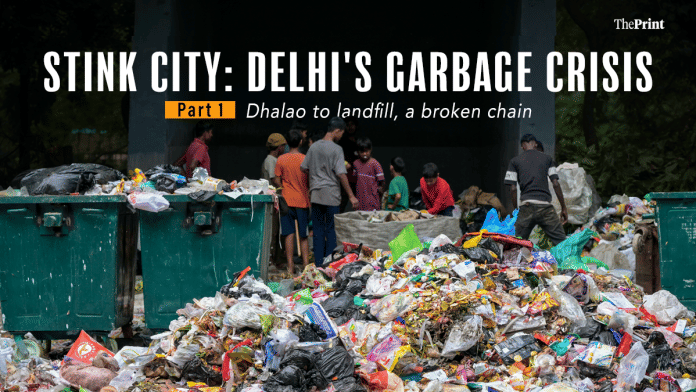
New Delhi: It is 11.30 AM, there’s a persistent buzz in Anand Lok, one of South Delhi’s posh colonies. The buzz comes from a growing swarm of flies, drawn by the stench of a mound of garbage. The foulness grows every day; by mid-afternoon, residents are forced to tiptoe around the dhalao, the Capitals’ ubiquitous three-walled repositories of trash.
In Block A of Defence Colony, another posh locality where individual floors or flats cost over Rs 15 crore, residents cover their noses as they approach, and quickly pass, immortal piles of garbage, like participants in a trash version of Takeshi’s Castle.
By 4 PM in the New Friends Colony area, the waste has begun conquering the road, and bits are tossed around by passing vehicles even as palatial houses stand watch over the vile drama on the ground.
By 5 PM, in and around Greater Kailash II neighbourhood of Alaknanda, where lilies bloom inside manicured lawns, the stench of garbage overpowers everything, wafting into the homes of civil servants, business owners and some of Delhi’s most influential residents.
The stench reaches every single house here. When it rains, the garbage begins to flow, and when it is windy, small particles start flying.
— Senior citizen residing in Greater Kailash 1
Delhi has a garbage crisis on its hands, roads, and near every home.
“I have been part of the Residents’ Welfare Association (RWA) since April 2026, and my hands have been full trying to solve the garbage problem. We have made several calls related to garbage collection from our pocket to clearing of the dhalao, but this is a recurring problem, and we have raised multiple complaints over the last few months,” said Madhulika Singh, general secretary, RWA, Aravali Apartments.
On 30 August, Delhi Chief Minister Rekha Gupta said that the Delhi government had reclaimed 100 acres of land at the Okhla, Bhalswa and Ghazipur landfills after 2.16 metric tonnes of waste was removed.
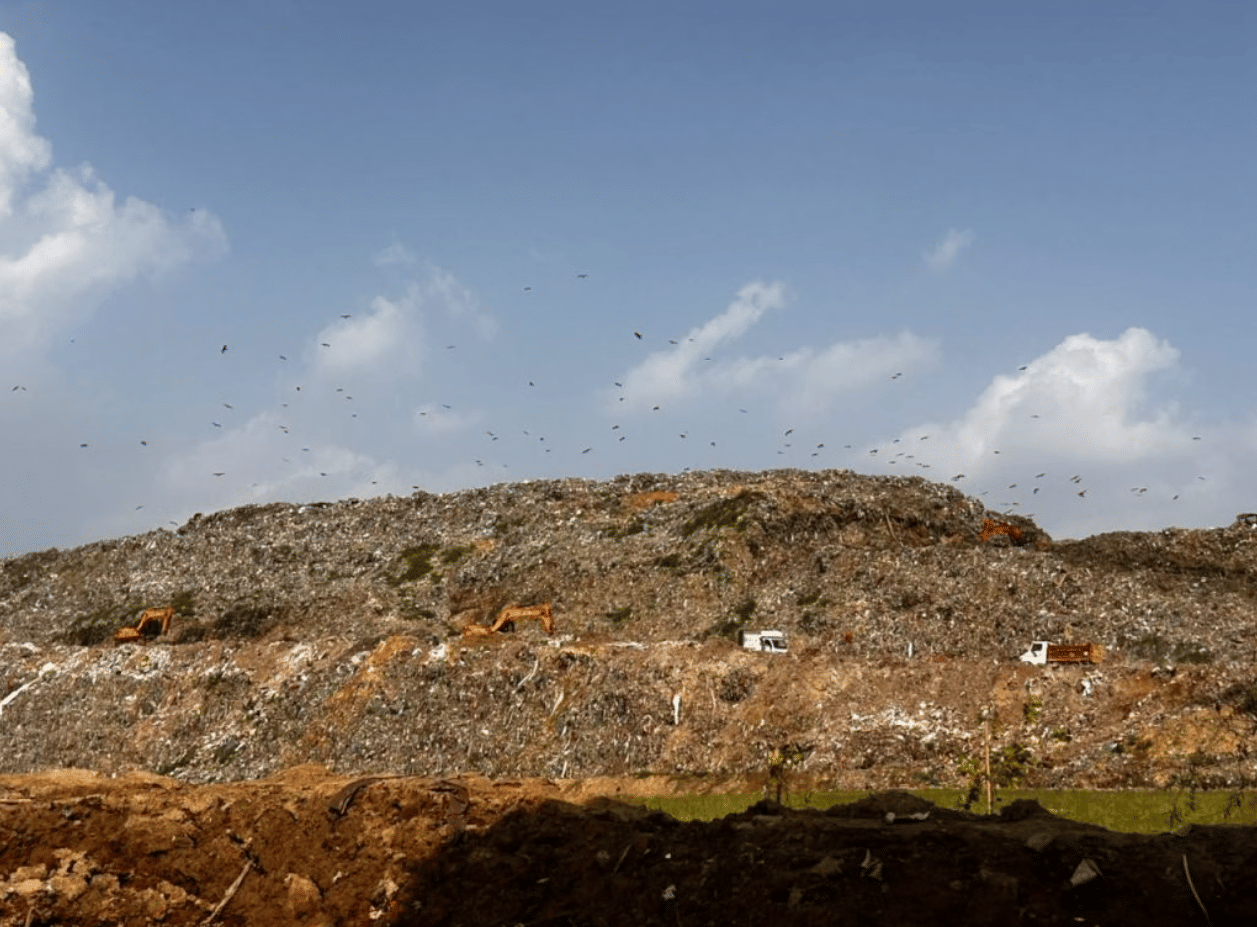
While Gupta claims that Delhi’s three infamous landfills—Ghazipur, Bhalswa and Okhla—are shrinking, the garbage appears to be moving from these man-made mountains of filth and refuse to the streets of the Capital. It spills out of dhalaos, piles up along roads and pavements, and turns neighbourhood corners into mini-landfills.
From upscale colonies such as Defence Colony, New Friends Colony, Lodhi Colony, Hauz Khas to busy markets, these garbage heaps now dot the Capital, making Delhi’s waste crisis not just an eyesore, but a serious health hazard.
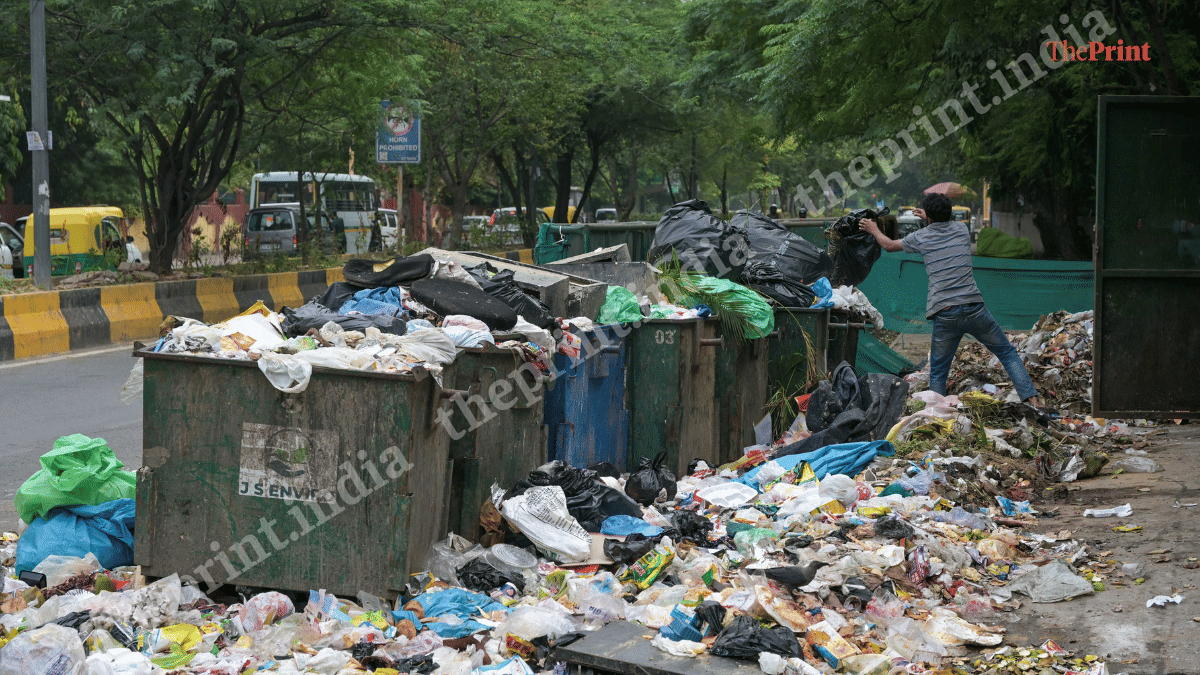
Conversations with Municipal Corporation of Delhi (MCD) officials and documents accessed by ThePrint point to a waste management system struggling at several points in the chain.
Despite an annual budget of Rs 1,000 crore for the collection, transportation, and processing of waste, garbage continues to pile up across Delhi.
Officials point to multiple gaps in the system: a 1.5-2 year delay in floating new tenders, repeated extensions to old contractors, and slow implementation of new contracts. Poor waste segregation has added to the problem.
One metric exposes the magnitude of the crisis. Around 13,500 metric tonnes of waste is produced in the Capital daily, but only 8,000 metric tonnes is processed. Multiply the remaining with days, weeks, months and years and Delhi has a problem that only grows.
Also Read: Delhi’s garbage mountains are finally coming down. New ones are rising
New Friends Colony to Lodhi: Garbage peaks across Delhi
In Southeast Delhi’s New Friends Colony, where a square foot of land costs more than Rs 60,000, a mountain of garbage greets residents, visitors and passers-by coming to the neighbourhood’s shiny houses and upscale eateries.
Waste from nearby residential blocks and that generated by restaurants finds its way here. Sanitation workers in the area told ThePrint that, to work in a place with such a heavy stench, they have to enter the “dhalao complex” in an “inebriated condition”.
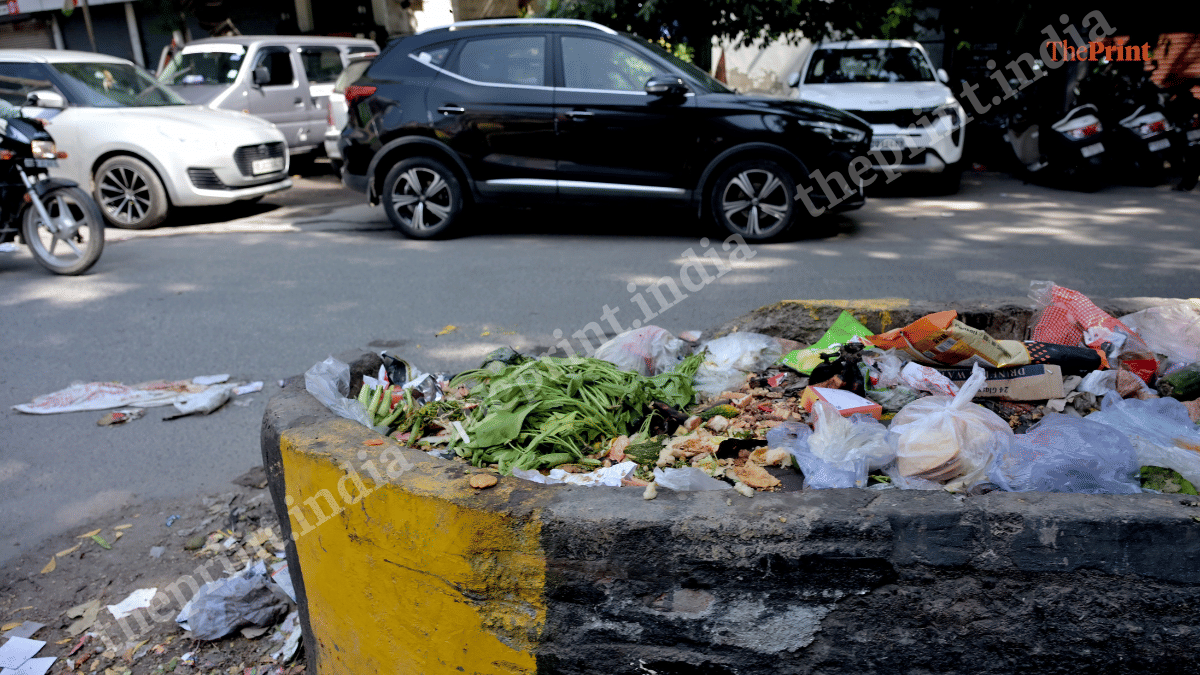
A few kilometres away in Defence Colony, the dhalao, next to a mosque’s entrance, is locked. In front of the locked doors stands a mountain of unsegregated waste, around which barefoot children walk and cats, dogs and insects proliferate.
A lawyer working in Defence Colony told ThePrint that the mound of waste has remained there for the past year. “I have been working here for the past year, and this (pointing at the garbage) has only gotten worse. On a windy day, particles and dry waste are carried by the wind, while on a rainy day, floodwater carries it to our office’s doorsteps. Meanwhile, on humid days, the acrid smell makes it difficult for people to even walk,” she said.
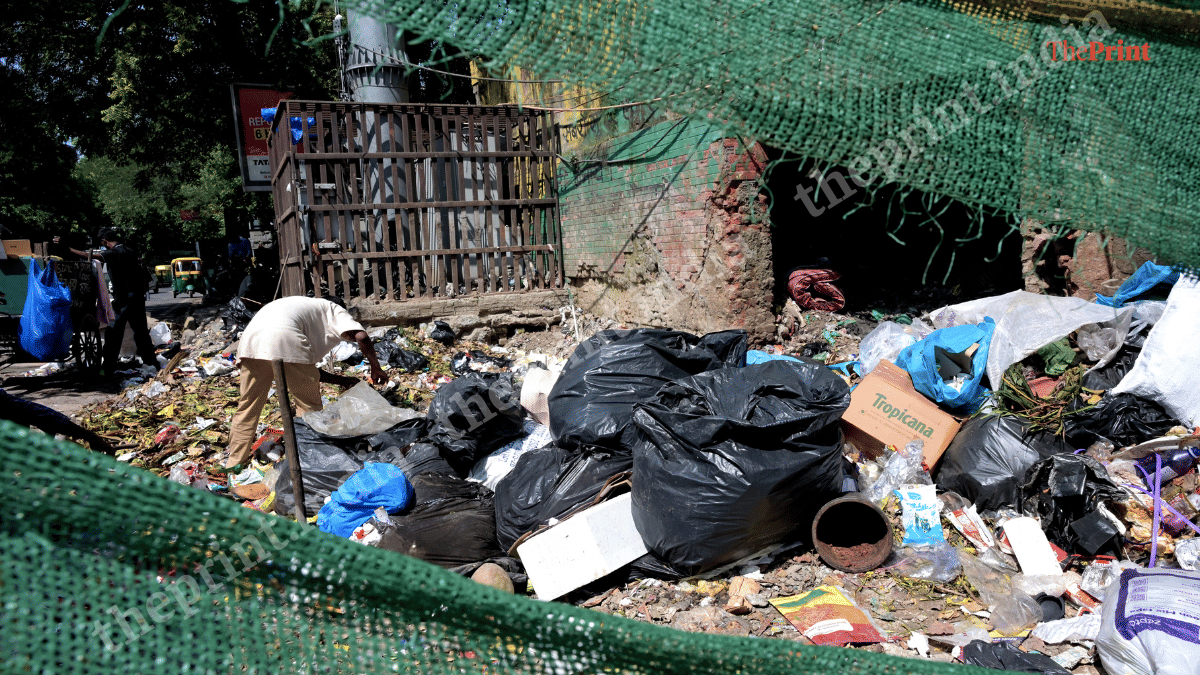
In Central Delhi’s Lodhi Art District, the scene is no different. Amid a plethora of restaurants, cafes and shops sits an overflowing dhalao, with leachate flowing onto the roads and pavements.
Of the eight dhalaos ThePrint visited, this was the only one covered on two sides with a green cloth, shielding the eyesore from passers-by.
1.9 lakh complaints, but garbage keeps returning
The mini garbage mountains on the roads of the Capital have added up to a problem that is being talked about everywhere, including on social media.
Passers-by driving through garbage-filled lanes frequently upload videos of the “garbage crisis”. Social media platforms X and Instagram are full of posts tagging the MCD, along with geotags showing the locations.
An X user, Sajal Ajmani, shared his complaint from Sector C, Vasant Kunj. “The complaint was assigned to officials and has now been marked ‘Closed / Complied’, but the issue was not resolved. Garbage continues to overflow outside the designated dhalao, creating a severe foul smell and unhygienic conditions on a road used daily by schoolchildren and parents,” he wrote. He added: “Request that you reopen the complaint, inspect the site, and implement a permanent solution rather than closing the grievance administratively.”
Not only are social media platforms full of such complaints, within private RWA WhatsApp groups residents frequently flag low or no collection of waste from houses. “Why did the garbage guy not come yesterday?” asked one resident in an RWA group in Chittaranjan Park. “My garbage has been lying in the same place since yesterday. Kindly check,” said another. “Same in our building no. X, our garbage has been overflowing,” said a third.
Out on a walk, a senior citizen residing in Greater Kailash 1 told ThePrint that the garbage problem only gets “temporarily solved”.
“The garbage stands next to a school and temple, just imagine! The stench reaches every single house here. When it rains, the garbage begins to flow, and when it is windy, small particles start flying. This is a serious health hazard now. And it is not that we have not complained, but the dumps only get cleared temporarily when requested and then they appear again,” the senior citizen said on condition of anonymity.
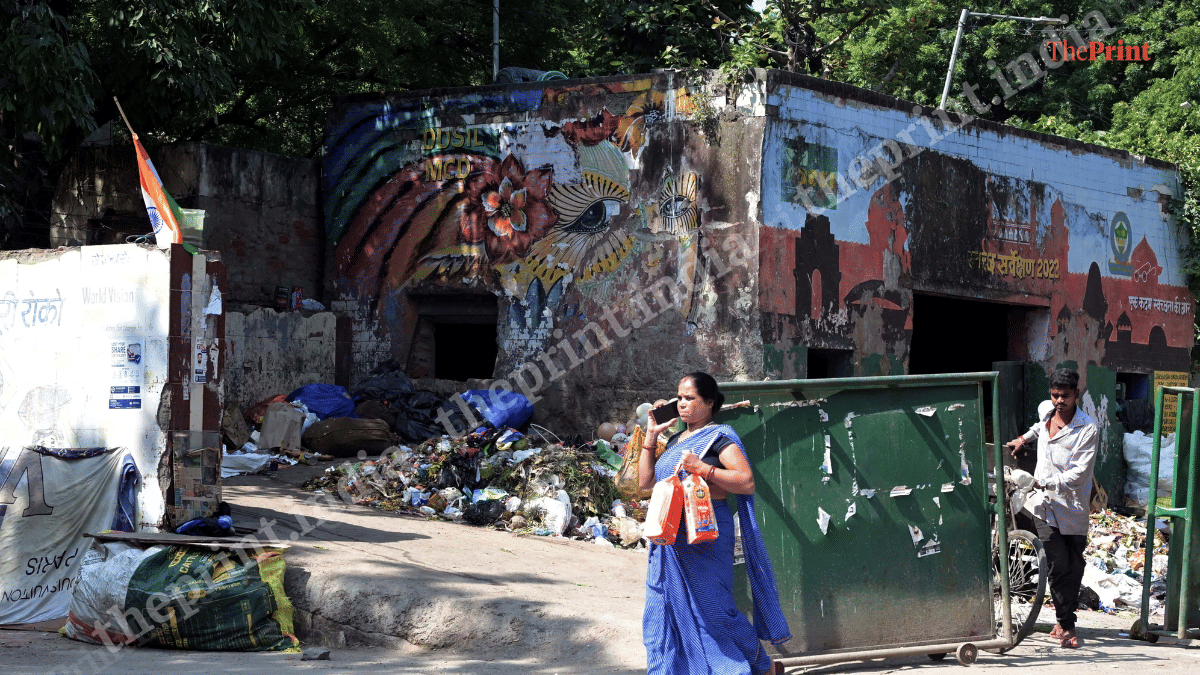
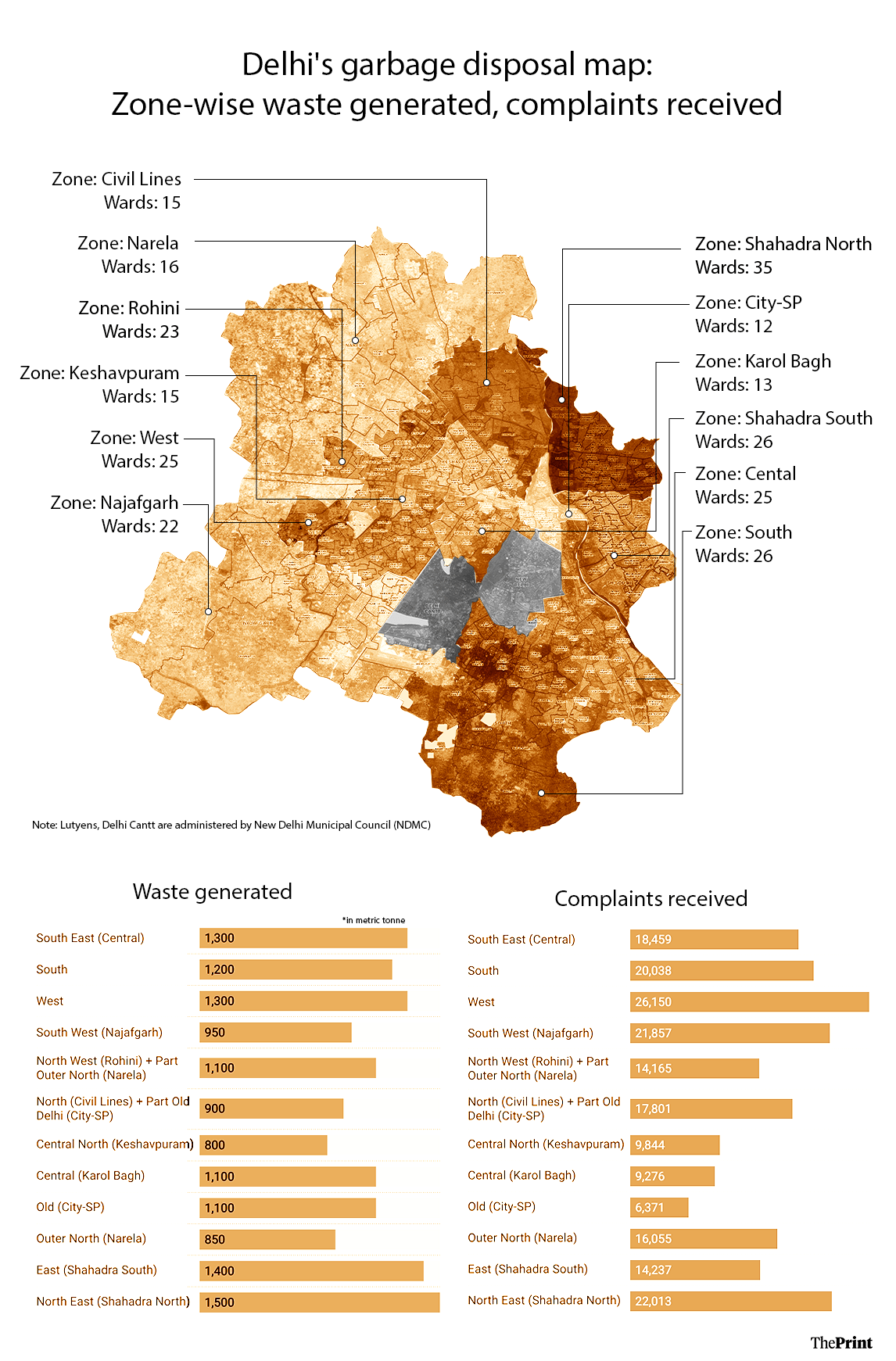
According to MCD data accessed by ThePrint, the civic body has received more than 1.9 lakh complaints from residents of its 12 zones since January 2026.
MCD Mayor Pravesh Wahi told ThePrint that the municipal body receives at least 200 complaints every day. “We receive 150-200 complaints every day related to garbage and we solve most of them, but due to limited capacity we fail to resolve all the complaints within 24 hours,” said Wahi.
A senior official in CM Rekha Gupta’s office told ThePrint that, while the primary responsibility for garbage collection and transportation falls under the purview of the MCD, the chief minister has been closely monitoring the process. “Earlier this month (October) in a meeting, Rekha Gupta instructed the top MCD officials to review the city’s cleanliness and devise better waste management strategies,” said the official.
Also Read: Dwarka was Delhi’s middle class dream. Now it’s fighting traffic, garbage, water woes daily
Delhi’s garbage chain and where it breaks
According to MCD data, the Capital produces 13,500 metric tonnes of waste every day, with the North-East Delhi zone producing 1,500 metric tonnes—the highest—and the Central North zone producing 800 metric tonnes, the lowest.
Delhi has the capacity to process only about 8,000 tonnes of this waste. But processing is a challenge that comes later—the immediate problem is that waste is not even being collected and transported efficiently enough to reach treatment facilities.
The waste is first collected by privately appointed waste-pickers from individual residences and transferred to a dhalao in small vehicles. Ideally, the waste at the dhalao is then segregated into wet and dry waste and loaded onto municipal trucks to be sent to treatment plants or landfills.
There was a gap of 1.5-2 years in drafting and sending out tenders for the collection and transportation of garbage.
— Senior MCD official
From collection to processing and transportation, the work has been outsourced by the MCD to five different private players: M/s Metro Waste, M/s AG Enviro, M/s DMSWSL, M/s J S Enviro Services, and M/s DWMN. These contracts have been given for a minimum of 10 years and a maximum of 20 years.
Contractors are paid according to the generation of waste in each of the 12 zones. Payment per metric tonne of waste generated across the 12 zones ranges from Rs 1,445 to Rs 2,809, according to MCD documents accessed by ThePrint.
Tender delays, extensions and difficult transitions
Officials point to another major reason for the garbage on Delhi’s streets—a delay of nearly 1.5-2 years in drafting and floating new tenders for collection and transportation of waste.
“There was a gap of 1.5-2 years in drafting and sending out tenders for the collection and transportation of garbage. The previous organisations were given an extension after extension before the new tenders were sent out,” a senior MCD official said.
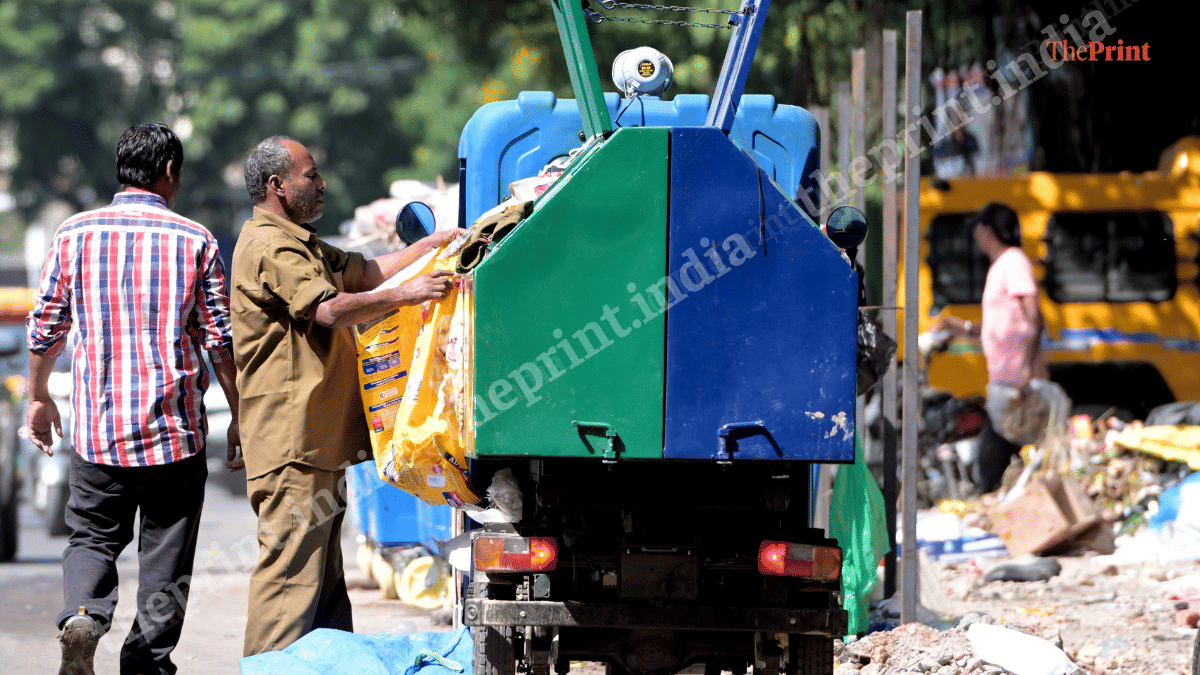
MCD Mayor Pravesh Wahi told ThePrint that towards the end of a tender’s duration, older organisations tend to do lackadaisical work. “The transition months are particularly difficult for the administration and the city. While the outgoing organisation does lousy work, it takes a certain amount of time for the incoming organisation to break ground,” Wahi said.
According to a document accessed by ThePrint, a new concession agreement was signed for three zones—Southeast, South and West—on 11 June with two different tender recipients, with collection and transportation to begin from 15 October. “At present, work in 12 wards has been started in West Zone, and in five wards in South zones,” the document reads. It adds that mobilisation work in other wards in these zones is in process.
Also Read: Hard to live, harder to relocate—Kanjurmarg residents’ fight to shut down Mumbai’s biggest landfill
Land crunch, poor segregation add to problem
Tendering and collection are only part of the problem. A senior Department of Environmental Management Services (DEMS) official in the MCD told ThePrint that a series of factors has given rise to the “garbage crisis” in the city.
“The Capital with a population of 2.3 crore inhabiting 60 lakh houses, produces 13,500 metric tonnes of garbage. This means each person produces roughly half a kilo of waste, but MCD at present has the capacity of processing only 8,000 metric tonnes of waste, leaving behind 5,500 metric tonnes of waste,” the officer told ThePrint.
The task of getting rid of dhalaos itself is not so linear, says a senior DEMS official. “Delhi has around 500 dhalaos and 350 Fixed Compactor Transfer Centres (FCTs). To remove dhalaos in a phased fashion, there have to be FCTs, which require a minimum of 10,000 square metres. But with Delhi facing a land crisis, such constructions are difficult,” he said.
Adding to that is the issue of residents not wanting waste plants in their neighbourhoods. “However, we are pursuing DDA to see if land parcels can be identified for the purpose,” said the officer.
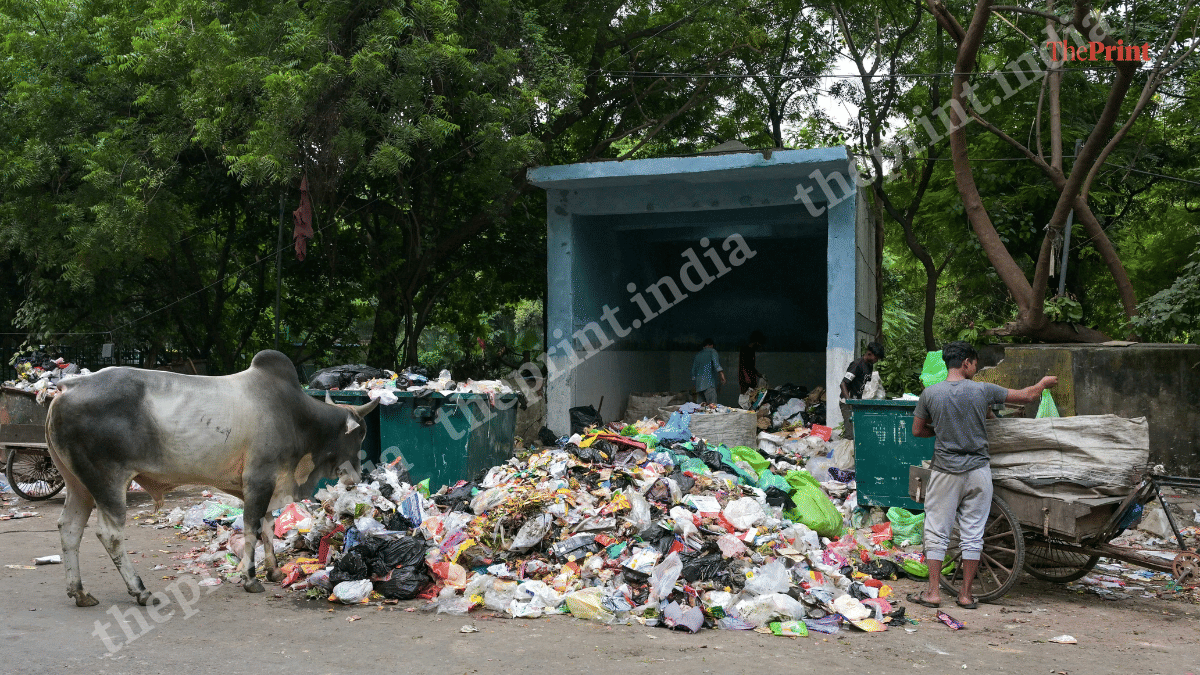
A major impediment that makes dhalaos a bigger problem is the lack of segregation, the Department of Environmental Management Services official said. “When residents do not segregate wet and dry waste, it entails that the kitchen waste will decompose in the open attracting flies, insects and animals and emitting odour. If they segregate, and compost, then the waste quantity generated reduces drastically,” he added.
Another MCD official said that even when all this is done, the “lack of political will” builds a lag. “We had devised a penalty that was to be charged if individuals generated most waste. We also once decided to add it to house tax, but politicians want votes and they believe that charging residents is a deterrent in vote collection,” he added.
Missed deadlines to NGT: Delhi’s long dhaloa battle
The problem of overflowing dhalaos is not new, nor are promises to eliminate them. The first target for a dhalao-free Delhi was set by then Lieutenant Governor (L-G) Tejendra Khanna in 2008. After several missed deadlines over the years, March 2022 and eventually 31 December 2024 were subsequently set as deadlines, through undertakings submitted to the National Green Tribunal (NGT). The Bharatiya Janata Party-led MCD has now set January 2027 as the deadline to remove all dhalaos.
The matter has also repeatedly reached the courts.
Neel Mani, an applicant, filed an application in the NGT seeking relocation of a dhalao situated in front of the entry gate of his residence in New Friends Colony. Next to his house is a service lane, a nallah and then the Friends Colony Club.
Earlier, Mani had filed a writ petition before the Delhi High Court in 2006, following which the court, on 2 February, 2010, directed the South Delhi Municipal Corporation (SDMC) to maintain hygienic conditions at the dhalao. Subsequently, Mani filed another writ petition before the Delhi High Court, where the court, in an order dated 5 February, 2020, directed the municipal body to maintain hygienic conditions.
In another order dated 4 September, 2023, the court stated that it is “essential that MCD should eliminate open dhalaos within a timeframe at the earliest and also clears solid waste periodically and timely. There has to be regular and effective door-to-door collection from households and its enforcement on the part of MCD.”
The court ordered the MCD to close the dhalao and maintain good sanitary and hygienic conditions. “We find that MCD has proposed alternative use of dhalao as mentioned in the status report. However, we consider that use of dhalao for MRF, decentralized composting Pits and attendance of safai-karamcharis will not be appropriate and is likely to perpetuate the very same state of affairs which closing of dhalao is meant to remediate Therefore, it will be appropriate that on closure such dhalao are alternatively used as milk booth, EV infrastructure (IGL), library, reading room, training centre for less privileged women and children or senior citizen recreation centre.”
The court further observed: “MCD shall also take appropriate steps to close the remaining dhalao with specific timelines as per directions of the Chief Secretary, Government of NCT of Delhi, and directions given by this tribunal for ensuring compliance with Solid Waste Management Rules, 2016.”
ThePrint reached Delhi Environment, Forest and Wildlife Minister Manjinder Singh Sirsa for comment, but had not received a response by the time of publication. This report will be updated if and when a response is received.
Also Read: Chennai is starting to clear the Perungudi garbage mountain. And make furniture from it
Why Indore works — and can Delhi replicate it?
On 17 July last year, when President Droupadi Murmu conferred the Swachh Survekshan 2024-25 Awards, Indore, Surat and Navi Mumbai entered the “premier Super Swachh League” in the category of cities with a population of more than 10 lakh. Meanwhile, the New Delhi Municipal Council (NDMC) was part of the “Super Swachh League Cities” in the category of population between 50,000 and 3 lakh.
The “Indore model” has become a successful example in India for clean cities. Indore could also be a lesson to other Indian cities that these standards can be achieved. Earlier, residents said, the commercial capital of Madhya Pradesh, with a population of more than 30 lakh, was like any other Indian city. Garbage dumps were always overflowing.
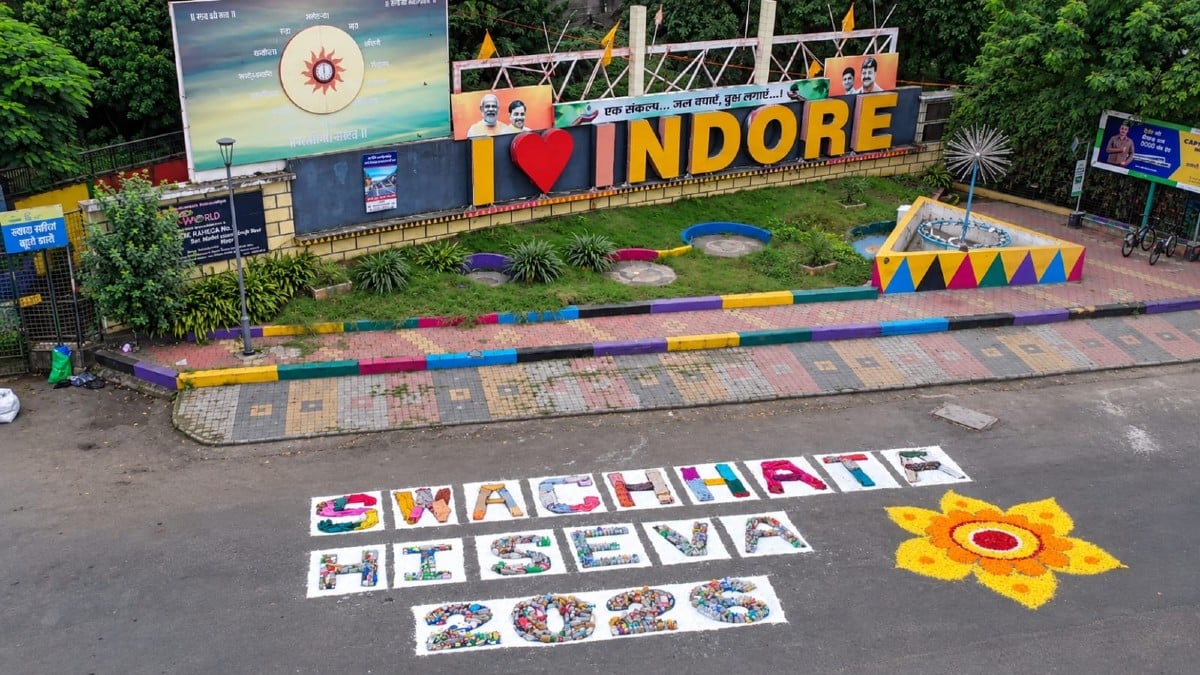
But a combination of an incremental garbage reduction policy, insistence on waste segregation and a change in mindset have pushed Indore to achieve what once seemed impossible.
Indore’s journey towards becoming India’s cleanest city began in early 2015, a few months after Prime Minister Narendra Modi launched the Swachh Bharat Mission to make the country clean and free of open defecation.
Delhi has a multiplicity of agencies, and the ranking doesn’t depend on waste pickup.
— Former MCD Chairman Jagdish Mamgain
Manish Singh, then the city’s municipal commissioner, took it as a challenge to get Indore on track. Now, in 2026, the model is making an impact in the Capital.
On 27 July, 2026, Delhi L-G Taranjit Singh Sandhu chaired a comprehensive review meeting and asked the MCD to explore the possibility of implementing the ‘Indore model’ of sanitation as a pilot project in one of Delhi’s areas.
“Emphasised that every MCD officer must remain vigilant, proactive, and accountable in delivering efficient civic services. A cleaner, safer, and more resilient Delhi can only be achieved through timely execution and a strong sense of responsibility,” he had said.
But Delhi is not Indore
How does the Indore model get followed in Delhi? For the MCD, it is not as linear as it sounds. “Delhi is a big city, with different types of population, and the garbage production and collection is more than Indore, the zones are different, so is the behaviour and awareness among people regarding garbage segregation,” said an MCD official.
We are expanding the Okhla and Tehkhand plants by an additional 1,000 metric tonnes each.
— MCD official
According to the official, Delhi has around 1,611 unauthorised colonies, many with narrow lanes from where waste cannot be picked up. Delhi has 853 colonies that have zero waste.
As former MCD chairman Jagdish Mamgain put it, “Delhi has a multiplicity of agencies, and the ranking doesn’t depend on waste pickup. We can see, in NDMC, a compact area with greenery, and a categorised collection and segregation process, the garbage is manageable, and it has successfully followed similar steps to the Indore model.”
What MCD plans to do
While lagging in its capacity to process waste, the MCD is now planning to expand processing units. “At present, Delhi operates four Waste-to-Energy (WTE) plants. These are located in Narela-Bawana (2,400 metric tonnes capacity), Ghazipur (1,350 metric tonnes), Okhla (2,000 metric tonnes), and Tehkhand (1,450 metric tonnes),” said the official.
He said expansion plans are underway. “We are expanding the Okhla and Tehkhand plants by an additional 1,000 metric tonnes each,” the official added. “Further, two new plants are coming up, a 3,000 TPD plant in Narela and a 2,000 TPD plant in Ghazipur, alongside roughly 200 local decentralised composting units running across the city,” he said.
Meanwhile, the MCD has a strength of 60,000 safai karamcharis and 66 mechanical road-sweeping machines and is in the process of procuring 70 more, he added.
According to an MCD source, the new contracts have focused on increasing primary collection vehicles and attached manpower by 5 percent each year to cater to enhanced quantities of municipal solid waste.
“To ensure continued availability of fit vehicles, 25 percent of the primary collection vehicles shall be replaced by new vehicles at the end of fourth year. Increase in infrastructure related to secondary collection and transportation to the extent of 20 percent at the end of 39th month from COD in case of increase in waste generation,” he added.
Additionally, the new contracts have listed the need for increasing auto-tippers by 70-100 in each zone and deploying e-rickshaws in areas with narrow lanes. “Separate collection and transportation system for silt from small drains less than four feet in depth,” he said.
The MCD also plans to increase the number of FCTs from 118 to 166 across the three zones.
“Development of minimum one integrated transfer station in each zone (of capacity 150-200 tonne) which shall act as a buffer for secondary transportation requirements. Increase in infrastructure related to secondary collection and transportation to the extent of 20 percent at the end of 39th month from COD in case of increase in waste generation,” the officer added.
(Edited by Nardeep Dahiya)
Also Read: Punjab needs more than smart bins. It requires a waste management overhaul