



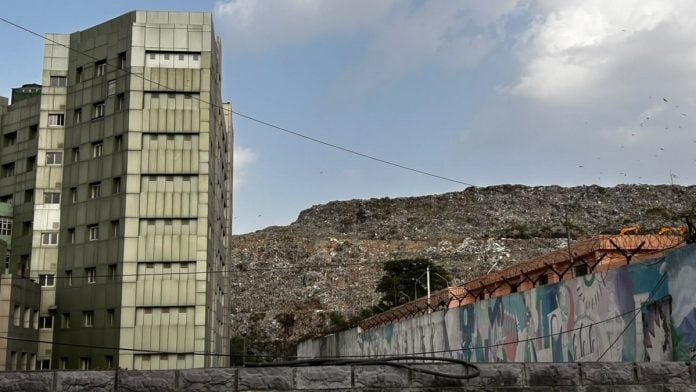
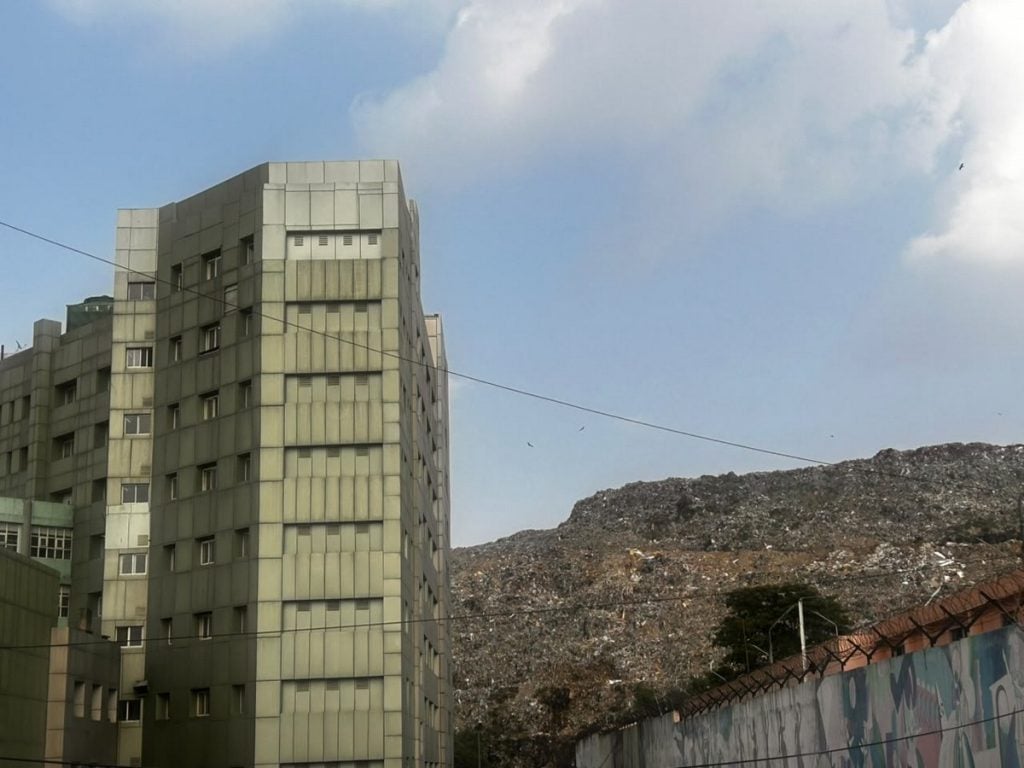
New Delhi: Sundar Lal can now clearly see the seven-storey ESI Hospital from his omelette cart in Tehkhand village, Okhla. He says it finally looks taller than the adjacent garbage mountain at the Okhla landfill. The air around him no longer reeks as badly as before.
“I saw this change in the last one year. It is better for me as I get mobile network now and I do not get bitten as much by mosquitoes,” said Lal.
Delhi’s garbage mountains have long been an emblem of its chronic waste-management failure. Now an ongoing drive to clear them has made the mounds at the three main landfills — Okhla, Bhalswa and Ghazipur — visibly smaller over the past year or so. The question is, for how long?
Earlier this month, Delhi Chief Minister Rekha Gupta posted on X that the “koode ke pahad” the capital watched rise for years were “finally coming down”. She claimed that in 1.5 years, 217.17 lakh MT of legacy waste had been biomined—a process by which heavy machines excavate and process buried garbage— and 100 acres had been reclaimed. Delhi is racing to finish the legacy-waste clearance at Okhla and Bhalswa landfills by the end of 2026, while Ghazipur’s deadline is December 2027.
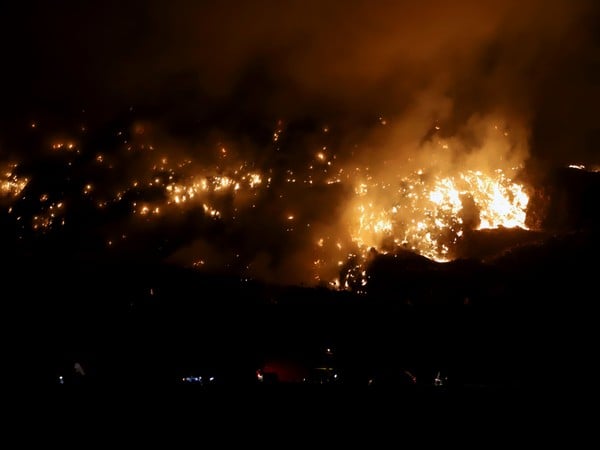
For every successive government in Delhi, conquering the garbage peaks has been nothing less than Arjun’s fish-eye target. Not only are they an eyesore, the relentless dumping produces toxic leachate that contaminates groundwater, creates conditions for methane fires and worsens air pollution. But premature declarations of victory have been made before as well.
In 2023, former Chief Minister Arvind Kejriwal said around 30 lakh MT of waste had already been removed from Bhalswa and promised to clear the rest by March 2024. It never happened. Progress is made only in fits and starts. The fundamental trouble is that the mountains have a way of rising again, with Delhi generating approximately 11,000 to 12,000 tonnes of fresh municipal solid waste daily.
This time, Gupta promised in a video message that her administration has a “scientific roadmap” and a “time-bound approach”. She added that the government is “fully prepared” to set up four new waste-to-energy plants.
“Once they are operational, no new mountains of garbage will ever rise again,” she declared.
#WATCH | Delhi Chief Minister Rekha Gupta says, "For years, people had been seeing mountains of garbage in Delhi. When our government came to power, we pledged to remove these garbage mountains. People wondered if we could actually fulfill such a massive promise, but we did. We… pic.twitter.com/RzCvHNtomN
— ANI (@ANI) August 30, 2026
While the Municipal Corporation of Delhi (MCD) has been trying to bring down legacy waste since 2019 through biomining, officials say the work is now moving at a better clip.
“There have been several problems with contracts and understanding the process, but now it is more streamlined, especially in Ghazipur, where there have been repeated changes of contractors,” an MCD official told ThePrint.
According to the Delhi Economic Survey, 74.11 lakh MT of legacy waste was cleared between April 2025 and February 2026, which it called “the highest annual processing achieved so far”. The report notes that 29.93 lakh MT was cleared in 2024-25 and 54.34 lakh MT in 2023-24.
However, despite the speedier work of late, the survey data also indicates that CM Gupta’s claim of clearing 217.17 lakh MT “in just 1.5 years” includes work done before the BJP government came to power. A June 2022 drone survey found that the total legacy waste in the three landfills was 203 lakh MT at the time. As of March 2025, 106.17 lakh MT had been cleared.
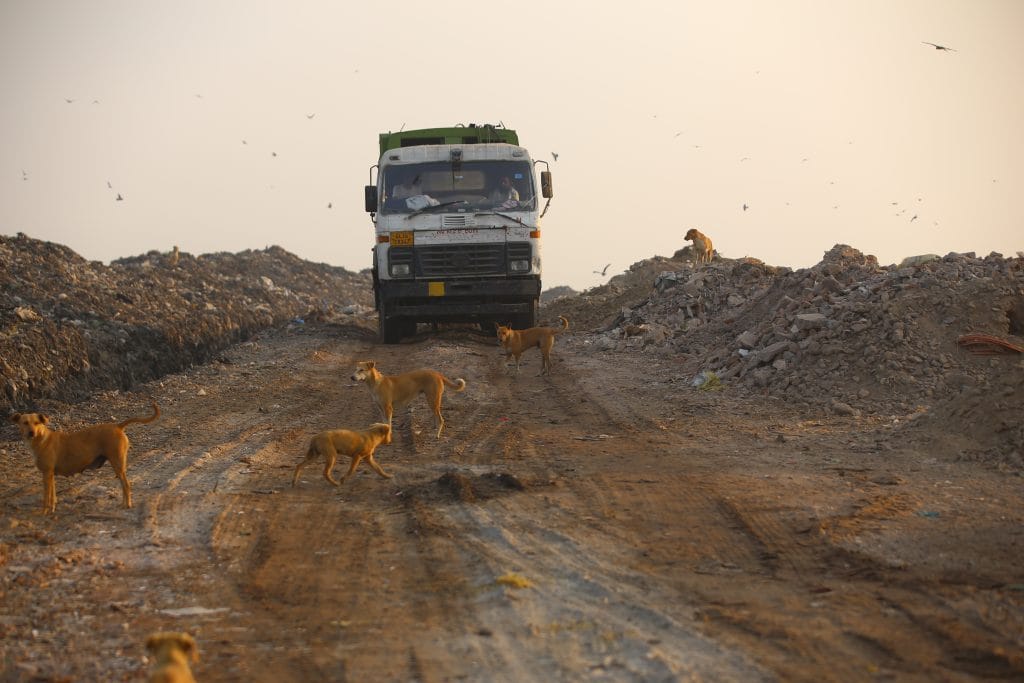
The results are more marked at Okhla, where the garbage mountain no longer seems to touch the sky. At Ghazipur, the change is less obvious. The familiar putrid smell still hangs in the air and dogs forage through the waste.
At Bhalswa, Sheikh Akbar Ali is sceptical. As coordinator of Basti Suraksha Manch, an organisation that works with communities around Delhi’s landfill sites, he says garbage is often just being moved around and new landfills are coming up.
“I have been working in Bhalswa for around 15 to 20 years, and what I see is that waste is being picked up from one place and dumped somewhere else. They have reduced the height of the landfill on one side, but on the other, the waste has increased considerably,” he said. “Today, there are six or seven points in Bhalswa where this waste has been dumped, affecting the health of people living there. Now another landfill has come up in Sanot village, Rohini. So, are we really finishing the landfills, or simply shifting the waste from one place to another?”
Also Read: A Delhi couple keeps climbing Ghazipur landfill to feed 400 dogs. Chicken, rice & dahi
How is land reclaimed?
At Okhla, a patch of green has appeared where garbage once stood. It was meant to be something of an oasis. Last year, the Delhi government announced 8,000 bamboo saplings, along with another 8,000 lemongrass and vetiver plants, for the reclaimed land. The MCD had said that the roots block heavy metals from seeping into the groundwater and enhance oxygen levels in the air.
But many of the bamboo shoots are struggling. Several looked weak and dried out.
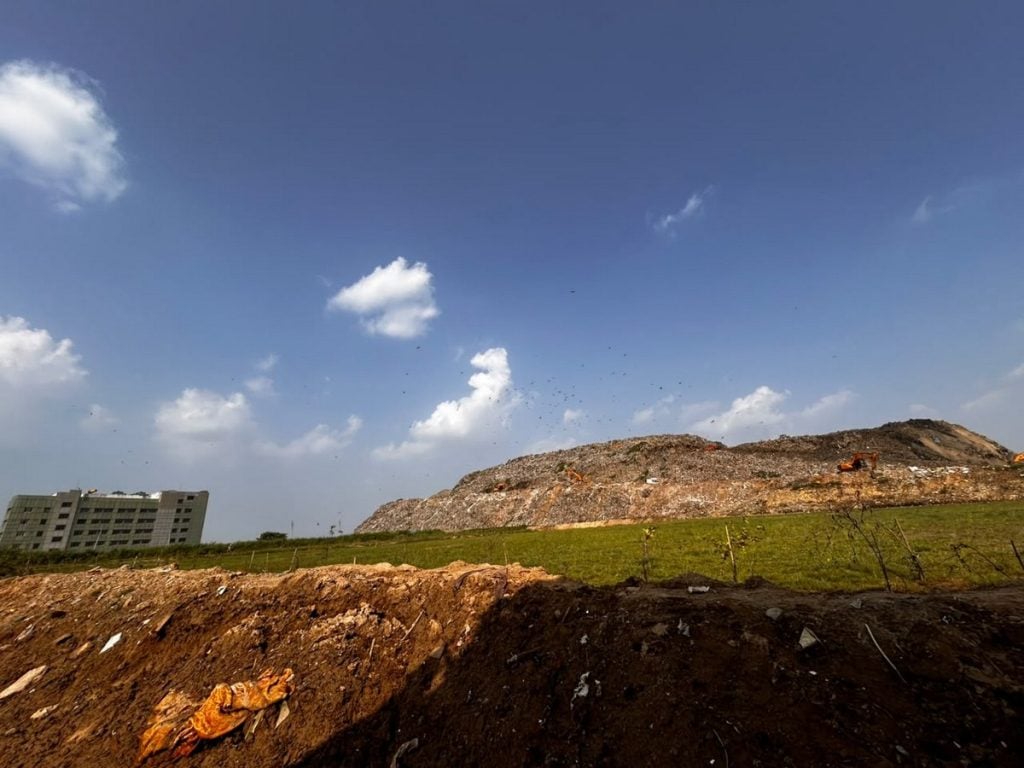
Ali said he is not surprised by this. He asks how plants can be expected to thrive when there are microplastics, e-waste, and other hazardous, undertreated waste underneath. He has seen similar attempts falter at Bhalswa.
“They also planted a large number of trees in Bhalswa’s pipeline area. On Environment Day, ministers came and planted trees with their own hands. But what happened after that? Nobody came back to check whether those trees were still alive. If there is no treatment of the waste and no follow-up after the plantation, then what is the point of planting trees just for the event?” he said.
MCD officials have also reportedly acknowledged that a five-acre patch where 6,000 bamboo saplings were planted last year is now covered by a fresh garbage mound around 30 feet high.
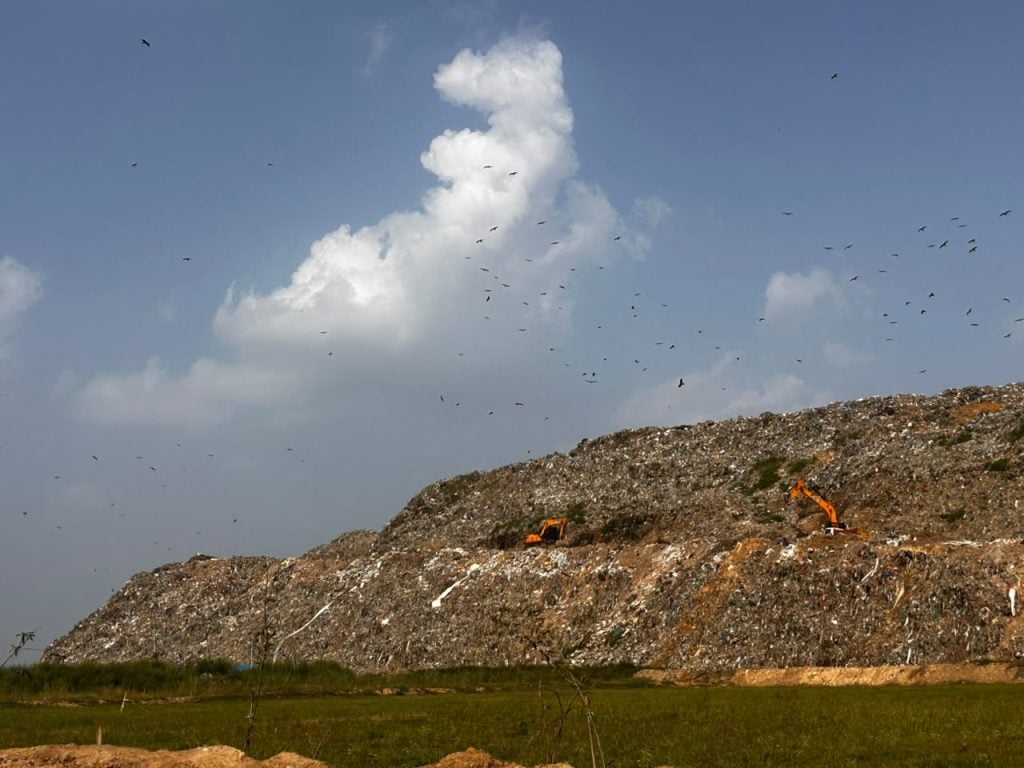
Official data has not yet factored this in. MCD data shows that from March 2019 to March 2026, around 214.5 lakh MT of waste was removed from the three landfills. At a press conference last month, Chief Minister Rekha Gupta said that of the 100 acres reclaimed across the three sites, 45 acres were at Bhalswa, 35 at Okhla and 20 at Ghazipur.
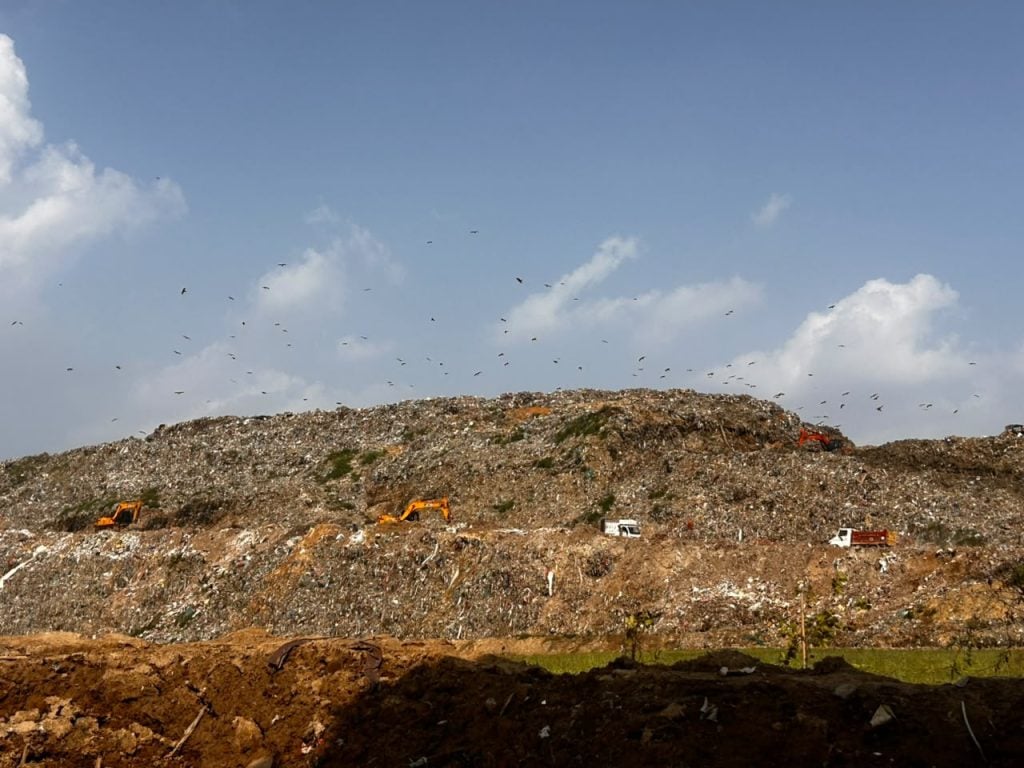
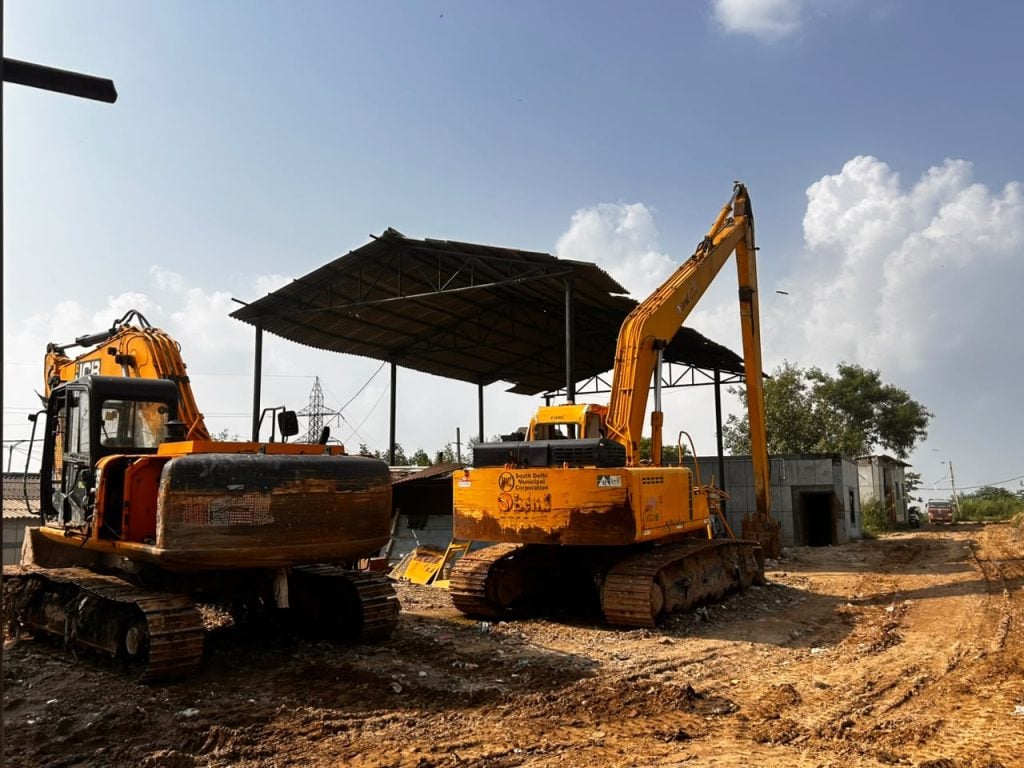
The plants are just the tip of the reclamation process. Before that comes biomining. The process began after the National Green Tribunal directed Delhi in July 2019 to clear all three major landfills. By October that year, trommel machines were at work. These giant rotating sieves take in compacted old garbage and shake it apart, letting finer soil-like material fall through while separating out construction debris, plastic, textiles, rubber and other waste. Once separated, these materials are sent for reuse, recycling, processing or disposal elsewhere.
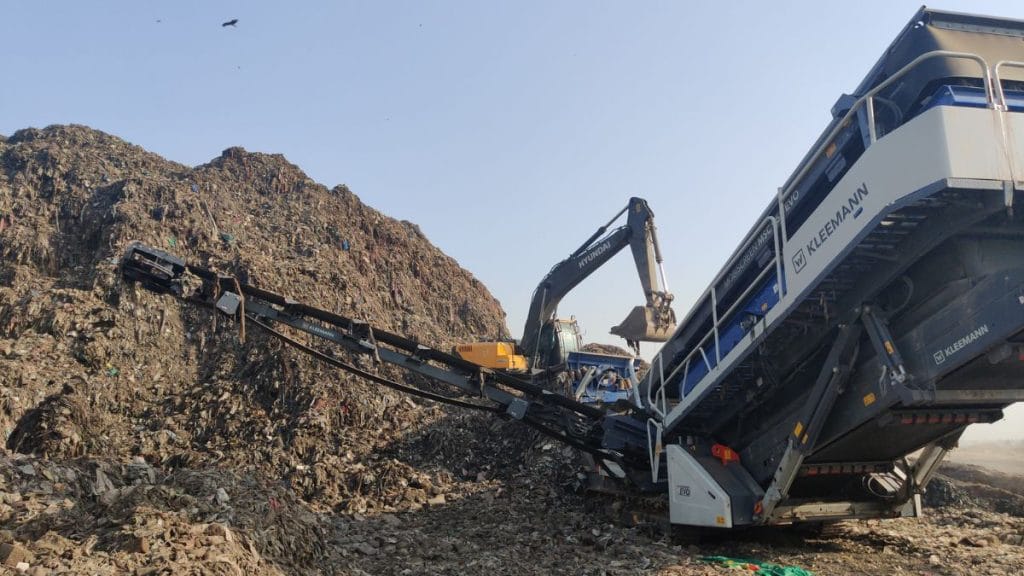
When MCD started its excavations, it had to contend with limited machinery and inexperienced contractors, officials said. At Ghazipur, one contractor was eventually terminated in December 2024 after processing less than half its 30 lakh MT target. Now, however, officials say the process is more streamlined, even if rain, fresh waste and contractor problems still slow it down.
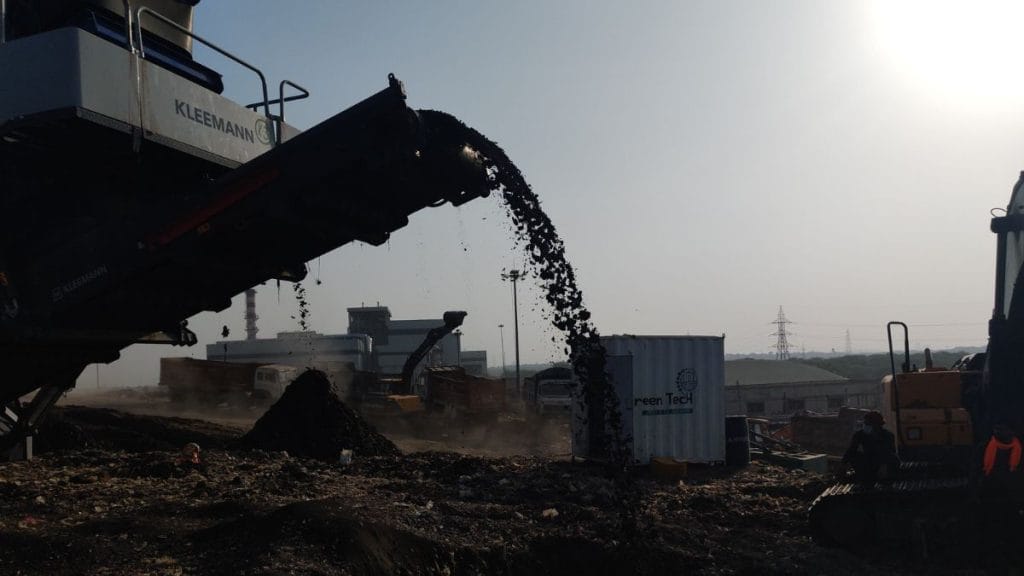
The number of trommels rose from 25 in June 2022 to 58 as of last year. But with decades of compacted waste to separate, biomining is neither easy nor fast. Seasonal factors, space constraints and segregation all throw up their own challenges. Rain turns old waste wet and sticky, which can clog machines. At times, there is not enough room to store the separated waste. Processing capacity is limited.
One bottleneck in biomining has been what to do with the material once it is separated. In 2022, on the directions of Lt Governor VK Saxena, MCD began offering inert and construction waste from the landfills free of cost to private firms, builders and government agencies for reuse. Within a month, private entities had lifted 8,421.75 MT, while agencies such as PWD and DDA had also decided to use the material.
The uses are several. Plastic waste can be shredded and mixed into bituminous road layers, while inert and construction waste can be deployed as fill or base material. NHAI used landfill material at Karala Majri, Burari, Kundli, Holambi and Faridabad-Mithapur, while C&D waste was sent to processing sites at Khampur and Keshav Nagar-Burari. The Urban Extension Road-II project, which runs from Alipur in north Delhi to NH-48 near Mahipalpur, also used material recovered from Delhi’s landfills.
An NGT panel in 2023 recommended that once the dumpsites are cleared, roughly one-third of the land should become dense forest, one-third should be used for integrated waste-processing facilities, and the remaining third can be used for “any other purpose… including monetising”.
Okhla’s advantage
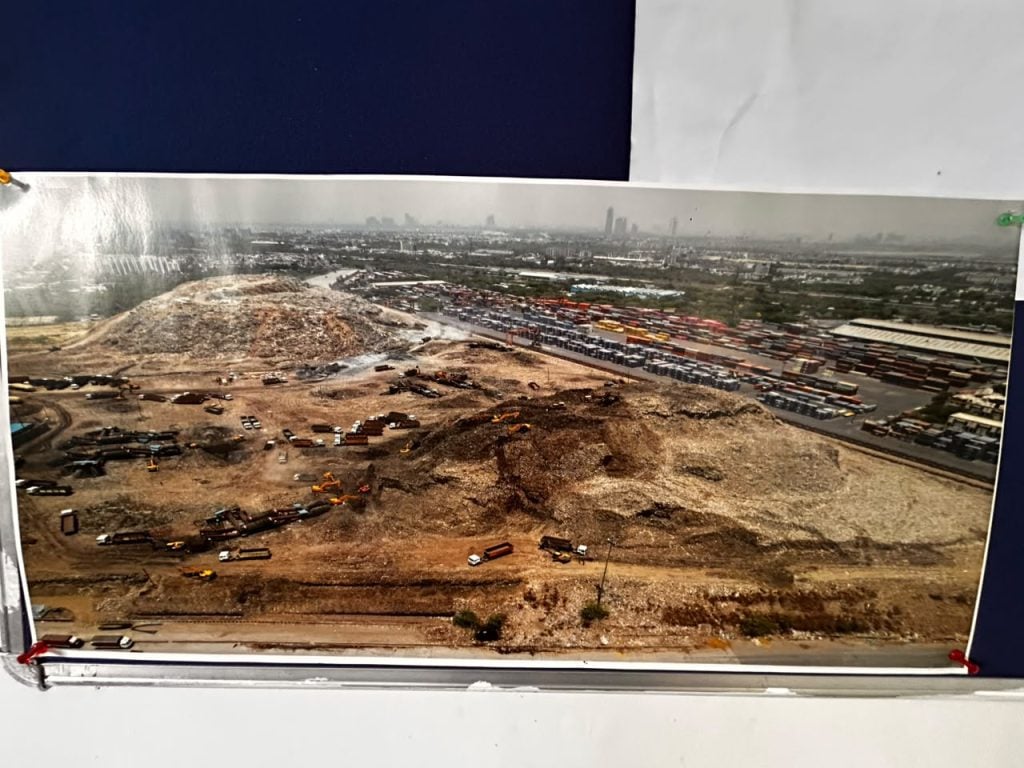
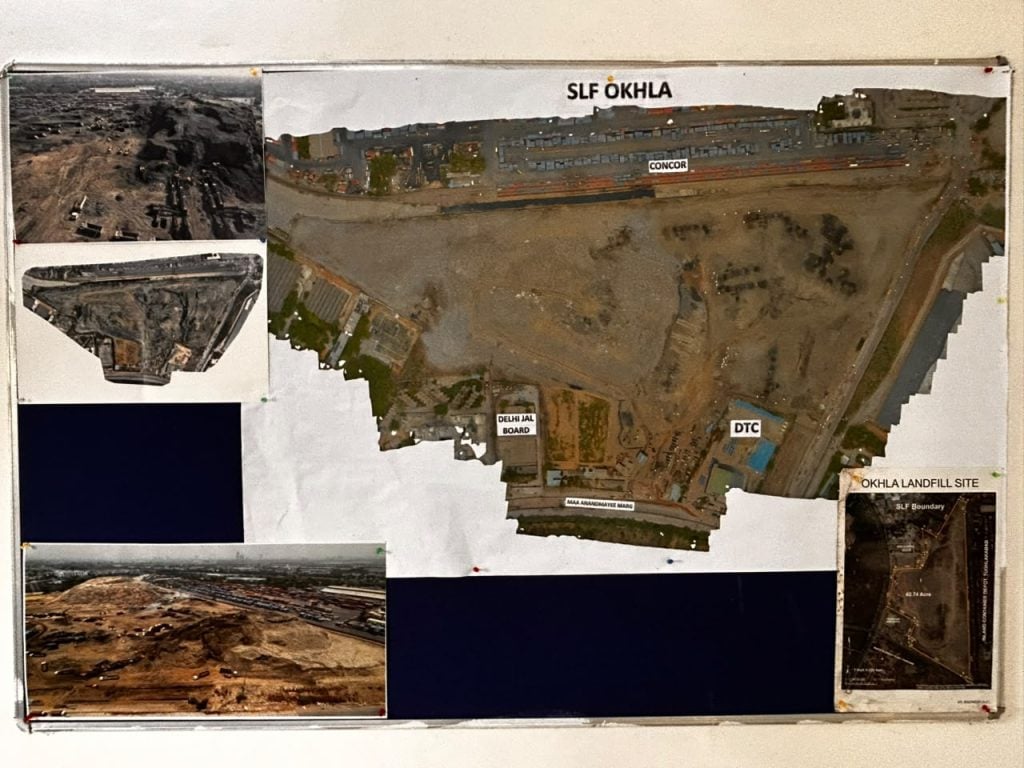
At the Okhla landfill site, inside a small MCD office, a big board displays before-and-after drone photos showing how dramatically the humongous garbage mound has shrunk. Where it once loomed menacingly over the landscape like a craggy cliff, it now looks like a couple of gentle hillocks.
MCD officials claim all three mounds have come down by around 30 metres over the last six years, but Okhla shrank fastest, helped by its smaller size and proximity to a waste-processing plant.
“In the case of Okhla the advantage is the waste plant, processing is faster,” said the MCD official.
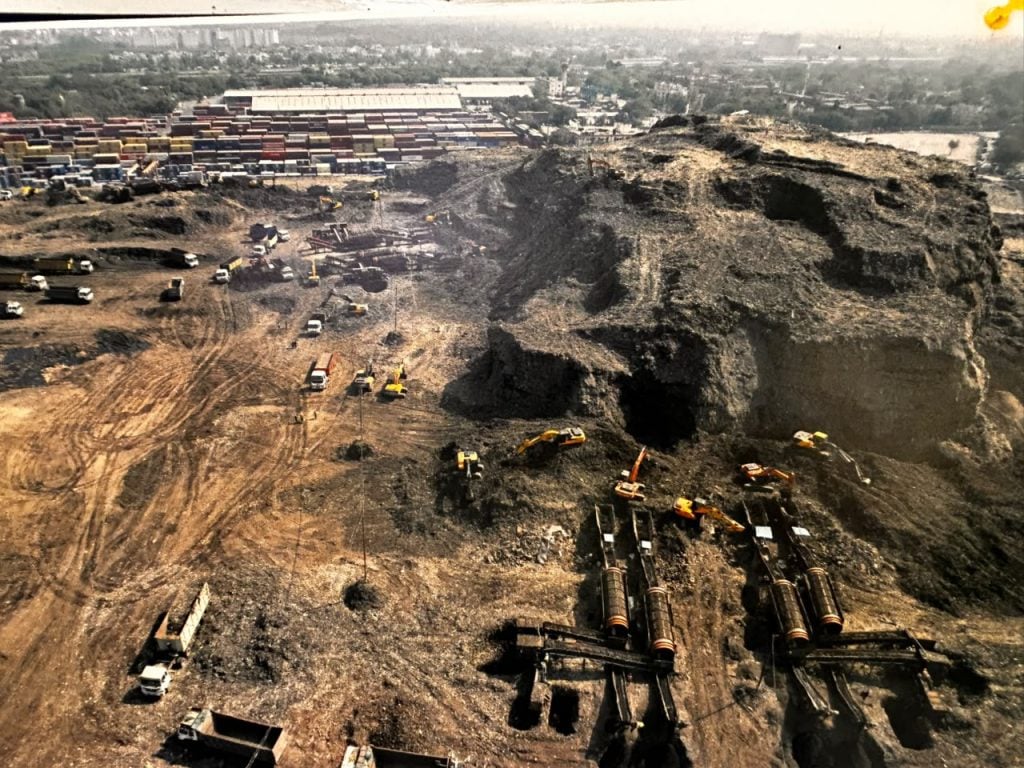
A ‘before’ drone photo of the Okhla landfill, showing the looming garbage mound before the current round of clearance | Photo: Manisha Mondal | ThePrint
Among the three, Ghazipur is the largest and most challenging. In 2019, when biomining began, it covered 70 acres and rose 65 metres. Bhalswa covered 36 acres and stood 62 metres high, while Okhla spread across 46 acres and was about 40 metres high.
Processing capacity is set to increase for all landfills over the next two years. Okhla’s existing waste-to-energy plant handles 1,950 tonnes a day and is being expanded to 2,950 tonnes by March 2027. At Bhalswa, a new 1,800-tonne-per-day fresh-waste processing plant has been approved on reclaimed land. Ghazipur is due to get an 800-tonne-per-day processing facility, as well as a new 2,000-tonne-per-day waste-to-energy plant by December 2028.
MCD officials told ThePrint that Ghazipur’s contractor has been finalised and that work there should pick up pace now.
Fresh vs legacy waste
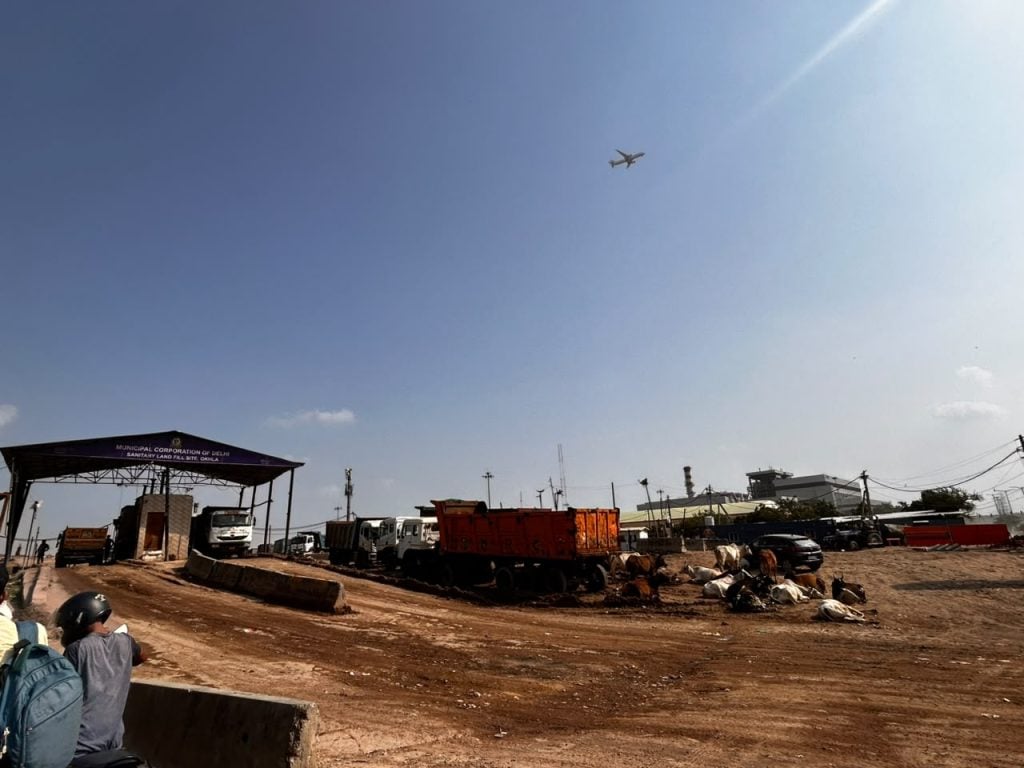
The smell has reduced at the Okhla site but trucks keep arriving to dump waste — about 2,800 metric tonnes of it every day. Biomining can clear more than that in a day, but only when conditions are right.
In August, the machines removed 6,000-9,000 tonnes a day. But between 3 and 11 August, that fell to just 650 tonnes a day because of rain.
“Rain has been a major problem during these months. Biomining gets tedious and exhausting during these months,” said Manish Jain, a senior MCD official.
Since the clean-up began, deadlines to clear the legacy waste and deal with fresh waste have repeatedly slipped. Okhla, which was earlier supposed to be cleared by 2023, now has a December 2026 deadline. Bhalswa, originally meant to be cleared by 2025, has also been pushed to December 2026. Ghazipur, the biggest of the three, has a deadline of December 2027.
Delhi Mayor Parvez Wahi, who inspected the Okhla landfill in July, said half the land had been cleared, and fresh waste arriving there would also be “processed and disposed of by December 2026”.
The current waste at the landfill is fresh, only months old, MCD officials said.
Also Read: Chennai is starting to clear the Perungudi garbage mountain. And make furniture from it
Black water, new garbage piles
The Okhla landfill has been a constant in Balaram Gupta’s life. He was born in Tehkhand village and now runs a small cart near ESI Hospital. Another constant for the 36-year-old has been political promises that the garbage mountain would disappear.
The CM’s video message said that the lives of people living near landfills had improved and that “property rates had gone up”.
Balaram Gupta attests that some progress is visible.
“There was less pollution and smell in the area in last one and half years,” he said. But not all the old problems have disappeared.
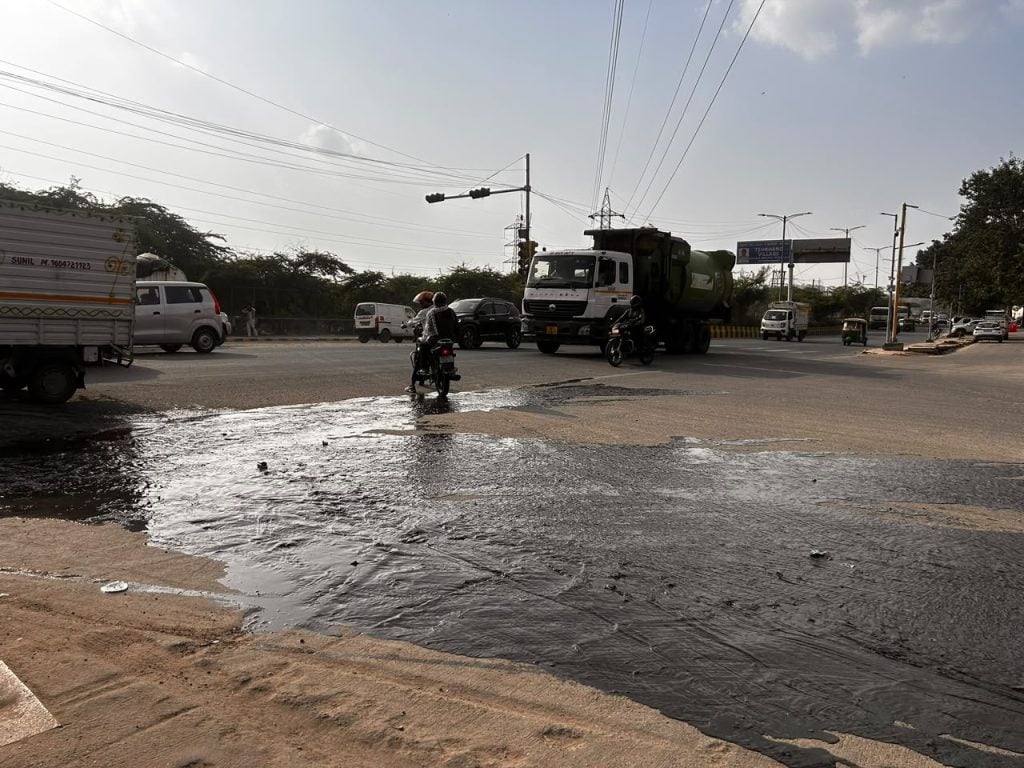
Near the landfill, a stream of black, foul-smelling water had filled the crossing. Cars drove through it and residents picked their way around it.
“Do not step into the water,” warned Anmol Kumar, a 60-year-old resident sitting nearby. He said he has seen this water for years. Though it has subsided somewhat now, the rainy season exacerbates the problem.
“During monsoon, this black water reaches the residences,” said Gupta. “Aam Aadmi Party made promises like the BJP, but none of them could find any solution.”
Preeti Kashyap, 30, who has lived for a decade in a low-income colony at Bajrang Chowk near Bhalswa, was initially pleased when she saw the mountain shrinking. The view from her terrace changed. But the garbage topography is resilient.
“One day when I went to the other side of the landfill, I saw another mountain rising,” she said.
(Edited by Asavari Singh)