



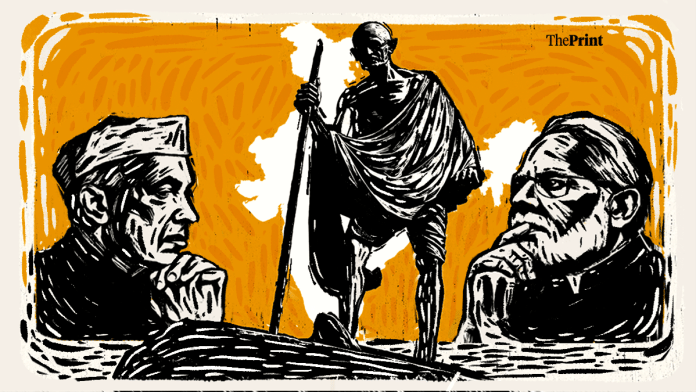
Post-Independence India was born in the turmoil of Partition, and war over Kashmir. Some armed conflict, external or internal, has bedevilled India in every decade since. But, who first justified India going to war? And what was his moral argument?
Let me hold back the answer for just a bit. Before that, an eternal question: Is India a soft state, chronically suffering from that Gandhian ‘offer the other cheek’ brainwash? Or, is it among the hardest post-colonial democracies, only cynically invoking the Gandhian pretence when convenient? My view, obviously, is the latter.
Mahatma Gandhi’s birth anniversary gives us a moment to lean back and examine a widespread belief that cuts across party lines—India is a soft state, and has conceded too much to the enemies outside and within; if only we had followed Sardar Patel, Netaji and Savarkar.
The overwhelming Gandhian indoctrination, the argument goes, was worsened by Nehru’s pacifist internationalism. This thrived under most governments that followed. It continues even now, with Donald Trump’s ‘humiliations’ going unanswered, and ‘unilateral’ outreach to repair ties with China, at the cost of a $112-billion trade deficit and no de-escalation following disengagement on the LAC.
The first is seen as submitting to a superpower, the other as an abandonment of all ambition of being a competitor to the deputy superpower, also our largest neighbour. In the 13th year of the Modi era, this is seen as more evidence that India was built as a soft, submissive Gandhian state incapable and unwilling to invest in hard power.
But facts and history point to the contrary. Given its economic and military limitations, India has mostly succeeded in punching above its weight.
Modern India might have been conjured up in Gandhi’s image. But, it was never a Gandhian state. Founders of the Republic, be it Nehru or Patel, nursed zero such notions. And if members of the Constituent Assembly romanticised Gandhi’s ‘India lives in its villages’ outlook, it was tossed aside skilfully and firmly by the seniors, especially Ambedkar.
And yes, you probably guessed right. It was Gandhi who blessed India’s first war. Far from there being a Gandhian overhang, it was the Mahatma who taught the nation, within the 10th week of gaining Independence, that going to war was virtuous, if your cause was just. We have a first-person, published account from a top warrior authenticating this.
Also Read: 2026 is like 1973 Indira-era oil shock plus youth anger. Modi has space, but not immunity
On 30 October, 1947, Lionel Protip Sen (later Lt-Gen) was a Colonel in the Directorate of Military Intelligence. Like most senior officers of that era, he was a Sandhurst-trained KCIO (King’s Commission Indian Officer). By that morning, the situation in Kashmir was dire. The commander of the state forces, Brigadier Rajinder Singh—who later became the recipient of India’s first Maha Vir Chakra, conferred posthumously—was killed in the fightback to hold the raiders in Uri.
The Maharaja had signed the Instrument of Accession. Indian forces were ordered to move to Srinagar and suffered a setback on arrival. Commander of the 161 Brigade, Brigadier J.C. Katoch, was shot in the leg and had to be evacuated. Sen was summoned by Gen Sir Rob Lockhart (India and Pakistan still had British army chiefs), promoted to Brigadier, and ordered to immediately replace Katoch. He was also advised to consult political leaders before catching the Dakota to Srinagar.
Accompanied by his senior, future Army chief Brigadier P.N. Thapar, Sen met Sardar Patel who suggested they brief the Mahatma before setting out. The meeting took place on the evening of 1 November in Birla House. For what transpired at the meeting, we have Sen’s memoir, Slender Was The Thread. Here’s what he wrote:
He (Gandhi) listened most intently and when I finished and asked whether he has any questions he would like answered, he replied, “No, no questions.”
After a few seconds of silence he continued, “Wars are a curse to humanity. They are so utterly senseless. They bring nothing but suffering and destruction.” As a soldier, and one about to be engaged in battle within hours, I was at a loss to know what to say, and eventually asked him: “What do I do in Kashmir?”
Mahatma Gandhi smiled and said: “You’re going in to protect innocent people, and to save them from suffering and their property from destruction. To achieve that you must naturally make full use of every means at your disposal.” It was the last time I was to see him alive.
It’s among the little-known moments in our history when Gandhi endorsed violence and war. And the pattern continued thereafter. For every criticism thrown at Nehru for taking Kashmir to the UN, the fact is, he fought to enhance India’s interests militarily.
He worked on narrowing the gap that Pakistan was creating with the latest NATO standard equipment and training. In this decade, India began getting the Hunters, Centurion tanks—for real money, not aid—from Britain. To sum up, there were many failures in his nearly 17 years as Prime Minister, particularly the debacle against the Chinese, but India was by no means a soft state. It fought Pakistan, took on China if unsuccessfully, swept aside the Nizam/Razakar challenge in Hyderabad, and liberated Goa from the Portuguese.
This was also around the time the Naga insurgency broke out. Nehru had no hesitation in sending in the Army, and enacting the Armed Forces Special Powers Act. Today’s AFSPA, therefore, was brought in by the supposedly peacenik Nehru.
Also Read: Trump brings the Age of Humiliation for friends. Modi needs stoicism abroad, humility at home
Nehru failed at many things, but not because he eschewed hard power. His successor Lal Bahadur Shastri is already immortalised for proactively shutting down Pakistan’s last chance to take Kashmir militarily.
Indira Gandhi has a more familiar history, including 1971. I don’t believe anybody would ever accuse her of making India a soft state. Prime Minister Narendra Modi has sometimes criticised her for using the IAF to break the Mizo rebel siege of Aizawl. She issued the orders within six weeks of her January 1966 swearing-in. History will debate the morality of using air power against your own citizens. But, isn’t it exactly what hard states do?
Morarji Desai is the closest we’ve seen to a pacifist Prime Minister. He famously told US President Jimmy Carter that, while Nehru’s ideal was Machiavelli, his was Gandhi. It was Desai’s short-lived government, however, that ordered the Jaguar, which the IAF is still flying.
The second Indira innings saw Operation Bluestar, and the brilliant move on Siachen. Should she have sent the Army into the Golden Temple or not is up for debate. But, she made India a still harder state.
Rajiv Gandhi had a patchy five years despite his big majority. He exercised India’s military muscle overseas for the first time. We’re talking Sri Lanka and the Maldives. He spent more on defence than any of our Prime Ministers, with defence budget crossing that rubicon of four percent of GDP. Even today, if India goes to war, much of the equipment used would have been ordered by Rajiv. He made the Indian state not only harder, but interventionist.
The coalition era followed, and India saw its first government that was pusillanimous on national security. V.P. Singh started out trading terrorists for his Home Minister’s daughter, who was taken hostage. Most terror accused in Punjab were released, and he showed nerves when the Pakistanis sent out a nuclear threat in the summer of 1990. The best thing about this government was its very short life. It was, incidentally, backed by the BJP.
P.V. Narasimha Rao inherited national security in shambles, with Punjab and Kashmir on fire, a hostile Clinton administration, and human rights organisations at India’s throat. How he responded, ending the insurgencies in Punjab and Kashmir, and rebalancing ties with the US is a story of restoration of the Indian hard state.
The successors, Vajpayee and Manmohan Singh, took two of the riskiest decisions: nuclear tests, and the nuclear deal. Whether Manmohan Singh erred in not retaliating for 26/11 will be continue to be debated.
Finally, the Modi years. The hard element came to the fore with the doctrine of retaliation. The surgical strikes, Balakot and Op Sindoor established a new normal. The only area Modi erred in, was not spending enough on defence in his first 11 years, and not giving the defence budget a top-up for the additional cost of OROP.
The Modi era also saw the annihilation of armed Maoism, something Manmohan Singh called our greatest internal security threat.
And finally, something counterintuitive. He’s been mocked with cries of ‘Narender-surrender’ for ceasing hostilities during Op Sindoor. Or, not escalating after the one set of air exchanges post Balakot. I’d call each also an expression of strength, not weakness. Stepping off the escalation ladder, when you have enough to show for success, is also an assertion of a hard state. At least on this aspect, Gandhi would be happy with the state of the nation.
Also Read: No country is ever fully sovereign. Cold War era taught India its real meaning