



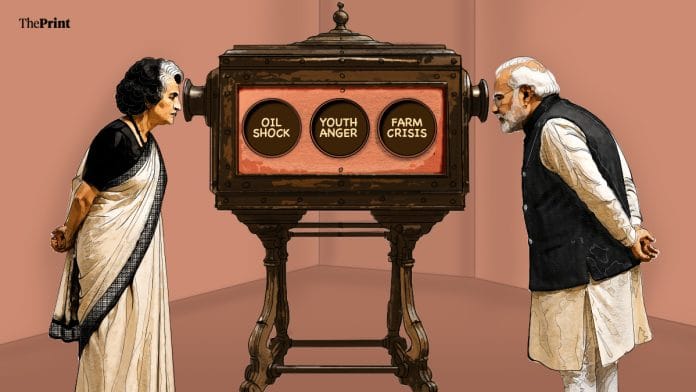

We might be conflicted over whose wisdom to use for history repeating itself: Karl Marx or Mark Twain. Marx said history repeats itself first as tragedy, second as farce. Twain argued that history doesn’t repeat itself but it often rhymes. A thoughtful look at developments today would indicate a return to the historic crisis of 1973. You can choose the words of Marx or Twain.
I’d prefer Twain to Marx because if I risk erring, I’d prefer to err on the side of optimism. Just that, if the turn of events today rhymes with 1973, it brings no gentle, benign, romantic tunes. Its essence is a prophetic lament, though we won’t call it apocalyptic just yet. That’s because India has grown far stronger in the past 53 years.
Let’s lean back to 1973. Indira Gandhi swept the 1971 general election, netting 80 percent of the seats with her allies CPI and DMK. Later that year she defeated Pakistan and Bangladesh was born. The next year, she swept, even more decisively, elections in 15 of the 19 states and Union Territories that went to the polls. The four where she missed out, Manipur, Meghalaya, Mizoram and Goa were tiny; the last two were still mere UTs. She was at the peak of her power and glory. She owned her party, Cabinet and Parliament. No Indian leader has enjoyed that kind of unchallenged sway. Narendra Modi is now close, and that’s another parallel with 1973.
As for Mrs Gandhi, things changed dramatically. First, India ran into consecutive monsoon failures in 1972-73. Consecutive monsoon failures are rare, and India had already endured 1965-66. These undermined the gains of the Green Revolution in the still predominantly agricultural economy. Then, in 1973 came the oil shock with the Yom Kippur War and the weaponisation of oil by the Islamic West Asian powers for the first time. Oil shortages and climbing prices compounded the distress of drought. And the young people in India got angry, first in Gujarat.
Their Navnirman Andolan (rejuvenation movement) wasn’t politically-led. The economic distress affected everybody: unemployment, rent and rising prices. In this case, the spark came from the rise in mess fees in college hostels. That morphed into an anti-corruption protest against Chief Minister Chimanbhai Patel (“Chiman chor”). Soon student activists in Bihar, notably Lalu Prasad Yadav and Nitish Kumar formed their own Bihar Chhatra Sangharsh Samiti and built an almighty protest mostly against price rise and corruption. They invited Jayaprakash Narayan (JP) to lead them.
Alarmed, Mrs Gandhi responded in multiple ways. Chimanbhai Patel was removed. Abdul Ghafoor in Bihar hung on through 1974 but had to go in April 1975. In the summer of 1974, Mrs Gandhi also carried out the Pokhran-1 nuclear test. She talked of dark conspiracy theories of foreign powers destabilising her government, the CIA in particular. Nothing changed the mood. Nothing would when unemployment had peaked and inflation touched 29 percent (28.60) in 1974. In September that year it was 34.68 percent, and whoever turned back a tsunami?
The weapon of mass destruction she used was on her own people. The Emergency remains a permanent blot on our democracy and it didn’t save her either. It was only a fair election and humiliating defeat that became her Ganga-snan in 1977.
Also Read: China insulated itself against energy shocks. India is ‘all talk, no walk’
Check out the events over the past 18 months and look ahead. A new oil shock is upon us with the war in West Asia. The industrial scale pullout of foreign portfolio investors (FPIs) has resulted in a $20 billion outflow. The FDI data is more or less a net zero as many big Indian companies are investing overseas. These put the rupee under pressure, ironically, against a weakening dollar.
The BJP erred grievously in the final UPA years by making rupee “strength” a political issue. It now has the reverse of a cricket batter’s nervous nineties. It’s afraid of the rupee reaching hundred to the dollar just as the batters are scared of missing out on a century by a run or two. Your currency will follow the logic of global markets and your economy’s health. Currency nationalism is and was always illogical. At least this we should have learnt from the Chinese who figured early enough they benefited from keeping their currency weak.
This oil shock mirrors 1973. Inevitably, the government will pass the price rise on to consumers, inflation will rise, unemployment will pinch more. Harking back to monsoon failures of 1973 is also the warning that this is an El Niño year though we don’t know how this’ll play out. Agriculture is a much smaller element in our GDP now than in 1973 but nothing affects more people than a farm crisis. That’s why, watch everybody’s mood, especially the young.
Some indications are clear. The NEET controversy reflects this anger. Our government talks of ease of doing business. But, spare a moment for the brutal unease of competing for the few jobs, or job worthy areas of education that exist. Between multiple level CATs, NEETs, JEEs, CLAT, the UPSC and its many poorer cousins, such as NDA, IMA, even Agniveer recruitment examinations and now CUET for simple college admissions today’s young Indian is caught hopelessly in a chakravyuha of the coaching centre economy.
It’s vacuum-cleaning the already stretched middle class finances and driving the lower middle class deep into debt. And, at the end of it all, you find that some crooks have gamed the system, the exams are cancelled, and you must do it all over again.
Also Read: Gulf war exposed India’s fragilities. It’s time for navel-gazing, in the national interest
Just how furious would these young Indians and their parents be? Especially when they find the government reaction blasé—we’ll lock up some crooks and hold the test again—and are resigned to this awful rinse-repeat cycle. Whether this anger is as intense as the fury over mess fees in Gujarat colleges or price rise in Bihar in 1973-74, is difficult to say. But, just the scale of the upsurge for what started out as a lark in reaction to an unguarded remark by the Chief Justice of India, the Cockroach Janta Party is telling us something. Within a week millions of young Indians have flocked to its social media handles, spooking the government into getting its X handle blocked. On Instagram, however, at 21 million at the time this was written, it was already two-and-a-half times the BJP’s following. Of course the Prime Minister himself is far ahead with 101 million.
As we said earlier, this is a different, much stronger India. Inflation will definitely rise, growth will slow down and government finances will suffer. Yet, there’ll still be some growth, and the Hormuz Strait will reopen at some point. The challenge for the Modi government is also lessened by the fact that today’s Opposition and its key leaders lack the credibility of their predecessors in 1973.
They had CVs already overflowing with a record of public protests, parliamentary craft, leading trade unions and farmers’ protests. Think George Fernandes, the master and commander of All India Railwaymen’s Federation who froze the great Indian rail systems in its tracks with a mere wave of his hand. Most importantly, those leaders had been mostly untouched by power yet, barring the fleeting Samyukta Vidhayak Dal interregnum in the late sixties. They were not exposed to the “they’re all the same” charge.
It’s these differences that persuade us to prefer Twain to Marx. These times rhyme with 1973. The factors we listed also give Modi government space. But, space isn’t immunity. If it doesn’t use the space wisely, come clean and carry out real reform—including in higher education—the space will vaporise. That “I too am a cockroach” impulse isn’t a mere canary in the coalmine. Instead, to confine our choice only to Indian birds, it’s like the honk of a peacock in anger.
Also Read: The Vishwaguru delusion, mine vs yours, is ruining our view of the world
It is surprising indeed that one leader is held responsible for difficult times and the other is poor victim of circumstances
Modi govt can subsidize petrol prices by saving budget by reducing the wastage on farm subsidies, reducing excess rice procurement and implementing Electricity Reforms.
Ms Sheela Bhatt posted a long tweet, asserting that the government will be in office for at least twenty years. The question ordinary Indians, whose plight this insightful, empathetic column brings out so well, will ask is, Why does no one talk about Achhe Din any longer. Not even on the election campaign trail.
I remember asking my father in Baroda in the summer of 1973, climate change lay far in the future, but Mrs Gandhi’s tiff with the Nixon – Kissinger administration was well understood, Does USA have the technology to engineer droughts in India.
The Editor and I share the same year of birth, 1957. There is also some telepathy. The comparison the column makes struck me a few days ago. How swiftly the national mood darkened for Prime Minister India Gandhi,. 1971 when she liberated Bangladesh, Durga, Empress. 2. We were in Poona when those two droughts struck in 1972 and 1973, Maharashtra hit especially hard. That became the genesis of the Employment Guarantee Scheme, the model for MGNREGA. 3. Then the first oil shock of 1973 which quadrupled oil prices. Almost all western democracies saw their leaders change, although it was Watergate that scalped Richard Nixon. 4. Sister had stayed back for a year in the hostel of MS University Baroda, so she gave us a first hand account of the Nav Nirman agitation. The railway strike organised by George Fernandes in early 1974 which would have paralysed the economy. Crushed with exceptional brutality. The finale came with Justice Sinha of the Allahabad High Court disqualifying Mrs Gandhi. The Emergency, which was an idyllic time for me personally in Calcutta because that is when my wife and I fell in love. So one will hope for a happy ending to what is now happening as well, the political capital is there to retrieve the situation.