



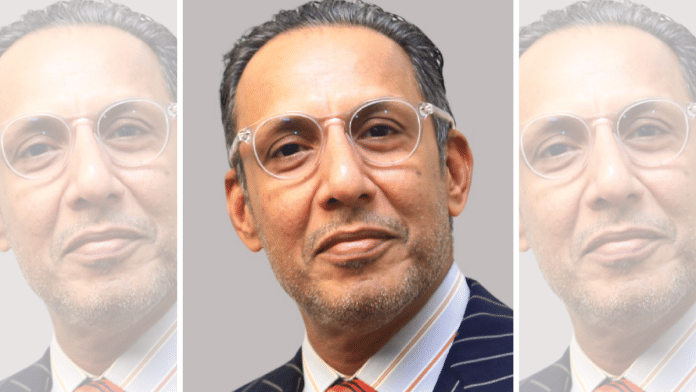
New Delhi: Back in 2010, NRI businessman Ahmed Buhari gave an interview to his alma mater, the Bayes (formerly Cass) Business School in London, elaborating his vision.
“Energising a billion plus people, with all types of energy…coal, nuclear, hydro, solar, gas, etc., starting charitable and educational institutions; we are already discussing a tie-up with Cass and our B.S. Abdur Rahman University. Starting a hospital, a bank and building my dream homes. And, generally having fun…,” Buhari, the promoter and director of Coastal Energen Power Ltd, had said.
The Chennai-based businessman, with a Master’s in Shipping, Trading and Finance from Bayes, went on to tick many of the boxes over a decade before the Enforcement Directorate (ED) arrested him in a money laundering case in March 2022.
Relief came last month for Buhari when a special PMLA court in Chennai dropped proceedings linked to the ED case.
In between these years, his firm Coastal Energen entered corporate insolvency and was taken over by Dickey Alternative Investment Trust (DAIT) and Adani Power in 2024.
Also Read: Facing ED heat in laundering case, ex-Haryana minister Kanda cites Delhi Police raids as defence
Entry into energy sector
Entrepreneurship ran in the Buhari family, according to the details available on the website of Chennai’s B.S. Abdur Rahman Crescent Institute of Science and Technology, which is named after his father.
Abdur Rahman was born to a pearl trader at the coastal port town of Kilakarai in Tamil Nadu’s Ramanathapuram district. The family is well-known in the state’s political and business circles.
Born in Hong Kong, Ahmed Buhari lived and worked across several countries including the UK, the UAE, India and Singapore, according to his LinkedIn profile. Initially, he had joined his family business, ETA-ASCON-Buharia Group, but later founded the Dubai-based Coal and Oil Group, an energy and infrastructure conglomerate, in 1997.
The group operates from Dubai and is engaged in mining, coal trading, shipping, logistics, and power generation across the Indian subcontinent and Southeast Asia.
Established in 2006, Coastal Energen was the power generation subsidiary of the Coal & Oil Group. According to Coal & Oil’s website, its clients included Goldman Sachs, Itochu, BHP, Sojitz, Mitsubishi, Morgan Stanley, Credit Suisse, ThyssenKrupp, among others.
It was Coastal Energen that built and initially operated the Mutiara Thermal Power Plant with an overall capacity of 1,200 MW in Tamil Nadu’s Tuticorin. Production commenced in December 2014. The plant was operated under the overall control of Coal & Oil Group through Mutiara Energy Holdings Ltd and Precious Energy Holdings Ltd—Dubai-based firms of the Buhari family.
It is now run by Moxie Power Generation Limited (MPGL), a joint venture between Adani Power and DAIT, after the National Company Law Tribunal (NCLT) approved their resolution plan of Rs 3,330.88 crore in August 2024. The Supreme Court then lifted the stay in September that year, effectively allowing the resolution process.
Case against Ahmed Buhari
According to the insolvency resolution documents, the Tuticorn power plant was bleeding money due to the absence of power purchase agreements at profitable tariffs and was failing to fulfil its debt obligations to its lenders, including the State Bank of India (SBI).
During the financial year 2016-17, it generated a revenue of Rs 1,880 crore, while the outstanding term debt as on 30 September, 2018 was Rs 7,227.09 crore.
As the debt was neither repaid nor restructured, the group of lenders acquired a 51 percent equity stake in Coastal Energen in 2018.
In 2019, the SBI admitted Coastal Energen into insolvency and sought its resolution. A total of three participants—Sherisha Technologies, Jindal Power and the consortium of DAIT and Adani Power, submitted their resolution plans.
The NCLT then approved the Rs 3,000-plus crore resolution plan submitted by the Adani-led consortium in August 2024 that paved the way for the takeover of Coastal Energen.
The Coal and Oil group, court documents show, was earlier composed of two entities: Coastal Energy Private Ltd (CEPL) and Coastal Energen.
Buhari and CEPL came under the scanner of investigative agencies in 2018, when the Directorate of Revenue Intelligence (DRI) flagged his subsidiary for allegedly inflating bills for imports of coal from Southeast Asian countries, primarily Indonesia.
Incorporated in 1997, CEPL was engaged in selling coal sourced from foreign countries. Coastal Energen, meanwhile, was incorporated in May 2006. The resolution process of CEPL is still pending before the Chennai branch of the NCLT.
CEPL, according to the DRI, obtained higher prices from PSUs in the power sector on the pretext of supplying higher-quality coal, but imported low-quality coal for supplying between the financial years 2011-12 and 2014-15.
In January 2018, the Central Bureau of Investigation (CBI) booked Buhari and his firm, and others on the grounds of over-invoicing by the NTPC and APCPL to the tune of Rs 487 crore across 147 consignments.
The ED took cognisance of the CBI’s case,initiated a money laundering probe and arrested Buhari in March 2022. It alleged that Buhari’s firm allegedly inflated bills on a total of 169 consignments, amounting to Rs 564.48 crore.
However, the CBI’s case did not move to the stage of a charge sheet until last year. Hearing a petition filed by Buhari’s counsels, the Delhi High Court asked the CBI to file a status report in the case. In September last year, the high court noted that the CBI did not dispute that it was “difficult to establish from the said samples that the coal supplied was substandard” as the NTPC had already used up the stocks.
Later last year, the Delhi High Court observed that Buhari and his firm were also exonerated by the Customs, Excise and Service Tax Appellate Tribunal (CESTAT) in the case probed by the DRI, which initially formed the basis of the CBI probe.
“Considering that a long period has elapsed and no material has been found against the petitioner so as to implicate him for the alleged offences, this Court considers this to be a fit case to exercise jurisdiction under Section 528 of the Bharatiya Nagarik Suraksha Sanhita, 2023 in order to prevent the further harassment to the petitioner and to secure the ends of justice,” Justice Amit Mahajan observed in September last year, quashing the CBI’s case.
Following the closure of the case, a Chennai court quashed the money laundering case last month for the absence of a predicate offence in April.
(Edited by Tony Rai)
Also Read: How HC order granting ‘limited’ relief to PMLA accused also outlined scope of ED’s powers & ECIR