







New Delhi: On April 30, 2025, a heavy silence filled the Union Cabinet meeting, the first since the Pahalgam terrorist attack eight days ago. India was reeling from the horrific incident. People were angry. They wanted action against terrorists. Some sought revenge.
Sitting at the head of the table, Prime Minister Narendra Modi demonstrated focussed calm. And then he delivered a chilling promise: “Wherever they are, we will not spare them.”
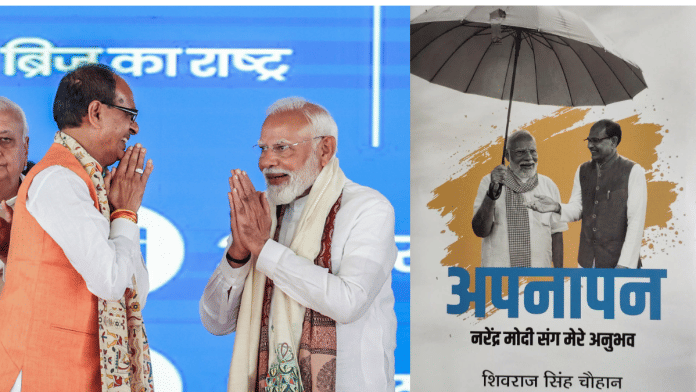
This gripping insider account forms the bedrock of Union minister Shivraj Singh Chouhan’s new book—‘Apnapan: Narendra Modi Sang Mere Anubhav—scheduled for release on 26 May.
The book, written in Hindi and published by Prabhat Prakashan, goes beyond the routine political script to reveal the inner workings of Prime Minister Modi—from planning Operation Sindoor, to appointing Nitin Nabin as the BJP president, and working the phones to evacuate Indians stranded in warzones.
“I repeatedly mention, especially at events in Gujarat, that Gujarat has given the country three great men (Mahapurush)—Mahatma Gandhi, Sardar Patel, and now Narendra Modi,” the Union agriculture minister writes.
In the book, the former Madhya Pradesh chief minister calls Modi a ‘rishi‘, a ‘tapasvi‘ and sheds light on different aspects of his leadership, personality and politics.
Across its 247 pages, the book chronicles Chouhan’s 35-year association with Modi. ThePrint examines five key events highlighted in the book that, according to Chouhan, reflect Modi’s fair and compassionate leadership.
Gujarat has given the country three Mahapurush—Mahatma Gandhi, Sardar Patel, and now Narendra Modi: Shivraj Chouhan in his book.
How Nitin Nabin was selected BJP president
After months of media speculation and multiple extensions to JP Nadda, the BJP appointed Nitin Nabin as the party’s national working president on 14 December 2025. He formally took charge as BJP national president on 20 January this year, becoming the BJP’s youngest president.
Many found Nabin a surprise pick. But Chouhan says it was a surprise only for those “unfamiliar with Modi’s method of seeking detailed feedback”
Chouhan writes that the announcement followed “months of analysis, deliberation, and discussion.”
“The fact is,” he mentions, “it was decided long back that the party would have to choose a president who was somewhat younger, a worker under 50 years of age.”
And the party indeed followed a detailed process, he writes.
“Nominations were invited from across India, and over 200 were shortlisted, and these were selected solely on merit. After detailed discussion on these 200 names, a shortlist of nine was finalised. Ultimately, from these nine, Mr. Nitin Nabinji was selected based on his background and track record,” he writes.
This highlights, Chouhan writes, Prime Minister Modi’s leadership style which “revolves around transparency, participation and fairness”.
“This is why the public has unwavering faith in him. He doesn’t seek faults during his feedback process; rather, he seeks to improve systems and maintain the dignity of every role. Through his work ethic, he sets an example for all of us that leadership doesn’t mean knowing everything yourself, rather learning from everyone around you,” he explains further.
Chouhan then goes on to write that PM Modi’s leadership isn’t just political but cultural.
“A culture where every idea is heard, every talent is respected, and ideology flows like a living stream, not like a book locked away in a museum. And whenever I sit with workers, I see their chests swell with pride when they recount, ‘Prime Minister Modi remembered my name. He inquired about my family’s well-being’. It would not be wrong to say that it is in such moments that great politics is created,” he added.
Operation Sindoor
The promise that PM Modi made in the 30 April Cabinet meeting was delivered within eight days. Indian armed forces launched Operation Sindoor on 7 May—targeting terror infrastructure and terrorists across the border in precision strikes.
The Union minister recalls the Cabinet meeting.
“I remember the silence in the room before the Cabinet meeting on 30 April 2025. It was the first Cabinet meeting a few days after the horrific terrorist attack in Pahalgam. Prime Minister Narendra Modi sat calm, focused, and with unwavering concentration,” Chouhan writes.
“He appeared the epitome of patience and determination. While any ordinary leader might have been overcome with panic, Modi remained composed, his eyes gleaming with determination. His statement to the Cabinet was clear: ‘Wherever they are, we will not spare them’.
“I witnessed this determination with my own eyes during Operation Sindoor on 7 May 2025. It was a precise and coordinated operation that demonstrated to the world how serious India is about the safety of its citizens. Each attack was carefully planned,” the book states.
He says that under PM Modi, a ‘new normal’ has been established against terrorism and history will record Operation Sindoor as a turning point. “When the operation ended, there was no unnecessary triumphalism. There was gratitude to the forces, caution about Pakistan’s response, and a clear message to the nation that India would remain steadfast in ensuring justice for the victims of terrorism.”
“Compare India’s response to Pakistan-sponsored terrorist attacks under Modi’s leadership, from the surgical strike in Pakistan-occupied Jammu and Kashmir (PoK) in 2016 to the air strike in Pakistan in 2019 and the demoralisation of the entire Pakistani army in 2025, with the Congress rule between 2004-14, where terrorist attacks occurred almost every month and India remained silent,” he says.
Chouhan also mentions that more than 20,000 Indian students were caught in the crossfire when Russia began its full-scale invasion of Ukraine in February 2022. Modi, he said, took immediate and decisive action and undertook the task of bringing every student back safely under Operation Ganga.
Chouhan said during the entire period, Modi spoke with the leaders of Russia and Ukraine multiple times, requesting the safe return of Indian students. “As a result, even in the face of fierce fighting, the armies of both sides temporarily halted hostilities and created a secure corridor, allowing buses carrying Indian students to pass safely and quickly. “
He writes that the Indian national flag, the tricolor, became a symbol of safe passage even in the fiercest battlefields. “India’s plan was so effective, and the power of the Indian tricolor so powerful, that students from other countries also relied on the Indian flag to safely exit Ukraine.”
Chouhan writes in the book that he has observed during Cabinet meetings that whenever a sensitive security situation is discussed, Modi gets straight to the point and insists on immediate action, as lives are at stake.
“This urgency, born of compassion, makes India a true Vishwabandhu (world friend), meaning a trusted friend of the world. All these experiences taught me that Modiji’s foreign policy is not just a calculation of friend and foe, but goes beyond that and serves humanity in times of crisis,” he adds.
Chouhan’s name missing from BJP’s MP list
The Union minister says PM Modi’s leadership is ‘filled with sensitivity and compassion’. He cites the example of 2023 Madhya Pradesh elections when his name was missing from the BJP’s first list of candidates.
“BJP tickets for the 2023 Madhya Pradesh Assembly elections were announced, and naturally, the first names were announced for seats where the party was relatively weak. It was also natural that my name was not included in the initial lists. At the same time, in a public speech, I said ‘Jab main chala jaunga, tab bahut yaad aaunga’,” Chouhan writes.
“As is often the case, my opponents twisted this and propagated that my political career was over. Some in the opposition ridiculed me, even saying, ‘Uncle has been buried’.”
Chouhan says that the Congress tried to create confusion and started sharing his statement by “distorting it” on social media.
“Today, when I recall that time, I recall not the Congress’s ridicule, but Modiji’s heartfelt compassion. Despite being extremely busy with the election environment, he personally called me,” Chouhan writes.
PM Modi asked Chouhan why he looked worried and asked him to seek guidance from some Guru if he followed one.
“He wanted me to pause, reflect, and reawaken my inner strength. His affection touched my heart. A leader immersed in national responsibilities was also concerned about my personal situation—that’s true sensitivity,” he said.
Following the PM’s advice Chouhan went to Uttarakhand, watching the flowing water and the immovable mountains gave him clarity, he writes.
“I fully understood what Modiji had done. His affection wasn’t just for me; it was also strategic. He understood well that if misleading media reports demoralised me, the impact would reach our workers. By standing with me emotionally and expressing personal trust in me, he not only bolstered my morale but also that of thousands of dedicated workers,” he writes.
“This is the highest level of leadership—where compassion and strategy blend seamlessly. I was also humbled that he had personally gauged my feelings from my mere statement and called me. His words were both guiding and reassuring.”.
The BJP won those elections, but Chouhan was not made the chief minister, which went against popular expectations.
Chouhan writes he was not upset over not being named the chief minister. A new opportunity awaited him six months later.
On 9 June 2024, he was sworn in as a Cabinet minister in the third Modi government.
“I was given responsibility of the Ministry of Agriculture and Rural Development. At that very moment, I realised that Modiji had me in mind when he spoke to me during the swearing-in ceremony in Bhopal.”
Feedback mechanism
The book also sheds light on how Modi uses ‘feedback mechanism’ to gather information about people, programmes and policies.
Chouhan recounts an incident when he received a phone call from the PM after the conclusion of the Pravasi Bharatiya Divas in Indore (Madhya Pradesh) in 2023 and asked him how it was received.
Chouhan, who was then the chief minister, told the PM that it was a good programme and people were satisfied with all the arrangements and they had a good experience.
However, the PM went on to quiz him over the feedback mechanism and asked whether he had such a system in place. Modi also termed it inappropriate that both Chouhan and Union minister Jyotiraditya Scindia made long speeches while three presidents were seated on the stage.
“He then shared with me the information he had already received: the hall was running out of space; some officials had improperly occupied the seats reserved for guests; the atmosphere had become noisy, and the conference delegates who had been left outside due to the crowd were also upset.
“But more important than all this feedback was Modi’s reminder of formal etiquette. Three presidents were seated on the stage at that event: Dr. Mohamed Irfaan Ali of Guyana, Mr. Chandrika Prasad Santokhiji of Suriname, and our then President Mr. Ramnath Kovindji. He said that when such distinguished guests are present, the speeches of those speaking before them should be brief and to the point, whereas Jyotiraditya Scindia and I had given lengthy speeches. Modiji then advised me that ‘in such a situation, a short speech is sufficient. Taking too much time for a speech is not appropriate’.”
“This approach to Modiji’s work ethic is evident in every aspect of his leadership. His approach to feedback isn’t limited to programmes—it extends to policies, good governance, and the selection of responsible individuals. Whether appointing a Vice President or a Governor, sending someone to the Rajya Sabha, or assigning key responsibilities, Modiji never lets personal likes and dislikes get in the way.”
He writes that Modi solicits opinions from many, thoroughly evaluates them, and ensures no one is overlooked. Those who work with dedication, even if they stay out of the spotlight—their hard work never goes in vain.
“Their dedication is not overshadowed by the noise of high-level politics. I personally witnessed this comprehensive and well-planned process employed by Modiji during the recent election of Shri C.P. Radhakrishnan as Vice President of India,” says Chouhan.
Modi’s tenure a ‘golden chapter’
Chouhan describes Modi in the book using phrases such as ‘rishi’, ‘samaj sudharak’, ‘tapasvi’, ‘Mahapurush’ among others, and says his tenure can be described as a ‘golden chapter’ in India.
“In more than three decades of public life, I have met many leaders. Some pursue power, some seek recognition. Only a few are true great men (Mahapurush): those who change the course of history as well as the future. I can say with complete honesty that when Modiji assumed the executive office, it marked a turning point in India’s political history,” he writes.
Under the subtitle – Vistar, Satikata aur Saflata: Modi Cabinet ka tareeka—Chouhan sheds light on how the Modi cabinet functions.
Chouhan writes in the book that while people think Cabinet meetings are merely formal, where one person speaks and the rest simply nod in agreement, the reality is quite different.
“My experience of Cabinet meetings under the Modi government has been quite different. There, the Prime Minister encourages every member to express their opinions openly,” the Union minister writes.
“He often enters a meeting, looks around, and asks in a very casual, friendly tone, ‘if anyone wants to say something, they can’. If there is a need for discussion, Modiji immediately suggests that a meeting be held again on that topic to understand its practical aspects and to check whether our timelines are realistic or not,” he said.
“I have seen many times that when a minister proposes a new perspective or idea, Modiji, without hesitation, puts the proposal on hold for reconsideration, even if it has already been finalised for cabinet approval,” he writes.
This is a hallmark of his governance style where decisions are not made hastily, but based on depth and foresight, Chouhan writes.
Chouhan says it is this inclusive approach that helps the government reach better and more practical solutions.
Chouhan then goes on to describe one of the most distinctive features of Modi’s leadership style—he listens more and speaks less. “I’ve never seen such a listener before.”
The Union minister says in the book, “Even in the party’s Central Election Committee meetings, Modi never speaks first. The BJP chief minister of the state being discussed speaks first; if the BJP doesn’t have a government in that state, the opposition leader from that state speaks on behalf of the BJP,” he writes.
Modi offers his suggestions only after listening carefully to everyone, according to Chouhan. “He doesn’t impose decisions, but builds consensus. His leadership is marked by humility, discipline, and respect for collective intelligence, all of which are rare in today’s politics.”
Chouhan further terms Modi as a ‘Karmayogi with an ascetic spirit’.
Duty, Chouhan says, demands clarity and that “we proceed with both courage and caution”.
“This same balance between emotion and duty is also reflected in Modiji’s leadership in collective decision-making within the Cabinet. I believe the reforms undertaken during Modiji’s tenure also played a major role in the success of Operation Sindoor. The creation of the Chief of Defence Staff, integrated theatre commands, joint logistics, tri-service training, and networks like the Integrated Air Command and Control System (IACCS) have made our armed forces a future-oriented force,” he adds.
(Edited by Ajeet Tiwari)
Also Read: How MP’s ‘Mama’ Shivraj Singh Chouhan, under siege from within, turned things around for BJP