






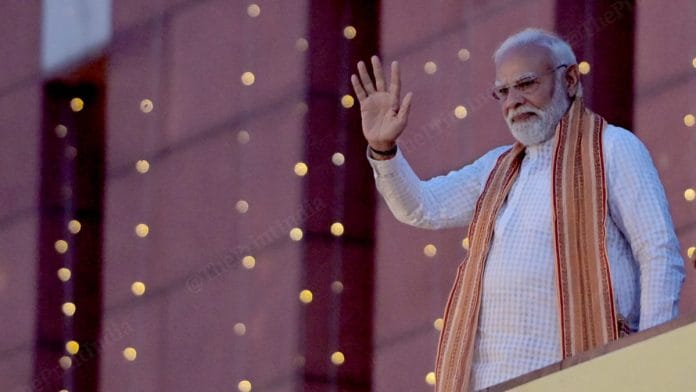


Prime Minister Narendra Modi completed an uninterrupted stint of 4,399 days in office on Wednesday, overtaking Jawaharlal Nehru’s record of 4,398 consecutive days as India’s first elected PM. Brace yourself for a surfeit of paeans and eulogies in the coming days. Mind you, BJP president Nitin Nabin is likely to announce his new team in the next fortnight. It may coincide with PM Modi carrying out a major Cabinet revamp.
Modi’s latest record is calculated on two parameters — a democratically elected PM and an uninterrupted stint. It counts Nehru’s prime ministership from the first parliamentary election of 1951-52, excluding his initial tenure as a non-elected PM.
BJP leader Ram Madhav highlighted several milestones: “He (Modi) will also have crossed 9,000 days in office as an elected head of government by then, including his 13-year stint as Gujarat CM—overtaking CMs like Pawan Chamling (Sikkim) and Naveen Patnaik. Come October, Modi will complete 25 years in public office.”
Last July, when Modi had surpassed Indira Gandhi’s record of 4,077 consecutive days in office, the BJP listed “record breaking highlights”: first and only prime minister born after India’s Independence; longest-serving PM from a non-Hindi speaking state; and the only leader in India to win six consecutive elections as party leader — three to a state Assembly and three to Parliament.
The list of firsts was long. It grew longer on Wednesday. Politicians love records. See how the Congress high command waited for Karnataka Chief Minister Siddaramaiah to break Devaraj Urs’ record as the state’s longest-serving CM before making moves to replace him.
For all we know, PM Modi may go on to break another Nehru record—that is, around 17 years in office with his ‘non-elected term’ included. An opposition leader told me tongue-in-cheek: what if Modi decides to set a new record next year—the first Prime Minister to become the President of India, too? Wishful thinking, I guess.
Their political legacies
Coming to Modi versus Nehru debate, I am not getting into the governance part. From economy to foreign policy, national security, et al, reels have been written about their respective achievements or failures. The India of the 1950s and 1960s was different from 21st–century India; its challenges and opportunities in the two eras were different. Therefore, contemporary debates over who performed better are largely dictated by which side of the ideological fence the debater sits. I would focus on their political legacies.
One, Nehru inherited a party of the freedom movement that barely faced any opposition. In the 1951-52 general election, the Congress won 364 seats, with the Communist Party of India being the largest opposition with 16 seats and the Socialist Party being the second-largest with 12. In the 1957 election when the Congress got 371 seats, the largest opposition was the CPI with 27 and the Praja Socialist Party the second-largest with 19. In the last election with Nehru as prime minister, in 1962, the Congress got 361 while the CPI got 29 and the Swatantra Party 18. The Jana Sangh secured 3,4 and 14 seats respectively in these elections. Much changed in the country’s politics in the next 52 years, including Atal Bihari Vajpayee’s six years as the Prime Minister. The Congress weakened much during this period but remained the only pan-India party (with some other parties being national parties only in a technical sense).
Modi’s 4,399 days as the PM have changed it all. The BJP is the only pan-India party today. To an extent, it’s a return to the Nehruvian era, with the Opposition becoming politically irrelevant—not in terms of their numbers in the Lok Sabha but in terms of their ability to influence national policies or programmes. Indira Gandhi and Rajiv Gandhi also ran majority governments, but the opposition wasn’t as ineffective then as it is today when Modi’s party has only 240 members in the Lok Sabha. To cite just one instance, think of the parties that were once the biggest advocates of individual rights and liberties choosing to remain silent as live-in relationships are subjected to state regulations.
Two, the Leftist-Socialist ideology in its various hues and forms — including the so-called centrism of the Congress that mostly veered to the Left — remained the core reference point in national political discourse from the Nehru era until 2014. It has decisively shifted to the right during PM Modi’s tenure, with every party struggling to readjust its politics and ideology in reference to the BJP’s Hindutva politics.
Also read: The real Modi story begins where comparisons with Nehru end
A BJP beyond Modi
Three, the beginning of the Congress’ decline had coincided with the rise of regional parties and advent of coalition governments. Their ascendancy could very well be traced to Samyukta Vidhayak Dal governments in several states in 1967, barely three years after Nehru’s death. The first regional party to prop up a government at the Centre was the Dravida Munnetra Kazhagam (DMK) that—along with the CPI—supported the Indira Gandhi government after the split in the Congress in 1969. It did not take many years after that to see coalition governments become the order of the day, especially from 1989. Regional parties, for good or bad, started ruling the roost at the Centre and in many states.
PM Modi’s 4,399 days in office have seen a reversal of this trend, with the Trinamool Congress becoming only the latest regional outfit to be felled by a national party. It’s still too early to predict the end of regional parties. The Modi government depends on regional parties for a majority in the Lok Sabha and there are quite a few such as the Samajwadi Party still guarding their turf. But, overall, the clout of regional parties is shrinking by the day with the BJP either felling them—like it did to the Trinamool Congress and the Biju Janata Dal—or coopting them before eventually reducing them into useful dependents.
Four, where Modi scores over Nehru is how he has made the BJP future-ready — to the extent that he has made the party independent of himself. Opposition leaders may be desperately hoping for PM Modi to hang up his boots but that’s wishful thinking. He is no longer the sole winner for the BJP. Otherwise, the party wouldn’t have won Haryana and Maharashtra Assembly elections, barely six months after the party did badly in those states when it sought a renewed mandate for PM Modi in the 2024 Lok Sabha election. And it has won many more elections after that. The Opposition may blame the rise of majoritarian politics, institutional breakdown, vote theft, money power and whatnot, but the BJP’s organic growth is undeniable. To make the party grow beyond his individual charisma is an achievement none of PM Modi’s predecessors could claim.
DK Singh is Political Editor at ThePrint. He tweets @dksingh73. Views are personal.
(Edited by Aamaan Alam Khan)
Nehru donated about 200 crores inherited by him in 1946 and its worth is more than Rs 50000 crores. Modi instead has handed over the country’s resources to Gautam Adani, whose net worth surged from approximately $7.1 billion in 2014 to over $116 billion by 2024, an explosive growth of over 1,500%. Someone please explain the maths in zeroes to Modi bhakts.
I don’t think the BJP will ever create another leader to equal or surpass him.