






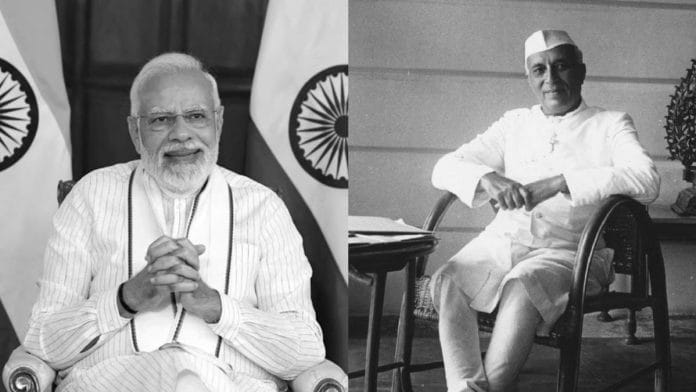


The fact that Narendra Modi would surpass Jawaharlal Nehru as the longest-serving elected Prime Minister (4,399 consecutive days, to be precise) is not just a matter of numbers and statistics. There is a sharp contrast in every aspect of their lives, whether it be personal, political, social, or even spiritual. Nehru was born with a golden spoon in his mouth, educated at Cambridge, and he never worked at the grassroots level. First to be nominated (un-elected) prime minister, he advocated liberal and socialist views, and was allergic to anything that is remotely connected with Hindu ethos. Nehru showed gross neglect (and in some cases even contempt) for national security.
On the other hand, Modi was born in a modest family of a tea seller, completed his education in Gujarat, and spent formative years of his life understanding India by extensive travel. He first did it alone and then, as Pracharak of RSS. Modi inculcated values of dedication and commitment toward a national cause in the minds of thousands of men and women. He became Prime Minister by winning people’s mandate and has only pride in the country’s ancient heritage.
Profit no longer a dirty word
Nehru was an opponent of capitalism in any form. He linked it with exploitation. Naturally, he was also allergic to wealth creation. He described profit as a “dirty word” in one conversation with JRD Tata. He created a license raj discouraging private investments, built public sector enterprises that were mostly white elephants, with outdated technologies, inefficiencies and corruption.
Modi is always focused on outcomes, whether it be giving financial muscles to small entrepreneurs, privatisation of loss-making PSUs (like Air India, which was originally Tata Airlines but was nationalised by Nehru in 1953), and making other PSUs profitable. He eliminated thousands of outdated laws that were a legacy of the British Raj and the Nehru government. He also nurtured a start-up and innovation ecosystem in India, making young people job creators rather than job seekers. Today, India has 1,50,000 plus startups and more than 100 unicorns. Over a decade, Indian startups are estimated to have raised in excess of 100–150 billion dollars of funding.
The difference is very stark on the issue of national security. Nehru always gave it a low priority. He admitted that it was a risky approach. But he still did it. The colossal failure of this policy was the 1962 aggression by China, which exposed weaknesses of the Indian security apparatus. He described Aksai Chin as a terrain where “not a blade of grass grows there.”
Also read: Hidden pracharaks, coded postcards, and secret meals kept the RSS alive under Emergency
Modi’s land of opportunities
On the contrary, Modi implemented a long-awaited plan of modernisation and rationalisation of security forces, created an integrated command and control structure in the form of CDS, equipped them with modern tools of warfare, brought private players, start-ups and innovators in defence R&D and manufacturing, and at the same time strengthened public sector defence manufacturers.
This comparative analysis can fill thousands of pages. But the real Modi story begins where his comparison with Nehru ends.
Whole of the government: This is the underlying common principle of governance under Modi. This has resulted in bringing all the key stakeholders on the same platform, therefore making decision-making processes quick and effective. Mind-boggling statistics of some of the multi-departmental, inter-state projects such as infrastructure, GST, and DPI are just a few examples. It is indeed a paradigm shift in the functioning of government.
India as a friend when someone is in need: Covid‑era vaccine diplomacy is one of the concrete examples of this principle. Under Vaccine Maitri, about 160 million doses were shipped to roughly 100 countries, spanning immediate neighbours as well as Small Island Developing States (SIDS) and partners in Africa and Latin America. Beyond vaccines, India has mounted multiple large‑scale evacuation and humanitarian operations—airlifting its own citizens and foreign nationals from conflict zones, and sending food, fuel, medicines and medical teams in the Indian Ocean Region and beyond.
Economic success story: India is now the fastest‑growing economy, outpacing most G20 peers including China. More than 250 million people have exited multidimensional poverty in this period, which the government presents as a key driver of rising social optimism and expectations. This is a gigantic shift from a “fragile five” economy to an emerging economic pole in a multipolar world order.
India as a land of opportunities: The country’s internet subscribers have grown from roughly 250 million around 2014 to close to 1 billion by the mid‑2020s, with average monthly data consumption going up from 1 gigabyte to over 20 gigabytes per user. This rapid diffusion of cheap mobile data has effectively brought hundreds of millions into the digital economy, expanding access to education, services, and markets.
Official narratives emphasise that India has climbed over 40 places in the Global Innovation Index since the mid‑2010s, and that R&D spending has roughly doubled while annual patent grants have multiplied more than ten‑fold.
Resolute India in national security: Under Modi, India has signalled a more “muscular” national security posture through both action on the ground and reforms. Strategically crucial displays of India’s security muscle in Operation Sindoor, surgical strikes, Air strikes and abrogation of Article 370 and 65(A) (which was again a painful gift of Nehru to the Indian people) are a few such examples.
Pride in India’s civilisational heritage: The Modi government’s “New India” discourse is explicitly rooted in a civilisational self‑image, but it is useful to see how this translates into policy and international initiatives rather than rhetoric alone. Promotion of Yoga, Ayurveda, Millets, etc are now hallmark of India’s soft power diplomacy. PM Modi humbly prays to Ram Lalla in Ayodhya and Mahadev in Somnath, inaugurates a temple in Abu Dhabi, visits temples, Gurudwaras, Buddhist shrines, churches and even mosques all over the world. Unlike Nehru, who tried to put multiple bottlenecks in rebuilding the Somnath temple and put the Sengol in hiding.
No wonder India under Modi displays satellites, Brahmos, DPI, green diamonds, Varanasi, Amritsar, or Mahabalipuram in front of a global audience and not snake charmers.
Vijay Chauthaiwale is in-charge, foreign affairs department, BJP. He tweets @vijai63. Views are personal.
Read the article and then read about the author at the end!!! Even Modi will be embarrassed by this flattery!!
No wonder sycophants like Vijay Chauthaiwale give Modi the courage to divide our society by othering some communities who are irrelevant to his electoral victory.
Modi has made India an Electoral Democracy! The institutions are eroded and become powerless, be it the SC, Election commission, Police/ED, Governorship and even our military.
Sad to see such an evaluation that belongs more to Whatapp forwards than to an actual analysis and a prestigious magazine such as ‘The Print.’