



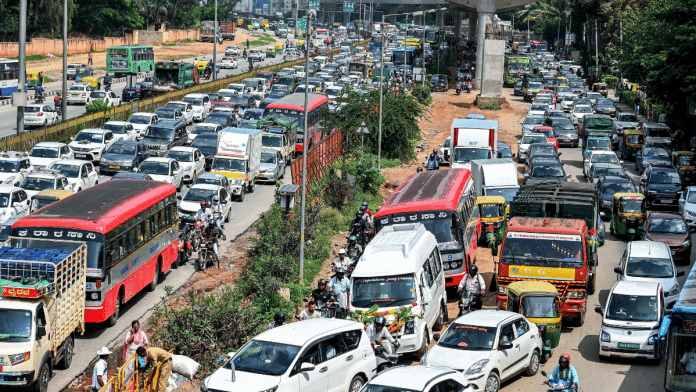
Bengaluru: Karnataka’s Home and Transport departments are exploring ways to overcome regulatory hurdles around carpooling and help decongest Bengaluru, ThePrint has learnt.
The departments are also considering updating outdated regulations to facilitate shared mobility. “We have had preliminary discussions and our legal teams are meeting on Saturday (3 October) to see if and how we can make this possible,” a senior government official, requesting anonymity, told ThePrint.
Carpooling currently falls into a grey area under the Motor Vehicles Act, 1988, which does not recognise it as a separate category. The law states that private vehicles with white number plates cannot be used for hire or reward without a commercial transport permit.
While informal carpooling is not prohibited, the regulations pose challenges for app-based services. Several such platforms continue to operate, but authorities consider them illegal because the Motor Vehicles Act has no specific provisions governing them.
For such services to operate legally, “we must amend the existing MV Act,” the official said. Adding, “There are safety concerns, and the law currently only allows commercial vehicles or yellow taxis for such services.”
After a meeting with state Transport Minister Byrathi Suresh, Home Affairs and IT Minister Priyank Kharge said the government was exploring several shared-mobility measures, including carpooling and shared rides. These include a possible ‘One City, One Fare’ framework for mobility aggregators, updating Karnataka’s Aggregator Regulations in line with the latest central guidelines, and regulating unregistered electric bikes.
Had a discussion with Sri @byrathi_suresh and Dept of Transport on:
• Point-based system for suspension of driving licences for repeat traffic offenders
• State policy for carpooling and shared rides
• Stronger penalties for violations that cause congestion or endanger… pic.twitter.com/pfbMJh4vLT
— Priyank Kharge / ಪ್ರಿಯಾಂಕ್ ಖರ್ಗೆ (@PriyankKharge) September 30, 2026
Though Karnataka, particularly Bengaluru, prides itself as the ‘startup capital’ and ‘innovation hub’, experts say archaic laws have failed to keep pace with technological advances, often creating friction between authorities and new mobility technologies.
Currently, autorickshaw driver unions have opposed the operation of bike taxis in Bengaluru, while regulations governing carpooling remain unclear. The uncertainty has contributed to repeated confrontations between different sections of the city’s mobility ecosystem, sometimes involving consumers.
Also Read: Bengaluru may be stuck in traffic, but its AI future has already arrived
‘No clarity on regulations’
Several employees of large corporations in Bengaluru use carpooling platforms such as Quick Ride. The app claims to have more than 45 lakh users and over 40 lakh completed rides. It also claims to have helped reduce more than 85,117 tonnes of CO2 emissions.
K.N.M. Rao, founder and CEO of Quick Ride, said the service continues to operate but lacks regulatory clarity. “If there is clarity that the government is encouraging carpooling, then tech parks and others will also get on board and this model can be scaled up,” Rao told ThePrint.
Service providers have approached the Karnataka government several times, Rao said, but have not received clear timelines for proposed guidelines.
He added that several IT companies were interested in adopting carpooling as it could reduce lost productive hours, carbon emissions and the need for parking space on their campuses.
Quick Ride lists several companies on its app as users of its services. One testimonial is from Wipro’s transport department head Danya Kumar, who said more than 40,000 employees had registered for carpooling through the platform.
“We have more than 40,000 Wiproites registered for carpooling through Quick Ride and as a sustainability initiative, we adopted carpooling with Quick Ride. Happy to see we have saved 12 percent of parking space and lots of carbon footprints. Carpooling also helped us optimise employee transportation costs,” he is quoted as saying on the app.
However, regulatory crackdowns have raised concerns among users. In 2016, the Karnataka Transport Department cracked down on Bengaluru-based startup Zipgo, which offered services similar to Uber Shuttle. The action reflected the authorities’ position that private operators could not run a ‘contract carriage’—a vehicle hired by one person or party to transport passengers—as a ‘stage carriage’, which picks up unrelated passengers.
Uber Shuttle is also currently unavailable in Bengaluru.
Rise in private vehicles
Rough estimates suggest that 1,500-2,000 new vehicles enter Bengaluru’s roads every day.
In June 2026 alone, 78,084 new vehicles were registered, taking the total number in the city from 1,27,32,832 to 1,28,10,916. The figure includes two-wheelers, cars, tractors, taxis and other motor vehicles.
Of these, 13,519 were passenger cars, taking the total number of cars in the city to more than 25 lakh.
Delays in mass-transit projects such as the Metro, the stalled Suburban Rail project, a stagnating bus fleet and poor road quality have increased reliance on private vehicles, adding to congestion.
In Bengaluru, successive governments and civic authorities have also pursued projects such as the proposed Tunnel Road and elevated highways to ease traffic. Experts, however, have argued that such road-expansion projects can encourage greater dependence on private vehicles.
In 2019, Bengaluru was ranked as having the worst traffic among 415 cities in 57 countries by TomTom, the Netherlands-based provider of navigation, traffic and mapping products. Bengaluru and several other Indian cities have continued to feature on the company’s traffic rankings.
A study by traffic expert M.N. Sreehari estimated that congestion causes an annual economic loss of Rs 20,000 crore in Bengaluru.
While congestion is a problem in several Indian cities, its scale is particularly pronounced in Bengaluru. “Carpooling and private vehicle lending offer a practical, scalable response. Yet these services continue to operate without regulatory recognition, tailored insurance frameworks or industry-wide safety standards,” said the Personal Vehicle Pooling & Sharing Association, an advocacy group that began operations earlier this year.
Sanjeev Kumar Lohia, a retired IAS officer and secretary general of the association, said it was working with several government agencies to make carpooling and ride-sharing more widely accepted.
“We are trying to work with multiple governments to help formulate guidelines and help car pooling come up. I am helping bridge the gap between what the government is thinking and industry aspirations,” Lohia told ThePrint.
(Edited by Chingkheinganbi Mayengbam)
Also Read: Won’t hire men from UP, Bihar, Rajasthan, MP: Bengaluru entrepreneur faces backlash