





The first thing I noticed about Bengaluru was how slowly it moved.
It was my first time in the city, and within hours, I had taken a Rs 600 cab ride, watching two hours disappear as I travelled to a place that looked pretty much the same as the one I had just left.
The driver was chatty. He was very eager to tell me how much people earn in this city, how much he earns, and how, despite all that money floating around, nobody seems to have any sense of peace.
As the cab inched forward, I found myself thinking about how quickly I could have made this journey in Delhi. Two metro lines, perhaps a short walk, and I would be there for a fraction of the price.
That, I had always thought, was development.
But over two weeks, Bengaluru gave me a very different idea of what moving forward could look like. What I hadn’t expected was how much of this city already runs on AI.
In Delhi, AI had seemed like something that was coming. Everyone I knew was using it, sometimes profusely: ChatGPT-written emails, generated images, the occasional therapy session or late-night rant. But it still felt like a tool sitting on the edge of everyday life.
Yes, AI would take jobs. Yes, there were layoffs. Yes, there were endless predictions about how work would change.
But surely there was time.
Not anymore.
Inside a sci-fi film
That was the reality that ambushed me in Bengaluru — a city that moves at snail speed is already functioning in a way that I had not quite comprehended.
The AI future I had imagined is already here. At one event I went to cover, people in their 20s sat introducing themselves — what they studied, what they did, how their careers had changed. The conversation kept circling back to AI.
Designers. Engineers. Marketers. The tech bros and tech girls of Bengaluru.
They spoke about the AI models they use with the casualness with which people elsewhere might talk about MS Excel.
And then came the part that made me look around the circle a little differently. For some of them, their job was increasingly to monitor AI agents doing the actual work.
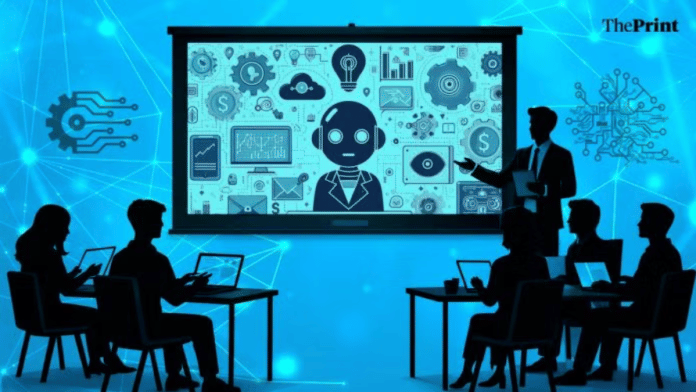
In my head, this became a scene from a sci-fi film: every engineer in Bengaluru sitting behind a giant monitor, watching little AI agents work away on multiple screens, occasionally intervening when one of them goes rogue.
Except this wasn’t sci-fi. This was somebody’s Tuesday.
There would be a pause in the conversation every now and then. A little lull after someone had enthusiastically explained just how integral AI had become to their work. For a moment, the excitement would give way to something else: uncertainty about what their careers might look like as layoffs became an increasingly familiar part of the industry.
I wanted to break it. I wanted to ask them: Aren’t you scared?
But I didn’t.
Who was I to arrive as the harbinger of bad news when these people were, in some ways, the bringers of it?
Then there was Instinct. It is an AI assistant, except “assistant” doesn’t quite capture what it is capable of doing. The idea, as it was explained to me, is that Instinct can have access to your calendar, WhatsApp, and other parts of your digital life. And if your Instinct is friends with my Instinct, apparently the two of them can talk to each other.
So, if I want to know whether you are free for coffee tomorrow, I don’t necessarily have to ask you. My Instinct can ask your Instinct. Your Instinct can check your calendar, figure out when you are free, and tell mine. Mine can then tell me.
At some point, I realised I was trying to imagine a world in which two people could organise a friendship without actually talking to each other.
It was both deeply efficient and mildly terrifying.
I was told about people running entire startup teams through AI assistants — telling their assistant what they want communicated, and having it relay those instructions to employees.
There is something very strange about watching this happen in real life. I had always imagined AI entering our lives through the obvious doors: work, search, writing, coding, maybe eventually robots.
I had not considered that it might enter through the WhatsApp group.
My mind, by this point, had stopped trying to keep up.
But if Instinct was AI quietly inserting itself into people’s personal lives, my cracked-engineer friend was doing something much more radical — hiring AI employees.
Digging one’s own grave?
I made a friend in Bengaluru who described himself as a “cracked engineer”, the kind of person who is so obsessed with building things that sleeping on the office couch to catch a 3 am bug apparently sounds reasonable. Of course, sleeping at the office also has the convenient benefit of avoiding Bengaluru traffic.
The friend told me his startup was hiring. More cracked engineers, he said.
Then he explained the larger plan.
The team, eventually, could have around 50 AI employees and perhaps two or three humans to monitor them.
Eventually, he said, even those AI employees could monitor themselves.
He said this with the excitement of someone describing a particularly clever business idea.
I listened with the internal horror of someone watching a person enthusiastically construct the machinery of their own future redundancy.
But what struck me most was that he wasn’t worried. Neither were the people at that event. Nobody was announcing the arrival of the future. They were just getting on with their lives.
I am still recovering from the experience. I suspect I have only scratched the surface of how much AI has already become part of the way people work, communicate, and organise their lives.
Watching people hand over tiny pieces of their lives to an AI assistant — a calendar here, a message there, eventually an entire team — made me wonder where the assistance ends and the dependence begins.
Then I came back to Delhi.
And suddenly, everyone seemed very still.
People were still writing their own messages. Still making their own plans. Still asking each other if they were free for coffee, and often failing to make a plan.
It felt almost quaint.
I had gone to Bengaluru expecting to report on a city preparing for the future. Instead, I came back wondering if I had already seen it.
It just happened to be stuck in traffic.
Views are personal.
(Edited by Aamaan Alam Khan)