



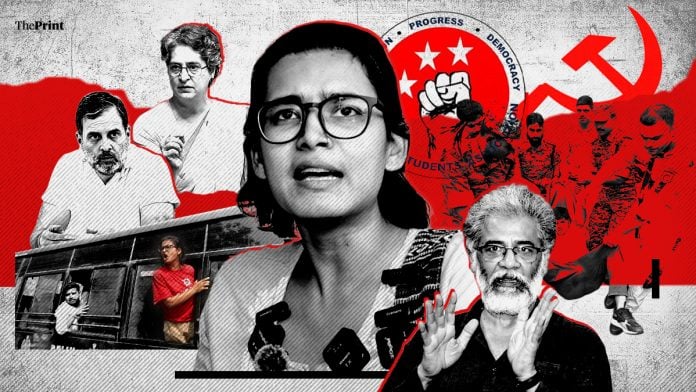
New Delhi: The student-youth agitation has brought All India Students Association (AISA) president Neha Bora to the national political centrestage. On 12 October, as the INDIA bloc marched towards the Supreme Court with a petition against Chief Election Commissioner Gyanesh Kumar, Congress leader Rahul Gandhi was seen shielding Bora from a crush of cameras and protesters. The moment captured how far the student leader’s profile has travelled beyond campus politics.
For the Left, which has seen its electoral base shrinking fast even as its student organisations remain active on university campuses, Bora’s rise raises a question: can the agitation help it regain lost political ground?
The Left and its student organisations had been mobilising on the ground before the INDIA bloc joined the protests, also extending support to groups such as the Cockroach Janta Party (CJP). At the INDIA bloc press conference, Rahul Gandhi was also seen urging Bora to speak before other senior leaders.
Congress leaders appear to have taken note of her emergence. A Congress functionary told ThePrint that both Rahul and Priyanka Gandhi Vadra liked Bora and saw in her several qualities they valued in political workers.
“Priyanka and Rahul really like Neha. She ticks a lot of the boxes for them. The Congress has always liked Left students for their ground connect,” the functionary said.
Also Read: Neha Bora, Ratna Singh and a new summer of women’s discontent
‘A larger coalition’
Bora is the president of AISA, the student wing of the Communist Party of India (Marxist-Leninist) Liberation. AISA has maintained a presence in university politics, particularly at Jawaharlal Nehru University (JNU), even as the Left has struggled to retain its wider electoral base.
In the November 2025 JNU Students’ Union elections, an alliance of AISA, the Students’ Federation of India (SFI), the students wing of the CPI(M), and the Democratic Students’ Federation (DSF) won all four central-panel posts. At Ambedkar University Delhi, the SFI won 24 of the 45 student council seats in March 2025, while AISA secured six. At the University of Hyderabad, a broader Left-Ambedkarite alliance won the central panel in September 2026, with AISA winning the joint secretary post and two councillor seats.
Dipankar Bhattacharya, the CPI (ML) Liberation General Secretary, says Bora’s rise and the wider agitation offer an opportunity to take the INDIA bloc beyond electoral alliances and towards a platform for movements.
“INDIA bloc has remained an electoral coalition. We always wanted it to be linked to movements. We wanted the bloc to always be resistance-oriented. That has started happening,” Bhattacharya told ThePrint.
According to him, the 12 October march reflected a wider coming together of political parties, civil society organisations and young people.
“The march was not just an INDIA bloc march. It reflects a larger coalition. We are reaching out to more political parties, civil society organisations and convergence with the new generation,” he said.
Bhattacharya says he is not looking at the agitation only in terms of electoral gains, arguing that the immediate concern was the electoral process itself.
“If this gets reflected in elections, the balance will be tilted. The generation is hungry for change and Neha will have a significant role in changing that, but first the election process needs to change,” he said.
Asked whether he spoke to Bora, Bhattacharya said she remained connected to the party.
“Neha is in touch with us. She’s not just a student leader but also a party volunteer,” he said.
Political analyst Chandrachud Singh, however, believes the convergence between the Congress and the Left may not benefit the latter electorally.
“The Left has always been doing this kind of agitational, street-based politics. And if the Congress is now coming back in that fold, then naturally there will be a sync between the two,” Singh told ThePrint.
He pointed to a pattern of leaders moving from Left student politics to the Congress, citing Kanhaiya Kumar, who joined the party in 2021, as an example.
“There has always been a lot of leadership from the SFI and AISA which got into the Congress. The Left has some kind of a presence at the university level, particularly in JNU. But the Left doesn’t have a national presence, nor does it have a kind of a national prospect. Therefore, they would find some kind of a natural sync in the Congress,” he said.
Singh said he would not be surprised if Bora eventually joined the Congress. “This is not out of the order,” he added.
The movement of student leaders from the Left to the Congress is not new. Several former student activists have gone on to work within the Congress ecosystem, including in political communications, campaign management and social media operations. Their experience in campus mobilisation and political organising has also made them useful to a party seeking to connect with younger voters.
The Left struggles
The CPI (Marxist), CPI, Revolutionary Socialist Party and All India Forward Bloc together won 59 Lok Sabha seats in 2004. Their combined tally fell to 24 in 2009, 11 in 2014, and six in 2019, before recovering to nine in 2024.
The CPI(M), which won 43 seats in 2004, was reduced to four in 2024, with its vote share falling from 5.66 per cent to 1.78 per cent. The CPI’s tally fell from 10 seats and a 1.41 per cent vote share in 2004 to two seats and 0.49 per cent in 2024. The CPI (ML) Liberation won two Lok Sabha seats in 2024, with a 0.27 per cent vote share, while the RSP won one.
The CPI (ML) Liberation has retained a foothold in Bihar, winning two Lok Sabha seats in 2024. Its assembly performance, however, has been less encouraging. The party won just two of the 20 seats it contested in the 2025 Bihar elections, down from 12 of the 19 seats it contested in 2020. The Left has also struggled to regain ground in West Bengal, where it lost power in 2011 after 34 years of Left Front rule, while Kerala has seen a changing electoral landscape.
Edited by Sunanda Ranjan
Also Read: At Dipke-Neha Bora-Sibal press conference: ‘Regime change’, Gyanesh-Modi & ‘silent erasure’ in SIR