




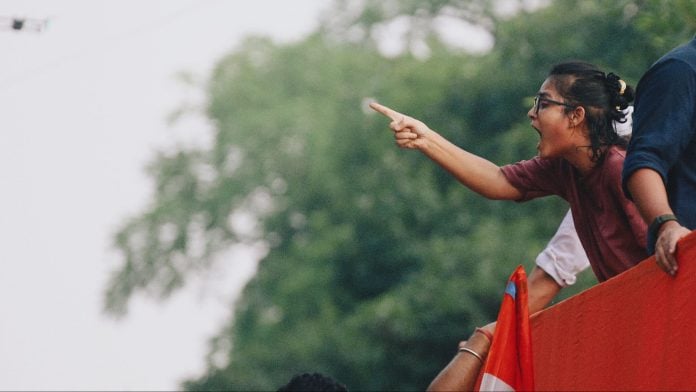

By now, an undertone of savage comedy is an expected outcome of the Gen Z-led protests across India. The second edition of the agitation, this time targeting Chief Election Commissioner Gyanesh Kumar and the murkiness around the Special Intensive Revision exercise, has been decidedly darker, but a farce unfolded this weekend.
At RK Ashram, the Delhi Police once again got its hands on Neha Bora, ready for another detention. At least they thought it was the AISA president, who uses they/them pronouns, in their trademark loose T-shirts and black spectacles. The real Bora was spotted at the same time, running around Connaught Place, cheered on by their comrades.
Since they undertook a protest fast alongside Sonam Wangchuk and others at Jantar Mantar in July and wrested Union Minister Dharmendra Pradhan’s resignation, Bora has been on our phone screens consistently. And the adulation for them mounts by the minute. Legions of their young and old fans drop hearts, virtually scream “Queen”, or extol their “aura” in the comment sections of their videos. It doesn’t matter whether they are being carted off – grinning unbothered – by policewomen or addressing a government that thinks “we are dogs, cockroaches and vermin”.
In just a couple of months, Bora has radicalised even the “apolitical” who were sitting on the fence. The 29-year-old has captured the nation’s imagination so completely that a fawning profile labelled them “the Marxist Madonna of a hybrid revolution”.
The Neha Bora phenomenon
Much of Bora’s charm lies in their particular brand of agitprop: their smiling defiance, their readiness to laugh at the authority that’s dragging them down the road, their equal felicity with English and poetic Hindi. It’s the impishness with which they played whack-a-mole with the Delhi Police. It’s the elfin cheek with which they demand their fellow detainees be served a meal: “Delhi Police khana khilao”.
They know, and they also know that we know.
Some of that aura is craft, learned over the years as a street theatre artist. But even Instagram canonisation requires depth that runs deeper than a reel. Long before cameras were trained on them, Bora had been a traditional Left activist for close to a decade, doing the unglamorous work of travelling from city to city and showing up with students protesting paper leaks in, say, Jharkhand. Over the past year alone, Bora has let death threats and ink attacks glide off their back.
No one is a better analyst of the Bora phenomenon than Bora themselves. In interview after interview, they decline with stoic patience the chance to agree that they are the unofficial leader of a leaderless revolution. Asked in an interview about Kanhaiya Kumar, Bora critiques the selective “fixation on the individual” and asks why no one is interested in the everyday work that student leaders go on to do with trade unions and women’s organisations.
“This mesmerisation is also a problem,” they say. “It comes from the intelligentsia who want to find a ‘pure’ leader behind whom they can all rally. They don’t exist.” Bora says that some youth leaders might leave and associate with the “bourgeois ruling party”, but others constantly dedicate their lives to people’s movements.
Also read: Fear ruled India after the CAA-NRC protests. The youth got over it by laughing at it
Beyond Neha Bora
Their point is easily proved: Just look at the other women leaders from their generation, being forged very publicly in this summer of our discontent.
On the morning of 10 October, Ratna Singh, the Cockroach Janta Party (CJP)’s legal head, got into a car at her Jangpura home to join one of the city’s several protests. Singh’s vehicle was boxed in by about two dozen Delhi Police personnel, who claimed that they had instructions “from above” to detain her but refused to produce any warrants or written orders. Singh filmed it all from inside the car, wondering aloud which “above” the cops were referring to. In a separate press conference on 11 October, she declared, with her flat, temperate demeanour, “Ye dari hui sarkar hai.” This is a scared government.
Detentions, manhandling, and violence – both from the Delhi Police and right-wing goons – are the headline story of these protests. None of this is new to Aishe Ghosh, former president of the JNU Students’ Union and an SFI member. The diminutive Ghosh is one of the most enduring images of the 2020 Delhi students’ agitation, which dovetailed with the anti-CAA-NRC protests.
In January 2020, Ghosh continued to appear in public even after being hurt in a brutal attack by a masked mob that went through her campus. Seemingly unencumbered by an arm in a sling and her head swathed in white bandages, she spoke with the same clear-eyed authority then as she does today. At the same CJP press conference on Sunday, Ghosh said that there was a definite line connecting BJP president Nitin Nabin’s hints to send out latthbaaz goons and the terrorising of protesters, some of them minors, all over Delhi.
Also read: BJP wants to be the party of Nari Shakti. Here’s a list to make that happen
Intergenerational solidarity
Despite the doom, Bora and co. now have some formidable chaperones. They have spent the last few weeks flanked by the Opposition’s grande dames, who took on the state long before some of them were born. The sight of this intergenerational solidarity, the battle-scarred and the barely-begun holding hands, has been heartwarming.
Chief among the returnees is the much-missed Renuka Chowdhury, who has been MIA since PM Narendra Modi’s infamous 2018 Ramayana jibe about her laughter in the Rajya Sabha. At 72, she’s still the stern headmistress. Hemmed in by the police at a demonstration this week, she informed them that she would “skin them alive” if they so much as touched her. She took the same attitude toward an automatic bus door closing around her while she was talking to the media. Bristling at the use of tear gas and lathis against protesting students in July, she had said, “They are not ‘Gen Z’. They are our children. Our students. Our citizens.”
Mamata Banerjee, out of hibernation after losing to the BJP in the West Bengal Assembly elections, is back too. Taking a leaf from the Gen Z playbook, Banerjee chanted a satirical version of “Johnny Johnny Yes Papa” and called for Gyanesh Kumar’s arrest. The former CM built her career on Kolkata’s streets, so it was familiar ground when she sat down on the asphalt near South Avenue and was later detained with her MPs.
It’s also been refreshing to see Brinda Karat return to form, alongside the acerbic Jaya Bachchan, who, when a reporter thrust a mic at her and asked a question, swatted it aside and said, “Nahi bataungi (won’t answer).” Millennial women like me, however, were ecstatic to watch Nivedita Menon tell the media that the young had cracked through the fear and broken 12 years of silence.
Neither fear nor its accomplice, isolation, is working on the women out on Delhi’s roads today. Not the 29-year-old and certainly not the 72-year-old.
Karanjeet Kaur is a journalist and a partner at TWO Design. She tweets @Kaju_Katri. Views are personal.
(Edited by Prashant Dixit)
Vultures have a singular aim in life – to feast on kills made by others.
Just like them, you too Ms. Kaur, love to celebrate anyone and everyone who opposes Modi and BJP.
Be it Neha Bora or Ratna Singh or Khalistani extremists or Islamist militants – anyone and everyone that despises Modi and attacks him is dear to you.
But for the love of God, please don’t put up the chicanery of being a feminist and supporting feminism. Because it simply does not matter to you.