


New Delhi: Bangladesh was once recognised as a global public-health success story for its progress in childhood immunisation, achieved despite widespread poverty and high population density. For years, its vaccination programme kept measles largely under control, with coverage rates often comparable to those of wealthier countries.
But a measles outbreak that began in March has exposed how quickly those gains can unravel.
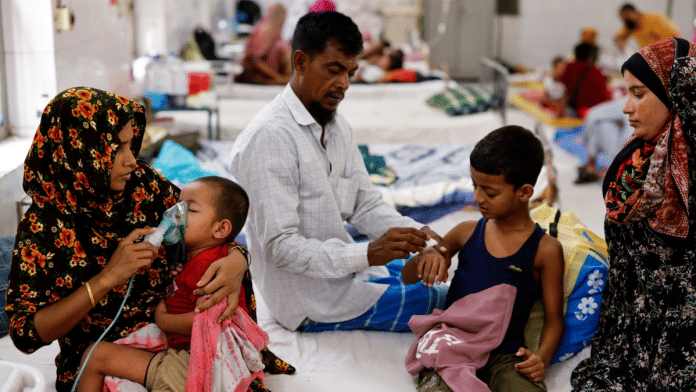
Bangladesh is now battling what the World Health Organization (WHO) has described as the world’s largest measles outbreak by suspected case count this year. Between mid-March, when the outbreak began, and 9 October, the country reported 202,000 suspected cases, of which 22,000 were laboratory-confirmed. No other country has reported a higher suspected caseload this year.
Public-health experts say the government must declare a national emergency.
“The government must take the outbreak seriously and declare it a public-health emergency, which is yet to be done. As an epidemiologist who has worked in the field for 40 years, I do not believe the outbreak can be contained if the current approach continues,” Professor Mahmudur Rahman, chair of Bangladesh’s National Verification Committee for Measles and Rubella Elimination, told ThePrint.
Official figures put the death toll from measles and measles-like symptoms at 1,257 since 16 March. Of these, 1,152 people died with measles-like symptoms, while 105 deaths were confirmed as measles-related.
Dhaka Division recorded the highest number of deaths from measles-like symptoms, at 511. It was followed by Sylhet (203), Chattogram (112), Rajshahi (93), Mymensingh (89), Barishal (69), Khulna (57) and Rangpur (18).
On Monday, the Directorate General of Health Services (DGHS) reported 1,492 new cases of measles-like symptoms and 1,385 hospital admissions in the preceding 24 hours.
Health experts attribute the outbreak to falling immunisation rates, disruptions in vaccine supplies, weak health infrastructure and gaps in identifying and reaching children who have missed their doses.
The outbreak has spread across all 64 districts, according to a United Nations (UN) situation report published in June. Children under five account for more than 80 percent of infections, while infants younger than nine months—many of whom are too young for routine measles vaccination—make up nearly a third of reported cases.
For a country that had come close to controlling the disease, the figures represent a sharp reversal. They also raise questions about what went wrong, why emergency vaccination campaigns have failed to contain the outbreak and whether Bangladesh’s health system is equipped to prevent another such crisis.
Also Read: Can blood sugar be controlled without drugs or insulin? A new wireless implant offers hope
A vaccination programme loses ground
Measles is among the world’s most contagious infectious diseases. Dr Shahid Jameel, fellow at Green Templeton College, University of Oxford, and visiting professor at Ashoka University, said the disease has a basic reproduction number (R0) of 12 to 18. This means that, in a population where no one is immune, one infected person can transmit the virus to an average of 12 to 18 others.
By comparison, the R0 of Covid-19 ranged from 1.5 to 6.7, with a global mean of 3.3.
The WHO recommends maintaining at least 95 percent coverage with both doses of the measles-containing vaccine among eligible children in every district to interrupt transmission and prevent outbreaks.
“When coverage falls below this level, susceptible individuals are no longer protected at the population level,” Jameel said.
Bangladesh had come close to meeting the WHO target. In 2024, WHO and UNICEF estimated that 96 percent of children in the country had received the first dose of the measles vaccine and 93 percent the second. The second dose is intended to protect the small proportion of children who do not develop immunity after the first.
This record was built over decades through the Expanded Programme on Immunization (EPI), which established a nationwide network of vaccination services and outreach workers. Between 2021 and 2025, Bangladesh reported only around 100 to 300 measles cases annually, according to WHO data.
But the system began to falter amid political upheaval and changes in the vaccine procurement procedure.
In 2024, student-led protests ended Sheikh Hasina’s 15-year tenure as prime minister. The political transition was followed by disruptions across parts of the public administration. Health workers went on strike, vaccine orders were delayed and follow-up procedures associated with routine immunisation were interrupted.
In 2025, estimated vaccination coverage in Bangladesh for measles fell to 90 percent for the first dose and 86 percent for the second, according to a WHO-UNICEF report published in July.
The report also questioned the reliability of Bangladesh’s vaccination data between 2023 and 2025. In some instances, preliminary figures suggested that the number of children vaccinated exceeded 100 percent of the target population, indicating possible errors in counting either doses administered or eligible children.
Rahman said the problem lay partly in the denominator used to calculate coverage—the estimated number of children eligible for vaccination. “The denominator problem has led to an accumulation of susceptible children over the years, and that has contributed to this outbreak,” he said.
He also pointed to the loss of experienced leadership and the abolition of some positions at EPI headquarters without adequate arrangements to replace them. Field monitoring was insufficient, he said, while accountability remained weak.
“The result was a growing population of children who had missed one or more doses and were vulnerable to infection,” he added.
Rahman said he and other public-health professionals had raised concerns about these gaps with senior officials as early as mid-2025. They had recommended more intensive monitoring and efforts to improve coverage in areas with low vaccination rates. “Those warnings were not acted upon with sufficient urgency,” he said.
The weaknesses in the immunisation programme coincided with changes in how the country procured vaccines.
Disruptions in vaccine procurement
Bangladesh historically relied on UNICEF to procure vaccines for the EPI, funded through a combination of government financing and international assistance, particularly from Gavi, the Vaccine Alliance, which provided financial support for measles vaccination.
By the end of 2025, however, the interim government led by Muhammad Yunus had moved towards an open competitive bidding process for vaccine procurement.
The change was presented as an effort to establish a more transparent, rules-based system, reduce perceptions of favouritism and bring procurement under the national budget process. Officials argued that it would strengthen institutional accountability and reduce dependence on external agencies.
But the transition coincided with delays in securing vaccines.
Bangladesh typically requires around 70 million vaccine doses annually. In 2025, however, only 17.8 million doses were secured through UNICEF’s pre-financing mechanism.
According to a report by The Economic Express, UNICEF repeatedly warned the government about the consequences of the procurement changes between 2024 and May this year. It sent multiple letters and held at least 10 meetings with officials, urging them to return to the earlier arrangement.
Another complication involved the repurposing of funds originally allocated for Covid-19 vaccines.
Dr Taufique Joarder, an adviser to the Public Health Foundation of Bangladesh and an associate professor at Duke-NUS Medical School in Singapore, told ThePrint that reports indicated that funds held through the Asian Development Bank (ADB) for Covid vaccination had to be returned before being reallocated to measles vaccines.
The process took months because the funding agency required the money to be returned before considering a fresh application, he said.
“Who can you blame, really? ADB can definitely defend themselves. This is the procedure as the money that was meant for Covid-19 cannot be used for another line item in the Budget. There are institutional regulations. But again, it was an emergency,” he said.
Together, these factors contributed to a shortage of measles vaccines. A nationwide vaccination campaign planned for 2024-2025 was postponed and eventually cancelled, leaving millions of children without the additional protection it was intended to provide.
Joarder cautioned, however, that accounts of the shortage were conflicting. Some reports described delays in importing doses and a sharp decline in coverage. Officials from the previous administration maintained that vaccines were available in the country, citing stock information on UNICEF’s website.
An emergency campaign—and children left out
After the Bangladesh Nationalist Party (BNP) government came to power in February this year, it approved a return to direct procurement through UNICEF in June to stabilise supplies.
Meanwhile, after the first measles death was identified on 16 March, an emergency measles-rubella vaccination campaign began on 5 April, initially targeting 30 high-risk sub-districts. It was subsequently expanded to four major metropolitan areas before being rolled out nationally from April 20.
The campaign aimed to vaccinate around 18 million children aged six months to five years. Officials said nearly 20 million children received a dose during the April-May drive, adding that the entire target age group had been covered.
For a time, the campaign appeared to be working, with new cases initially slowing after the mass vaccination effort.
But a subsequent health intervention raised questions about how many children had actually been reached.
In June, a vitamin A supplementation campaign identified around four million more children in the same age group than the measles campaign had accounted for. The discrepancy suggested that a substantial number of children may have been missed during the emergency drive.
Jameel said the gap highlighted why vaccination campaigns needed to be supported by a functioning health system rather than relying on vaccine availability alone.
“Vaccination programmes require not just vaccines but also a robust health system that can safely store, deliver, and monitor vaccines across communities. This includes supply chain and cold chain infrastructure (as most vaccines are heat sensitive), delivery networks and points of care, a surveillance (data and information) system, and trained staff to deliver vaccines,” he said.
Effective immunisation also depends on governance, leadership, stable financing and public trust, he added. “When any of these are missing, even temporarily, coverage drops.”
The government said it responded to the gap by launching a second emergency campaign to reach children who had been missed.
Ziauddin Hyder, special assistant on health matters to Prime Minister Tarique Rahman, told ThePrint, “Almost four million children who received vitamin A had not received the measles vaccine. Immediately after that, the government launched a second emergency campaign to cover those children who had been missed.”
Hyder said the government had since taken steps to ensure adequate vaccine stocks, deploy outreach teams and make vaccines available at upazila health complexes and hospitals. Parents could bring their children to these facilities for vaccination, he said, while awareness campaigns had been launched to help families recognise measles symptoms and seek medical care.
The government had also advised parents to isolate children suspected of having measles from their siblings and other children and seek treatment promptly.
Hyder acknowledged that the first emergency campaign initially focused on the worst-affected areas rather than being rolled out nationwide at once. It was expanded in stages, he said, adding that the government was not distinguishing between urban and rural areas in its vaccination efforts and was working to ensure equal access.
The government was also considering expanding the eligible age group. The National Immunisation Technical Working Group had recommended vaccination for children aged six months to five years, but Hyder said the upper age limit could potentially be extended to 10 years.
The WHO has also raised concerns about infections among older children. Those above five account for roughly a third of cases, suggesting that a campaign restricted to younger children could leave a substantial susceptible population unprotected.
There is another significant obstacle—the difficulty of identifying every eligible child.
UNICEF and the Bangladesh Bureau of Statistics estimate that as many as 40 percent of children in the country are not registered. This makes it harder for health authorities to identify eligible children, track missed doses and accurately plan vaccination campaigns.
Rahman said undercounting could make coverage appear higher than it actually was. “Even when the campaign reports 100 percent or 103 percent coverage, that may not reflect the actual situation. Coverage could be much lower than reported,” he said.
Joarder agreed. “On paper, it is 100 percent. But in reality, it is 80 percent. For a disease like measles, that is very dangerous,” he said.
He added that census figures and population estimates may have underestimated the number of children in some areas, potentially affecting the quantity of vaccines allocated to Bangladesh through international supply arrangements.
The government needs to recalculate the number of eligible children and strengthen the micro-planning process used by vaccination teams, he said. This involves identifying children in each locality before a campaign begins and ensuring that teams can reach them.
Rahman said the emergency campaign had been conducted under considerable pressure, leaving insufficient time for such detailed planning. Bangladesh still had the infrastructure to reach children through household visits and satellite clinics, he argued, but vacancies among health assistants had weakened the system.
Why are cases still rising?
Falling vaccination coverage alone does not explain the scale of the outbreak.
Measles typically kills two or three people for every 1,000 infections, according to the WHO. But the disease can be more deadly in poorer countries, where children may already be affected by malnutrition or other infections.
Joarder said Bangladesh’s high levels of childhood malnutrition were likely to have worsened the outbreak’s impact. Around 26 percent of children under five in the country are stunted, he said. Malnutrition can weaken a child’s ability to fight infections and increase the risk of severe illness. Respiratory infections, including pneumonia, can further complicate the condition when they occur alongside measles.
He also cautioned that some cases could have been misclassified, particularly when children were suffering from other illnesses with symptoms similar to those of measles.
The outbreak has placed additional pressure on hospitals already dealing with another infectious disease—Bangladesh’s dengue epidemic, which intensified during the middle of the year.
Joarder said the simultaneous burden of measles and dengue had stretched hospital capacity, making it harder to provide adequate care to the large number of patients arriving within a short period.
“The health system is already struggling. When you have another disease on top of an ongoing epidemic, you simply do not have enough amenities in hospitals to cater to so many people,” he said.
Another concern is the number of infections among infants too young for routine measles vaccination.
Children below six months are generally expected to retain some protection from antibodies passed on by their mothers. Yet health experts have reported infections among babies younger than the age at which routine vaccination normally begins.
Hyder attributed some of this vulnerability to maternal and child malnutrition. Malnutrition among mothers could affect breastfeeding and the transfer of antibodies to infants, while malnutrition among children could increase the severity of infections, he said.
Rahman also said infections among children younger than six months were higher than expected. He called for further research into the biological factors affecting maternal antibodies and the duration of protection in infants.
Joarder said Bangladesh needed to investigate the issue more closely, particularly because infections among younger babies could have implications for future vaccination policy.
Misinformation has added another layer to the crisis.
Joarder said that during the early days of the outbreak, a cleric with a large Facebook following described the measles crisis as a hoax and suggested that the outbreak was being exaggerated to encourage vaccine procurement. The claims received millions of views, he said, potentially undermining confidence in vaccination at a critical time.
A public-health system under strain
A shortage of health workers is another obstacle to containing the outbreak.
Rahman said strikes had disrupted vaccination and outreach activities. Health assistants are expected to visit households, identify children and administer vaccines through satellite clinics. When these positions remain vacant or workers are dissatisfied with their conditions, the programme’s reach suffers.
But the problem extends beyond staffing shortages to the management of public-health programmes.
Rahman argued that many officials responsible for running Bangladesh’s public-health system are trained primarily as clinicians rather than public-health specialists. This has left gaps in the expertise needed for vaccine procurement, storage, distribution, monitoring and evaluation, he said.
Joarder made a similar point, describing the shortage of trained public-health managers as a structural problem. Field-level undercounting and inaccurate reporting can occur in any country, he said. The more important question is why the system cannot identify and correct such errors.
In Bangladesh, officials recruited through the Bangladesh Civil Service Health Cadre are generally medical doctors, while the system does not consistently recruit or place professionals with specialised public-health qualifications in positions where they are needed.
“When there is a new government, a new group of people comes in. Even if the previous group was not fully trained, they had accumulated experience over many years. The new people may be clinicians without the training needed to manage public-health programmes,” he said.
Joarder said Bangladesh needed to make its response more targeted and data-driven. Hospital records, information from civil surgeon’s offices and the District Health Information System, known as DHIS2, should be used to identify outbreak hotspots. Vaccination and isolation efforts could then be concentrated in those areas to prevent further transmission.
Bangladesh had struggled with blanket interventions during the Covid pandemic, he said, and should instead use available data to design more focused responses.
Over the longer term, the country needs to strengthen preventive healthcare and establish a separate career track for public-health professionals, similar to the system in Sri Lanka, he added.
The outbreak also holds lessons for India, despite its greater self-sufficiency in vaccine manufacturing, Jameel said. “Unlike Bangladesh, which procures all its vaccines for children from elsewhere, India is in a happy position of self-sufficiency due to its vaccine companies. Serum Institute of India supplies around 80 percent of the global measles-rubella vaccine doses,” he said.
However, domestic manufacturing capacity alone cannot guarantee protection against outbreaks, he cautioned. “With a highly contagious disease like measles, every link in the chain is important. Equally important is to guard against complacency and to ensure that people continue to trust vaccines,” he added.
(Edited by Chingkheinganbi Mayengbam)
Also Read: US measles cases cross 2,200. Set to shatter 35-year record