



When you enter an electronics store in Ohio or Texas and examine a new smartphone, you might notice a shift in manufacturing origins. A decade ago, the label would likely have indicated “Made in China” or “Made in Vietnam.” Currently, it may state “Made in India.” In 2025, a significant development occurred: smartphones surpassed pharmaceuticals to become India’s largest export category to the United States, valued at $25.8 billion. Similarly, smartphones represent Vietnam’s primary export to the United States.
For the first time, smartphones have become the leading export to the US for both India and Vietnam, which have spent a decade vying to emerge as alternatives to China.
During Vietnamese President To Lam’s visit to New Delhi in May, the two nations elevated their relationship to an enhanced comprehensive strategic partnership, aiming for $25 billion in bilateral trade by 2030. However, their trade dynamics present a narrative distinct from what we see on American shelves.
Food out, electronics in
During FY 2017-18, India ran a $2.8 billion trade surplus with Vietnam, driven mainly by meat and fish exports, which accounted for over half of India’s total exports to Vietnam. These exports effectively offset India’s expenditure on imported electronics. However, in FY 2018-19, the trade dynamics shifted significantly. India’s electronics imports from Vietnam more than doubled, rising from $1.6 billion to $3.7 billion, while its meat and fish exports fell by $1.4 billion. These two changes, totalling about $3.5 billion, largely explain the shift from a trade surplus to a deficit. The current trade deficit stands at $4.9 billion.
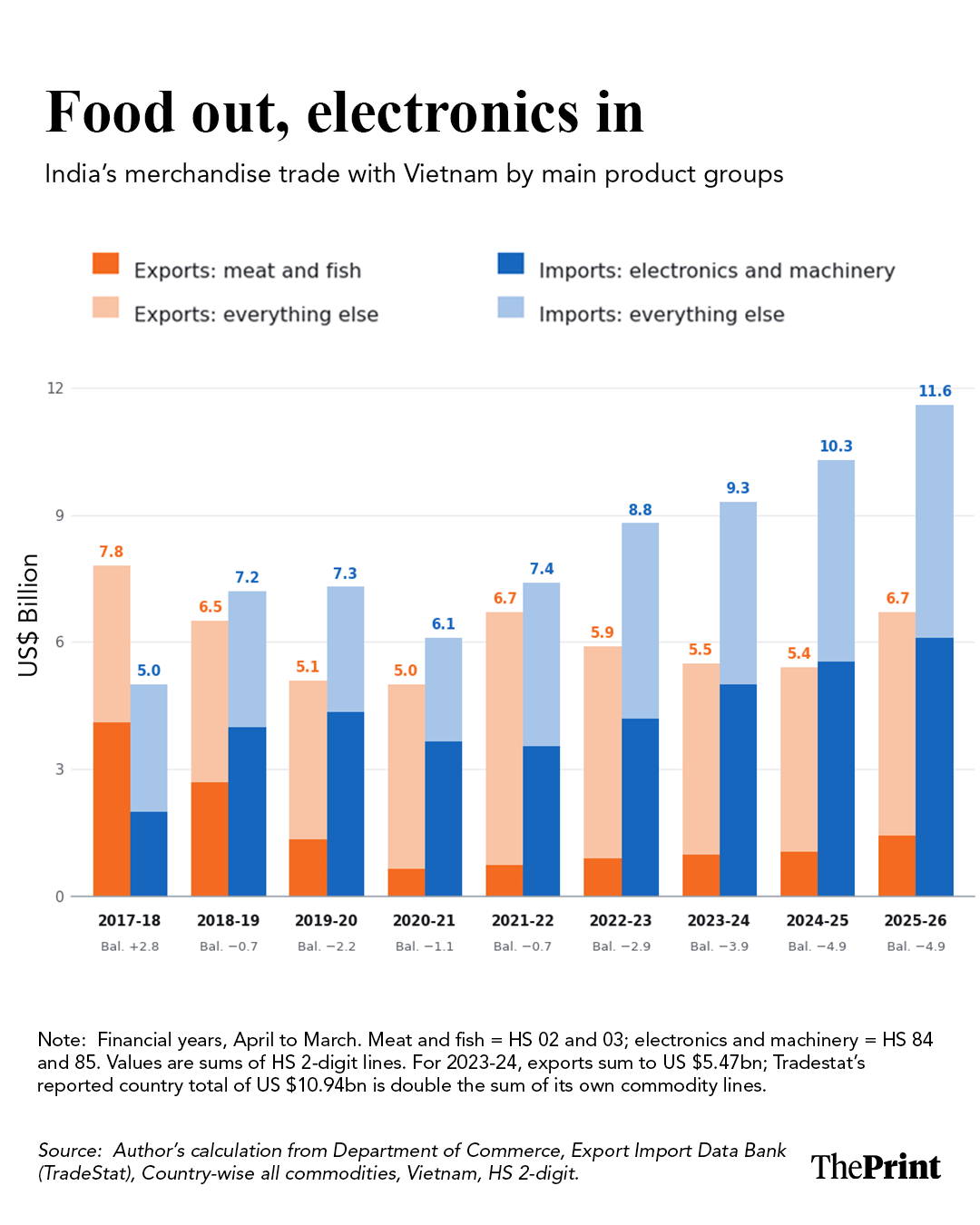
In FY 2025-26, over half of India’s imports from Vietnam, amounting to $6.1 billion out of a total of $11.6 billion, consist of electronics and machinery. For every dollar’s worth of these goods that India exports to Vietnam, it imports nearly ten dollars’ worth. Steel trade dynamics have also shifted. In 2021-22, India exported $1.5 billion worth of iron and steel to Vietnam while importing only $160 million. However, in the following year, exports fell to $497 million, while imports rose to $879 million.
A closer look reveals that India’s electronics imports from Vietnam have increased by only one-third since 2018-19. Over the same period, India’s phone exports to the United States surged from $0.3 billion to $25.8 billion, suggesting that growth in India’s phone exports does not rely heavily on Vietnamese electronics. The widening trade deficit is primarily attributed to machinery imports, which have nearly quadrupled, and industrial metals.
In 1975, economists Herbert Grubel and Peter Lloyd introduced an index to distinguish between two-way trade in similar goods and the exchange of different goods. Based on my analysis of Commerce Ministry data, even when measured at the broad product-category level, less than one-third of India–Vietnam trade is reciprocal. The majority of the trade involves the traditional exchange of food and raw materials in one direction and electronics and machinery in the other. In contrast, the trade pattern with the United States exhibits a different trend.
Also read: India-Vietnam in talks over BrahMos, maintenance & repair of defence platforms as ties elevated
What one old index reveals
In 1979, economists J. Michael Finger and Mordechai Kreinin introduced a method to quantify the competitive overlap between two countries in a third market. Their export similarity index evaluates each product that two countries export to a shared market, records the share of each country’s exports accounted for by that product, retains the smaller proportion, and aggregates these values across all products. An index value of zero indicates entirely distinct export profiles, while 100 signifies identical export baskets.
I computed this index for India’s and Vietnam’s exports to the United States, using official US import data from the US International Trade Commission, which encompasses nearly 1,200 product lines over a twelve-year period. From 2014 to 2019, the index remained relatively stable at approximately 20. During this period, India exported diamonds, medicines, and textiles to the United States, whereas Vietnam exported furniture, footwear, and electronics. However, beginning in 2022, the index increased to 37.9 in 2025, its highest level in at least 12 years, and remained at 37.1 during the first eight months of 2026.
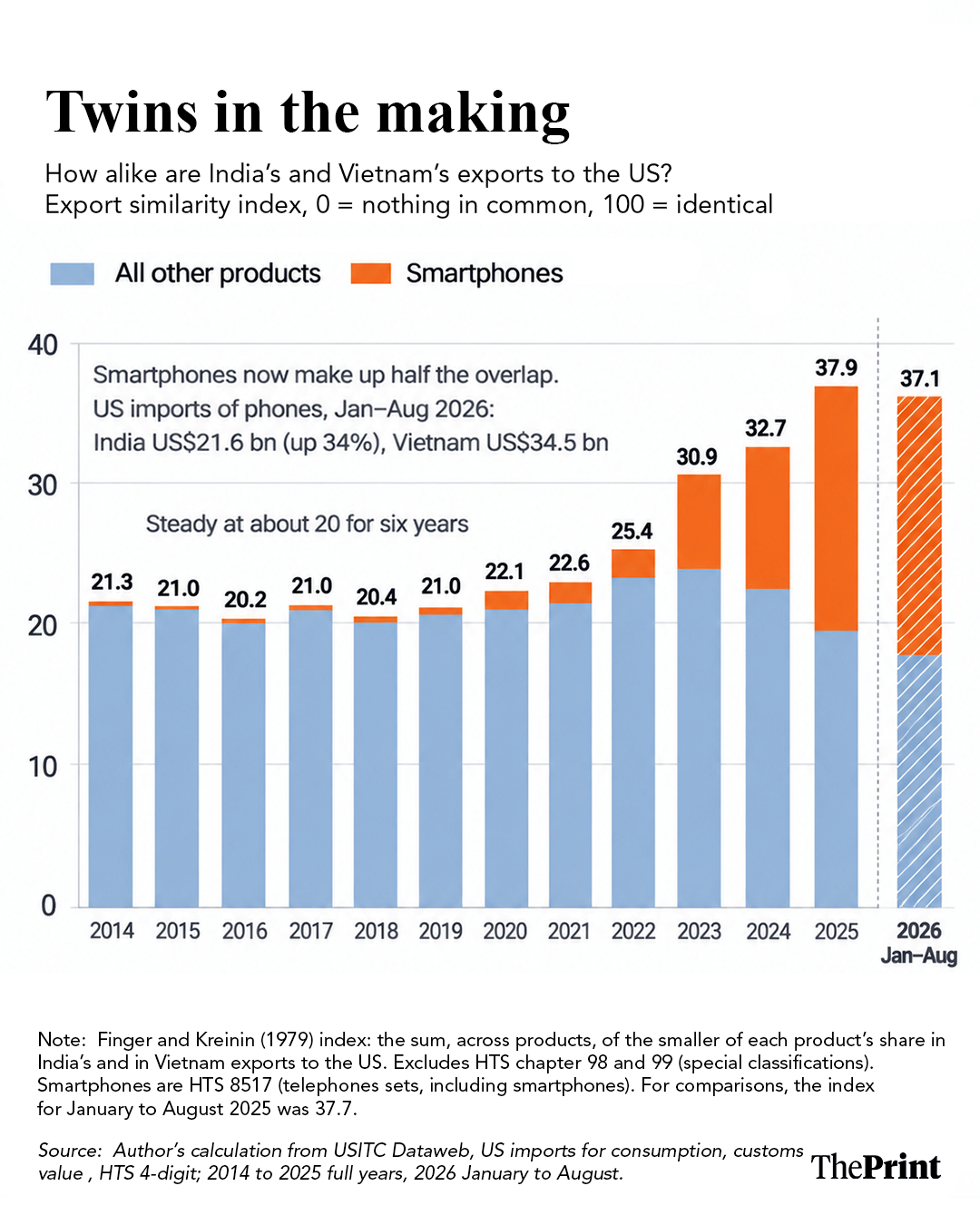
Approximately half of the overlap originates from a single product category: smartphones. In 2019, Vietnam exported 40 times as many phones to the United States as India did. By 2025, this ratio had decreased to 1.4. Excluding smartphones, the overlap has diminished because both countries have increasingly focused on electronics. In their 2007 paper, “What You Export Matters,” Ricardo Hausmann, Jason Hwang, and Dani Rodrik showed that countries with export baskets similar to those of wealthier economies tend to grow faster, because the products a country manufactures reflect its developed capabilities. India’s advancement beyond medicines and diamonds, which have been the mainstays of its trade with the United States for over a decade, occurred within six years. Vietnam, meanwhile, has also progressed; between 2019 and 2025, its phone exports to the United States tripled.
From late August 2025, most Indian goods entering the United States faced an additional tariff of 50 per cent, compared to 20 per cent for Vietnamese goods. Smartphones, however, were exempt, allowing India’s phone exports to continue increasing even as its garment and furniture industries faced challenges. The disparity ended in February when the Russian oil duty was rescinded, and the US Supreme Court invalidated the emergency tariffs. Since July, the new Section 301 regime sets tariffs at 10 per cent for India and 12.5 per cent for Vietnam. As I argued in July, India achieved this lower tier by complying with regulations, specifically by announcing a ban on forced-labour imports ten days before Washington’s tier announcement.
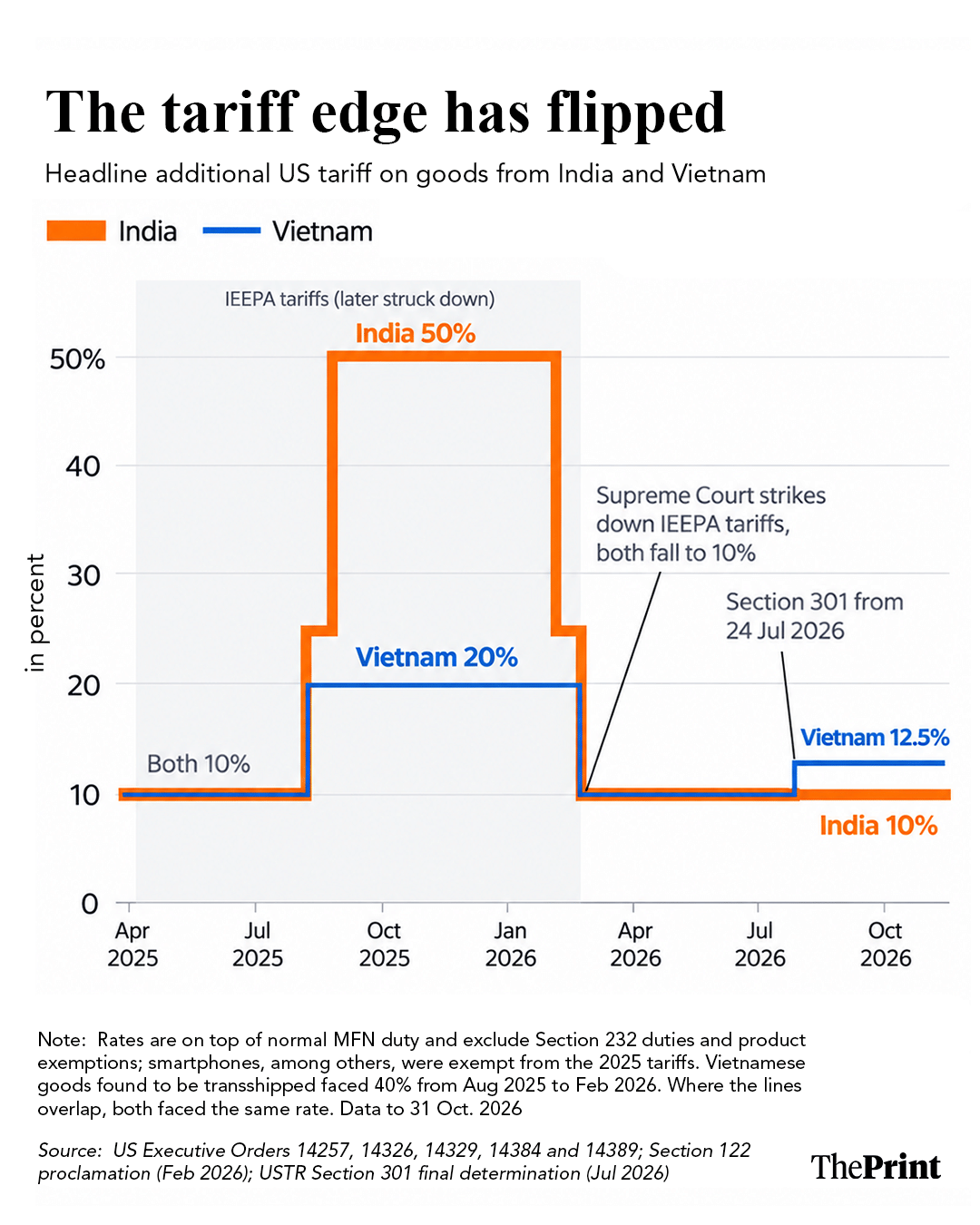
Given the exemption of phones, this competitive edge is minimised in areas where India and Vietnam overlap significantly and maximised in sectors where Vietnam maintains a lead, such as apparel, footwear, and furniture. In these sectors, India’s American sales declined between 2022 and 2025, as did engineering goods like transformers and valves. In these sectors, the two-and-a-half-percentage-point tariff advantage could potentially recover orders, contingent on India’s small exporters demonstrating compliance as cost-effectively as Nashik’s grape growers have through GrapeNet.
A third factor is also at play. China emerged as the second-largest source of new foreign investment in Vietnam last year. Indian factories also rely heavily on China; in FY 2025-26, China accounted for at least 80 per cent of India’s imports across 71 electronics product lines. Thus, India and Vietnam can be considered dual twins: both serve as alternative global manufacturing and assembly hubs and remain reliant on Chinese components. The decisive factor for the coming decade will be which country first establishes a sufficiently robust component base to achieve self-sufficiency.
From rivals to partners
When juxtaposing the two indices, a paradox becomes evident. In the United States, India and Vietnam appear as counterparts, offering identical products to the same consumer base. However, in their bilateral relations, they function as complements, exchanging food and metals for electronics and machinery. Internationally, they compete, while bilaterally, they complement each other.
In the 1930s, Japanese economist Kaname Akamatsu conceptualised Asian development through the flying geese model, in which leading economies move towards more sophisticated industries. Vietnam is already progressing in this regard, with its computer exports to the United States increasing from $1.2 billion in 2019 to $33.6 billion in 2025. Conversely, India maintains a stronghold in sectors that Vietnam scarcely penetrates, particularly pharmaceuticals, which generated $14.8 billion in revenue from the United States last year. Nonetheless, India exported only $176 million worth of pharmaceuticals to Vietnam in 2025-26, highlighting a significant disparity for a nation often called the world’s pharmacy.
Investment is another area of concern. Vietnamese government data indicates that Indian enterprises have approximately $1.17 billion registered across 503 projects in Vietnam. Conversely, Vietnamese investment in India remains limited, apart from VinFast’s $500 million electric vehicle plant in Thoothukudi. For two nations with annual bilateral trade of $18 billion, this represents a narrow foundation.
This scenario presents four opportunities. First, the ongoing review of the ASEAN-India goods agreement should establish product-specific rules of origin. Second, Vietnam should leverage the tariff advantage to secure enduring market share in the goods it covers, supported by a unified national traceability system modelled on GrapeNet. Third, bilateral trade should be rebalanced by increasing Vietnam’s imports of India’s key products, such as pharmaceuticals and engineering goods, rather than relying on commodities whose trade volumes fluctuate. Lastly, trade should shift to joint investment, enabling Indian and Vietnamese firms to develop value chains together instead of competing for American contracts.
The indices reveal that India and Vietnam have become counterparts internationally and complements domestically. However, they do not indicate whether they will remain rivals or become partners in the future. This decision rests with both New Delhi and Hanoi.
Bidisha Bhattacharya is ThePrint Consulting Editor (Economics) and an Associate Fellow, Chintan Research Foundation. She tweets @Bidishabh. Views are personal.
(Edited by Prashant Dixit)