



Two decades ago, grape producers in the Nashik region faced challenges as their produce was held up at ports due to European threats of exclusion over pesticide residues. The infrastructure India developed to resolve this issue back then has since become one of its most valuable assets. There were echoes of this last week when India and the United States were negotiating the final 1 per cent of the legal text for their inaugural trade agreement. The real breakthrough was in the form of a tariff adjustment, influenced by a regulation enacted in Delhi.
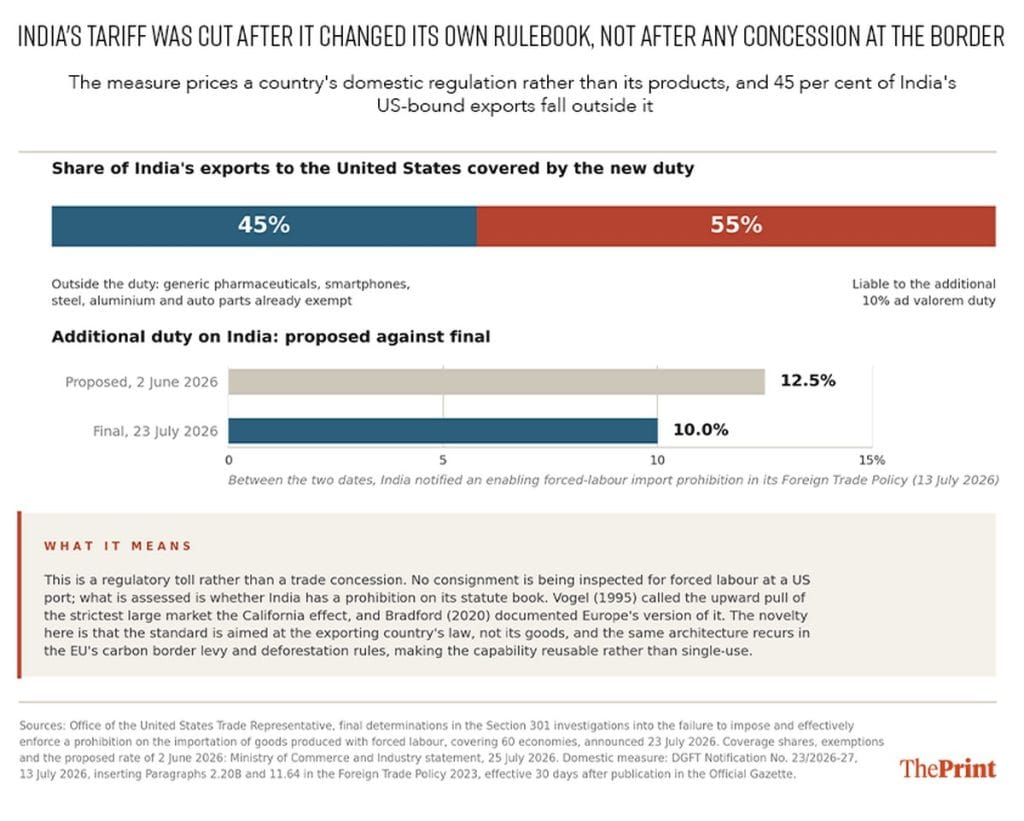
On 23 July, the United States Trade Representative (USTR) imposed tariffs under Section 301 of the Trade Act of 1974 on 60 economies for allegedly failing to ban or block imports made with forced labour. Most of these countries were hit with an additional 12.5 per cent tariff. India, however, was categorised in a lower tier with an additional 10 per cent tariff, alongside 16 other economies, including the United Kingdom, Canada, and Mexico. Approximately 45 per cent of India’s exports to the United States are exempt from this duty due to existing exemptions for generic pharmaceuticals, smartphones, steel, aluminium, and auto parts.
India’s placement in the lower tariff tier is explicitly stated in the American notice. The USTR’s decision is based on findings from its investigation into India, specifically citing its implementation of a forced labour import prohibition following the June proposal for a 12.5 per cent tariff. This refers to a notification issued in Delhi on 13 July, numbered 23/2026-27, which prohibited imports of goods produced wholly or partially with forced labour and adopted the International Labour Organisation’s definition of the term. Ten days later, India was placed in the 10 per cent bracket, joining five other economies that enacted similar legislation.
Thus, India effectively utilised a non-monetary strategy by instituting a regulatory measure.
Toll booth has moved from ports to filing cabinets
That currency has a history. In Trading Up (1995), the scholar David Vogel noted that when the largest market establishes the most stringent standard, producers globally tend to raise their standards too. This is because maintaining a single compliant production line is more cost-effective than operating two. This phenomenon was termed the “California effect” by Vogel. Anu Bradford later documented a similar phenomenon in Europe, referring to it as the “Brussels Effect” in her 2020 book of the same name.
Vogel’s analysis focused on product standards, and the importance of manufacturing quality products for sale. However, the current measure targets a different aspect: whether countries actually block imports made with forced labour. USTR rejected requests to credit countries for steps such as ratifying ILO conventions or enforcing domestic laws, arguing that these efforts were irrelevant to the practices under scrutiny. It also refused to reduce tariffs for exporters supplying American retailers that conduct their own supply-chain checks, contending that such comments misinterpret the role of tariffs as a tool for leverage.
In essence, the measure assesses whether countries enforce their own border regulations. No American inspector is examining Indian cotton at Long Beach; instead, the focus is on the legal framework. Recognising this, one can anticipate similar measures. Europe’s carbon border levy will assess emissions records, its deforestation regulation will evaluate land records, and the sustainability chapters of the India-EU agreement will ask a version of the same question. Although the subjects differ, the underlying requirement remains consistent: provide proof in a format acceptable to a foreign agency.
Furthermore, these regulations do not have automatic expiration dates, and some specifics are still under development. The notice specifies tariff-rate quotas for Bangladesh, Cambodia, Indonesia and Malaysia, initially for three years, linked to their procurement of American cotton. India has indicated ongoing engagement with Washington on textile-related issues within bilateral discussions. Consequently, the pertinent question is not the recent 2.5 percentage point adjustment, but whether India possesses the mechanisms to continually meet such demands in the future.
Nashik answered that question in 2007
The machinery in question is indeed present, yet it has been constructed in a location overlooked by participants in the tariff debate.
In the mid-2000s, Indian grapes faced the threat of exclusion from European markets due to pesticide residues, resulting in consignments being detained at ports and financial losses for exporters. The Agricultural and Processed Food Products Export Development Authority (APEDA) initiated a response through a Government of India regulation that delineated the responsibilities of each participant in the supply chain. This was followed by training, the involvement of monitoring agencies, and subsequently, the computerisation of the entire process.
This initiative culminated in the creation of GrapeNet. Since the 2007 season, every consignment shipped to the European Union has been tracked through this system, encompassing over 40,000 farmers, more than 100 pack houses, over 100 exporters, more than 20 laboratories and 32 district-level officials.
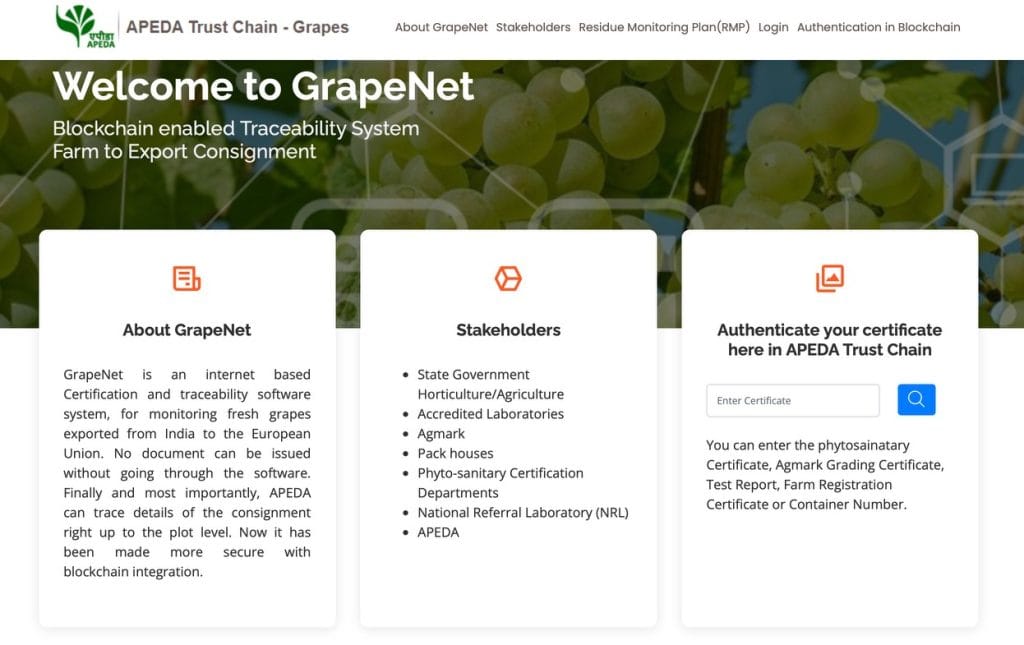
The returns generated by this particular system elevate it to the status of a policy model, distinguishing it from a mere anecdote. The same residue control measures were implemented in Russia, China, the Gulf, Indonesia, and Canada. APEDA expanded the design to encompass all fruits and vegetables, as well as peanuts for aflatoxin control. A zero-residue program was initiated for the domestic market in 2017-18, resulting in growers obtaining higher prices both domestically and internationally, alongside an increase in exports.
This should be interpreted as an economic strategy rather than an administrative one. India achieved compliance with a foreign standard by developing a unified compliance system, which was subsequently adapted for every market with similar requirements. The benefits of this system extended to even the smallest farmers in the supply chain. However, the extent to which these benefits reach the smallest farmers is determined not by goodwill but by the cost structure.
Also Read: Why EU-Mercosur FTA should interest India
Compliance is a fixed cost—and a public good
Demonstrating compliance involves maintaining records, conducting audits, performing laboratory tests, and ensuring a documented trail. These costs remain approximately constant regardless of whether ten or a thousand containers are shipped. Large firms can distribute these costs over substantial volumes, rendering them negligible. In contrast, small firms lack this capacity, making such costs prohibitive.
As demonstrated by the American economist Marc Melitz in 2003, only firms exceeding a certain productivity threshold can absorb the fixed costs associated with international sales. Consequently, increasing these costs does not incentivise small exporters to enhance their efforts; rather, it excludes them from participating in the export market.
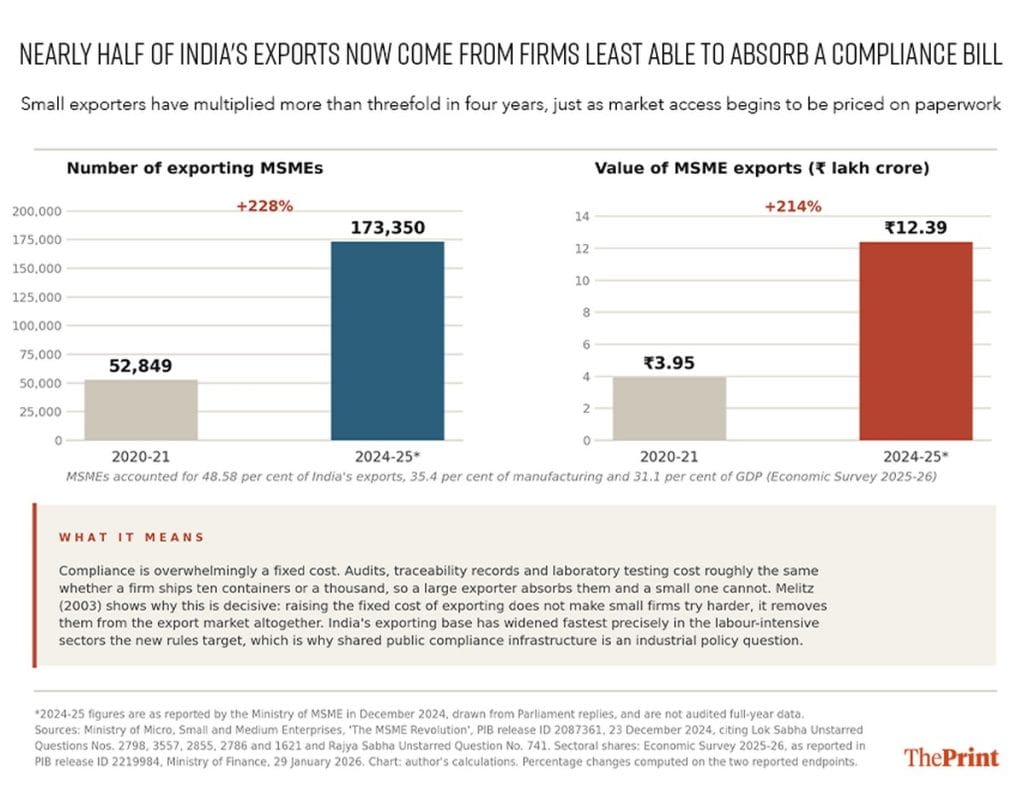
India cannot afford the removal of MSMEs from its economic framework. According to the Economic Survey 2025-26, MSMEs contribute approximately 48.58 per cent to exports, 35.4 per cent to manufacturing, and 31.1 per cent to GDP, with over 7.47 crore enterprises employing more than 32.82 crore individuals. The number of exporting MSMEs has increased from 52,849 in 2020-21 to 1,73,350 in 2024-25, as reported by the government. This expansion is particularly evident in sectors such as textiles, leather, gems and jewellery, marine products, and processed food, which are precisely the areas targeted by the new standards.
A shared public platform can alter this economic equation by transforming a fixed cost, which no single small firm can manage, into a system-wide expense. This mechanism is already present in the Export Promotion Mission, specifically through its NIRYAT DISHA component, which is designed to offer non-financial support concerning export quality and compliance.
The focus should be on developing a single traceability backbone with sector-specific modules, rather than creating a new portal for each crisis. Once established, this system can address various international demands, such as labour standards from Washington and carbon regulations from Brussels.
India developed the foundational blueprint on a grape farm nearly two decades ago. The remaining task is to implement it on a national scale proactively, rather than reactively, in response to external notices.
Bidisha Bhattacharya is ThePrint Consulting Editor (Economics) and an Associate Fellow, Chintan Research Foundation. She tweets @Bidishabh. Views are personal.
(Edited by Asavari Singh)