



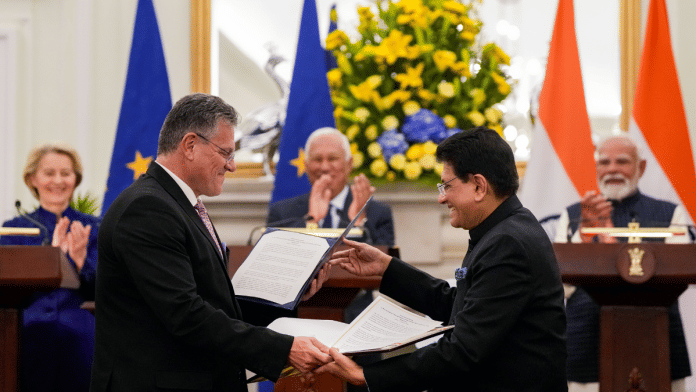
Three months before the European Union prohibited Brazilian beef, India finalised a significant trade agreement with Brussels. The timing highlights the importance of a particular clause in Europe’s other major trade agreement—the one with Mercosur—for Indian stakeholders. The clause illustrates the nature of protection against potential policy reversals by Europe, making it particularly pertinent for India’s agreement with the EU.
The EU-Mercosur agreement, which took 25 years to negotiate, was implemented on 1 May this year. Brazil, the largest economy within the bloc, had waited the longest for the reduction of tariffs.
A mere 11 days after implementation, the agreement faced its first significant challenge. On 12 May, following extensive protests by European farmers, Brussels declared a ban on Brazilian beef, chicken, eggs, and honey from the EU market. Effective on 3 September, the ban was announced due to concerns over antibiotic use on Brazilian farms. This decision effectively restricted the market access that Brazil had been promised. Brazil expressed surprise and committed to contesting the decision. The scenario exemplifies the purpose of a specific clause within the agreement.
Known as the rebalancing mechanism, the clause allows Mercosur to seek compensation, increased quotas, or reduced tariffs if a new EU regulation on food safety or emissions affects the market access initially promised. This compensation is not something Brazil must request; it is a provision guaranteed by the treaty, established years before any specific rule was anticipated to activate it.
The rationale behind the EU’s agreement to such terms lies in its understanding of domestic political dynamics. European farmers, although a minority within the EU’s population, are exceptionally well-organised, demonstrating that a determined minority can influence policy decisions that a larger, less vocal majority may overlook. This phenomenon was identified by economist Mancur Olson in 1965 as the logic of collective action: small, organised groups prevail over larger, diffuse ones because each farmer has significant stakes in the outcome, whereas each consumer is minimally affected financially.
Additionally, a second economic pattern, documented by economists Kym Anderson and Yujiro Hayami in 1986, is relevant: as a country’s agricultural sector diminishes, it tends to receive more protection, as the costs are distributed thinly across consumers while benefits are concentrated among fewer, more organised farmers. This has been termed the developmental paradox, with Europe exemplifying the scenario. Together with Olson’s logic, this explains why such pressures often remain unnoticed, manifesting as stricter regulations only after the fact. The rebalancing clause is unusual because it makes these pressures apparent and quantifies them well in advance.
That price Europe must pay remains unresolved. Shortly after the agreement was signed, the European Parliament referred the entire agreement to the EU’s top court, challenging the legality of the rebalancing mechanism, and consequently delaying ratification by more than a year.
In 1988, political scientist Robert Putnam characterised such situations as two-level games, where a negotiator must simultaneously address the interests of the other country and those of their own parliament, courts, and domestic stakeholders such as farmers. A deal is successful only if it is accepted at both levels. While Brussels succeeded in negotiations with Mercosur, it continues to face challenges domestically. The implementation of the beef ban proceeded regardless, illustrating that domestic political dynamics can advance independently of judicial processes.
India wrote a different contract
On 27 January, India finalised a trade agreement with the EU, following nearly two decades of intermittent negotiations. This agreement, referred to by both parties as the “mother of all trade deals”, adopts a different strategy from those in previous agreements. Unlike the Mercosur agreement, which heavily involves agricultural sectors, India’s deal largely excludes agriculture, thereby avoiding exposure in areas such as beef, dairy, or sugar quotas, which currently affect Brazil.
India’s primary vulnerability lies in the carbon sector, as it is a significant exporter of steel and cement to Europe. These exports are directly impacted by the EU’s carbon border tax, which imposes charges on carbon-intensive imports from countries with less stringent carbon pricing. Anticipating potential challenges, India proactively included a specific section on the carbon tax within its free trade agreement (FTA). This section, absent in Mercosur’s agreement, also establishes a fast-track mechanism for escalating disputes as soon as regulatory measures become problematic.
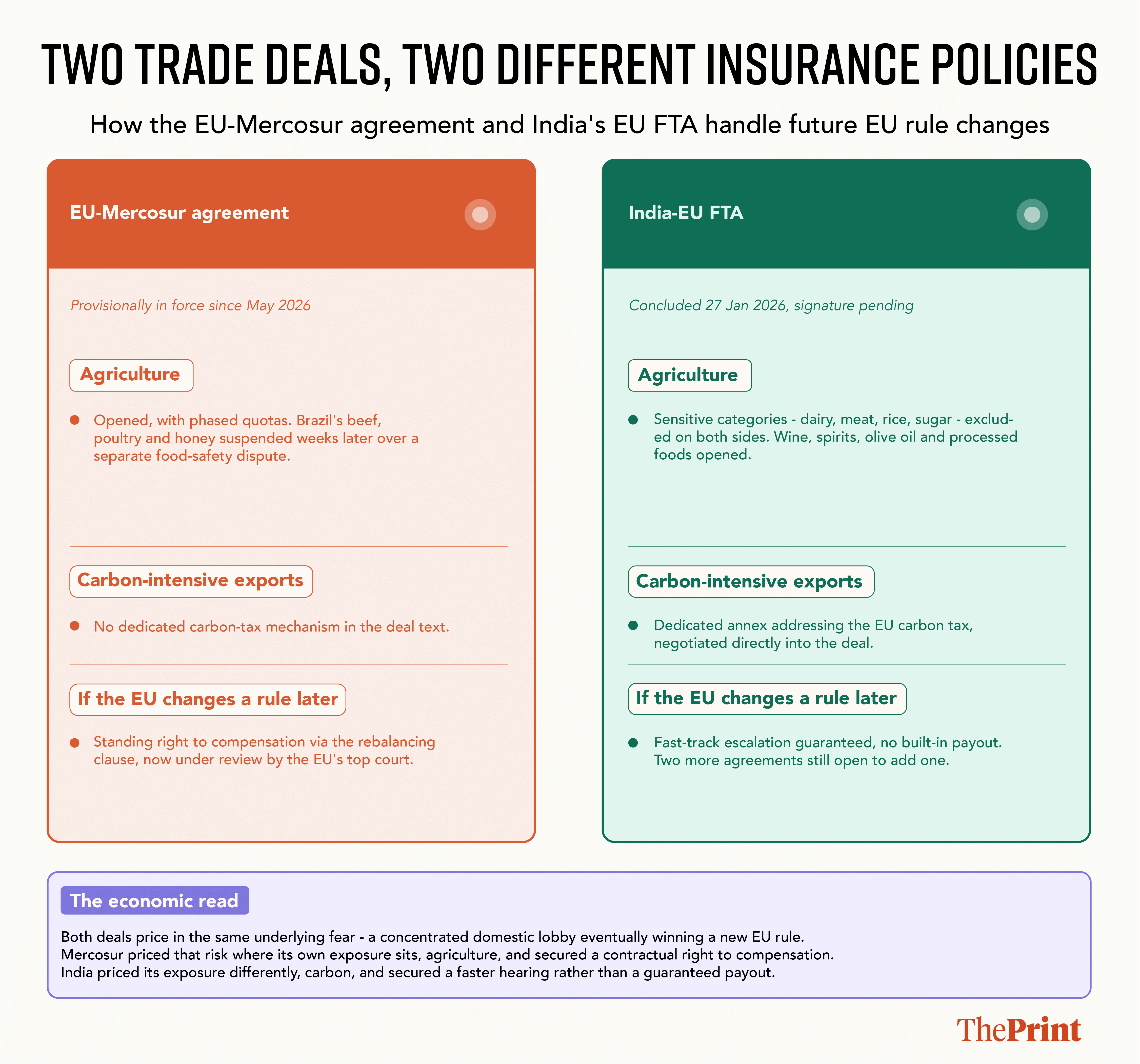
This mechanism ensures expedited resolution processes. Mercosur’s approach, on the other hand, secured a standing right to compensation that is currently under legal defence. Legal analysts highlight that certain aspects, such as the acknowledgement of India’s carbon audits, are still under negotiation.
Also read: Why India’s court digitisation keeps failing
The smarter insurance policy
These developments do not imply that India has been disadvantaged. Rather, they indicate that India has accurately assessed its own vulnerabilities. It avoided the conflict Mercosur faces regarding agricultural products and proactively addressed the carbon issue pertinent to its interests. Two additional negotiations with the EU, concerning investment protection and geographical indications, remain ongoing. These negotiations present an opportunity for India to secure terms similar to those Mercosur has achieved. This would include not only immediate communication when the carbon tax is implemented but also a guaranteed reciprocal benefit.
After 25 years of negotiations, Brazil finally got its deal, only to lose a portion of its beef market 11 days later. The critical insight here is not that trade agreements are inherently risky, but that the most secure agreements are those that clearly define, prior to any disputes, the entitlements when the opposing party alters the terms. Mercosur incorporated such assurances into its treaty, which is now being scrutinised in its courts. India still has two opportunities to draft an agreement that ensures enforceable commitments.
Bidisha Bhattacharya is ThePrint Consulting Editor (Economics) and an Associate Fellow, Chintan Research Foundation. She tweets @Bidishabh. Views are personal.
(Edited by Prasanna Bachchhav)