





I haven’t bothered to feel guilty about how many hours I’ve spent glued to my phone over the last week. There was a revolution to keep track of, the spectacle of watching a world turn on its axis, and where else was that available but Instagram? Amid an auto-refreshing feed populated by police brutality, chaos, tear-gassing, and stampede-like situations, a video edit titled “This Genre of Woman” has made it to the top over and over again—and I have watched it every single time.
At first, there is a bindi-ed young woman—20? 21?—speaking with an enraged steely evenness. “Democracy hai, naukar hain wo humare. Kyun nahi denge isteefa? Inke baap ka desh hai?” she asks. Why won’t Dharmendra Pradhan resign, he’s here to serve us. Then the cuts quicken; other women now, at other barricades, stopping police vans and shoving back at khaki, fighting, chanting, faces flung open and howling, all set to a remix of the old cabaret number, Hungama Ho Gaya.
I keep going back to the video because I still can’t quite believe what India’s young men and women have been able to accomplish in just a few days. It’s the butterfly effect made manifest. In a little over a month, a movement that began with the Chief Justice of India making an offhand slur about Indian youth being cockroaches has forced a Union education minister to resign. They have prised out of this government the one thing it is loath to hand a crowd: a concession. Last week, I ended my column wondering whether the Cockroach Janta Party and India’s students would be able to outlast a state that had all the time in the world. But India’s Gen Z weren’t, as it turned out, going to give power the pleasure of finding out. By Sunday afternoon, they had answered it.
It’s hard to put into words what most Indians—particularly millennials like me—have experienced this past week, watching people a couple of decades younger than us play David in a deeply unequal fight for their future. I know I’ve watched it all unfold, alternating between anguish, sadness, relief, incredulousness, grief, exhilaration, and pride. Just so much pride for an amorphous body of fearless youngsters, about the age of my nephews and nieces.
But most of all, I have felt a familiar rage that has lain dormant for a few years. It has cycled through shades of paralysis to helplessness to indignation to rest at that primitive surge of adrenaline. Through tears and heartache, I’ve had to Google phrases like “vaaste gana huiyeen” and who the Subway Surfers are supposed to be. I’ve injected so much raw footage, edits, and compilations into my veins that it will be a while before my cortisol levels and circadian rhythm reset.
If this is what a democracy in action is supposed to feel like, I’m ashamed to admit that I’d made my peace with never feeling it again. From a generation that has been scoffed and eyerolled at, labelled lazy, entitled, and disinterested, this has been a delightful humbling.
Also read: From Irom Sharmila to Sonam Wangchuk, every govt fears giving in. It can’t admit protests work
Winning through humour
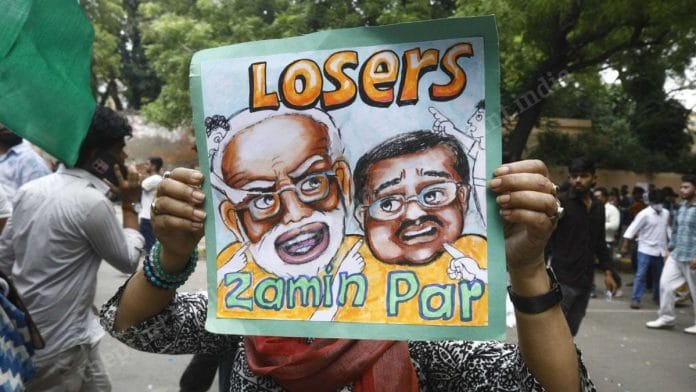
Beyond the irreverence and agility, what has taken me apart is the complete absence of fear among the protestors. This whole confrontation has been staged as a farce. How do you scare someone with a lathi when their placard announces they’re into BDSM? How do you batter young bodies with water cannons when they are just going to turn it into a rain dance party? How do you instill terror in their hearts when they are just going to open their selfie camera, and record themselves mocking you to your face?
A few days ago, I attended one of the spontaneous protests that broke out in several parts of India in solidarity with the ones at Jantar Mantar. A wave of fury had swept through the gathering, which included so many more people beyond the Gen Z core. As a series of speakers expressed their dissatisfaction with the government’s handling of the protestors—and so much more—a masked young man with a mithai box tapped me on the shoulder and politely asked me, “Ma’am, would you like a Modi-chor laddoo?”
I can’t remember if I was offered any laddoos during the anti-CAA-NRC protests of 2019-2020. For many of us, the dissent against CAA was the formative protest of our lives. Sure, before that was the “apolitical” India Against Corruption movement of 2011, but it unfolded during a very different era in India, when the repercussions for speaking up were not vicious.
I have gone looking for a memory of that winter with the kind of impishness we’ve witnessed over the last ten days, and come up empty. I remember the thunderous indignation and the groundswell, which was the same. For months, it felt like the whole country seemed to be gathered on one street or another. But what moved through it was a righteous, deadly serious anger, because the question on the table was elemental. In effect, the state was asking some of us whether we belonged here at all.
“Hum kagaz nahi dikhayenge”—we will not show our papers—rang through the streets. The defining anthem of that era was Faiz Ahmed Faiz’s Hum Dekhenge, chanted into the cold, every solemn syllable of it felt earnestly. What we saw, though, wasn’t pleasant. A swift and thorough reprisal ripped through India.
One issue began to coalesce into another: the attacks on the students of JNU, police brutality at Aligarh Muslim University, attacks on students in a Jamia Millia Islamia library, detentions during protests. Several attempts were made to uproot and delegitimise the sit-in protest by the women of Shaheen Bagh through dogwhistles. Protestors, we were told, could be identified by their clothes. A gunman fired on the students of Jamia while the police stood at his back. Umar Khalid was taken away under the UAPA and is, nearly six years on, still waiting for his trial to begin. Delhi burned in February 2020—hate speeches by senior BJP leaders, followed by riots, neighbours set loose upon neighbours. The riots left 53 people dead and thousands injured, and yet, all that popular discourse could focus on was the buses that had been burnt.
Eventually, Covid undid the protests, leaving the opposition to CAA with a twinge of failure. Fear, fed into the body politic like a slow poison, was the whole point of that winter. The lessons from 2020—that your voice will cost you—were meant to be learned only once. Somewhere, in a rush to disprove that we weren’t “anti-national” or “foreign-funded”, we lent the labels legitimacy. By taking these accusations seriously, we fell for the bait.
This week, Gen Z has shown us that the only way to take the sting out of these words is to laugh at them. Young protestors have taken the term “anti-national” and lobbed it back like grenades at the old uncles trying—in vain—to school them. They’ve ridiculed the idea of “foreign funding” so mercilessly that their accusers end up looking like fools. Every attempt to browbeat or sow communal panic or displace this rare moment of class and gender solidarity has been treated with derision. Gen Z will forever have the respect of millennials like me for this ingenious refusal to play a rigged game.
Also read: CJP protest isn’t a Gen Z victory alone. Millennials laid the groundwork
An improbable coalition
I’d love to be able to say that we were in this from day one. We weren’t. When the CJP first pitched up at Jantar Mantar, plenty of us watched the way you gather around a fender-bender—with curiosity but at a safe distance. More power to you, we thought. Good luck, but this one’s yours.
But the events of Monday blew that jaded complacency out of the water. Watching the state turn its water cannons and lathis on its citizens, once again, galvanised us off the sidelines. This part, many of us know by heart. Mutual aid networks activated overnight with learned precision. Pro-bono lawyers and doctors apparated. Volunteers to distribute food and water, and clean out the protest site, appeared by the dozen. Those who couldn’t make it to Jantar Mantar donated in big and small ways to keep the kids going. Those who could, hit the streets in an improbable coalition.
All that we were waiting for, it seems, was a reason to stop being so damned sensible.
In an Instagram AMA, someone asked a creator how millennials had actually contributed to the protests of 2026. Instead of bristling, the creator responded with the same infectious humour we’ve learnt from our Gen Z counterparts. Who do you think was Zomato-ing you lot your food, he asked. We’ve been so worried about your baddies that our own are upset with us. And we’d have shown up at Jantar Mantar over the weekend, only you wrapped it up before we got there.
It’s funny because it’s true—that joke answers a tart question without a smidge of solemnity. A few years ago we’d have met it with a wounded little essay on everything my generation had risked. That we reach for a punchline now is not nothing. It’s proof that what has passed between the generations this month has passed in both directions. Maybe they didn’t need it, but Gen Z could rely on the muscle memory of a country that still knows how to gather. In return, they have gifted us what the winter of 2019 took from us: the radical idea that fear can be kicked away like a tear gas shell launched at you.
The difficult work of sustaining the momentum of a movement, building community and networks, getting past demands of ideological purity, one-upping our own allies, and channelling all this fury into something that lasts begins now. It’s unglamorous, boring, back-office work that won’t make it to an edit, but we know at least one generation that has a little experience with this. We’ll be around.
Karanjeet Kaur is a journalist and a partner at TWO Design. She tweets @Kaju_Katri. Views are personal.
(Edited by Theres Sudeep)
Fear did not rule Bharat since 2014 especially from the BJP NDA government. I challenge her to prove it.
Proof…if either this blogger, her immediate family, and her extended family are still resident in Bharat, living comfortably, eating weol, praying well, working well, moving around well, raising their kids well, voting based on their conscience and doing all that everyone else is….then there is nothing to fear.
If you have self-induced anxiety, depression, panic, paranoia etc that is sourced due to other traumatic e in your life, then consult your immediate doctor.
If you want to really talk about the real and factual dangers with evidence, I have tons of news to share on the other side. Get well fear-mongerer.
The Print is the hub for cheap, chaotic, anarchic, meaningless, non-contextual guttersnipes to vent their baseless opinions.