






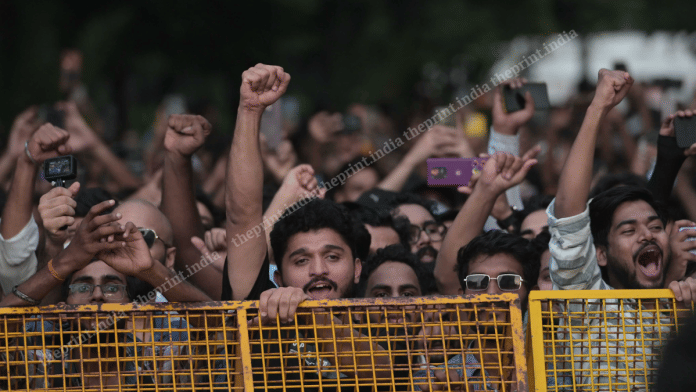


New Delhi: Gen Z is celebrating its political coming of age. After weeks of sustained protests, the movement at Jantar Mantar and on social media culminated in the resignation of a Union minister and acceptance of key demands. The movement also awakened a generation to realities it had long ignored: the power of dissent and the value of peaceful protests.
Amid the celebrations, though, social media has rushed to frame this as a victory of Gen Z over millennials. History, however, is rarely this neat. Movements are not born overnight, nor do they belong to a single generation. They are dissent in motion—shaped by successive generations before erupting into moments that history remembers.
The CJP protests, which were later taken over by the youth, were part Gen Z and part millennial. It was the energy, creativity, and digital fluency of one generation and mobilisation, political awakening, and dissent culture nurtured by another. It was the fusion that led to the first–ever resignation in the Narendra Modi government.
The protest saw all three generations—Gen Z, millennials, and Gen X—standing shoulder to shoulder in demanding reforms in India’s education system.
India’s protest culture didn’t begin with Instagram
India’s history is one of resilience and resistance. Long before hashtags and memes, it was rigorous groundwork—distributing pamphlets, knocking on doors, and facing crackdowns—that built movements and sustained mobilisation.
This was most visible during the 2012 movement in Delhi following the gang rape and murder of a 22-year-old woman, when millennials brought everyone to the streets through Facebook. Even the anti–CAA-NRC protests were built on the back of networks of students, citizens, and volunteers.
Let’s not forget that it was millennials who normalised dissent under the Modi government. The first signs appeared in 2015, a year after the formation of the new government. The students at Film and Television Institute of India (FTII) launched a months-long strike against the appointment of Gajendra Chauhan as chairman.
A year later, the death of Rohit Vemula, a Dalit PhD scholar at the University of Hyderabad, triggered nationwide protests and stirred conversations around caste discrimination. The JNU protests of 2016 paved the way for larger debates on nationalism, democracy, and constitutional rights. Student leaders Umar Khalid, Kanhaiya Kumar, and Anirban Bhattacharya were arrested on charges of sedition.
These movements did not always achieve their immediate objectives, but they created a rupture in a politics fuelled by polarisation. These movements were attempts to reclaim dissent as a democratic act. And they produced a generation that learned to organise, crowdfund, and document. Fact-checking sites such as Alt News did not emerge in a vacuum.
Also read: Drag or bangles aren’t insults. Students’ protest posters need to catch up
Millennials also paid a heavy price for keeping the culture of dissent alive. Student activists were branded as “anti-national”, “urban Naxals”, and the “tukde tukde gang”. Leaders such as Umar Khalid and Mahesh Raut faced jail under stringent charges. Arrested in 2020 under the UAPA, Khalid remains in jail today.
It was against this fertile backdrop that Gen Z created its memes and reels, establishing a new language of dissent.
But credit must be given where it is due. Gen Z has not only changed the vocabulary of protest, it has also reminded India of something deeper: the secular spirit of the country.
Students from different caste, religious, social, and economic backgrounds marched together, shared meals, and drank from the same bottles while standing guard for each other.
Millennials had long argued that the idea of India is still alive and thriving. Gen Z has proven it.
Views are personal.
(Edited by Prasanna Bachchhav)