




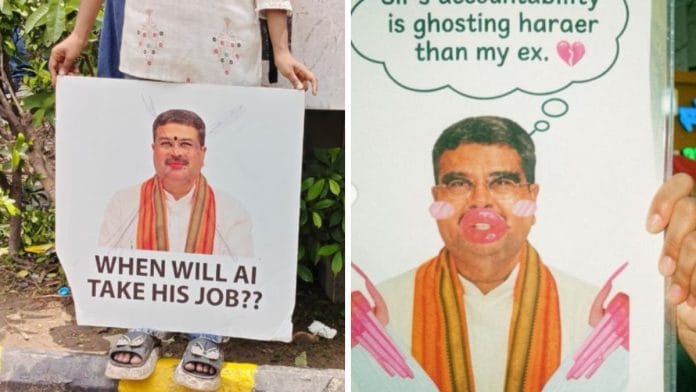

Misogynistic and queerphobic posters have infiltrated the stream of other funny posters at the Cockroach Janta Party protests. Gen Z has been extremely creative — with posters, reels and memes — in demanding accountability for exam paper leaks and the resignation of Union Education Minister Dharmendra Pradhan. The protest site is full of satirical placards, pop-culture references, and costumes.
However, this new generation’s creativity has paved the way for the same old boomer humour rooted in patriarchy.
Many of these posters put Prime Minister Narendra Modi and Pradhan in dresses, bikinis, or feminised drag — as if dressing like a “woman” is the worst thing that could happen to them. The posters borrow the idea that femininity is a costume of humiliation. It not only perpetuates misogyny but also pushes cisgender binaries linked to gender expression. A man wore a dress, and we are all supposed to find that funny.
These posters, which were supposed to demand accountability from the government, instead reveal fault lines in our own understanding of gender. Gen-Z prides itself on being better than former generations. We claim to be more “woke”, but the ease with which these images travel shows how shallow that claim often is.
Another poster at the protest reads, “Biwi Nahi Hai Toh Bacho Ki Maroge?” (If you don’t have a wife, are you going to screw children over?), echoing the same husband-wife boomer humour forwarded in family WhatsApp groups. The idea was for us to dismantle patriarchy, but we have seemingly given in to it. These jokes assume that power in a household always runs one way, and that the absence of a wife simply redirects the same force externally. It pushes the institution of marriage as a compulsory choice.
A number of posters at the protest site are also targeted toward sex workers. The placards sometimes compare the minister to unfaithful girlfriends and wives. The visuals depict the politicians with long pink nails and a bright neon lipstick – symbolic of them being incompetent “divas.” The language of the slogans is often full of gendered slurs.
Also read: New ‘patriotic’ songs have no place in student protests. They’re going back to Rang De Basanti
Same old prejudice
Women, children and queer people are not standing on the sidelines of this movement. They are an equal part of it. Young girls have been showing up in large numbers. Families have brought their kids. Trans and queer protesters have been present from early on, joining the same calls for accountability and for Pradhan’s resignation. Their presence should have made the visual culture more careful.
Instead, parts of the online conversation around the protest have gone the opposite direction. People have been calling the police and the state “hijda” as an insult. It only works if being trans or gender-nonconforming is already seen as low and contemptible. So while actual trans people stand in the crowd, sections of the digital chatter treat their existence as a convenient put-down. That is not radical. It is just the same old prejudice clothed in protest merch.
Gen-Z is supposed to be the generation that finally gets this right. More progressive, more fluent in the language of rights, less tied to the hierarchies that came before. This protest has been held up as proof of that shift.
However, the posters and the online language keep undercutting the claim. A generation that can organise quickly, invent sharp visual language and stay on the streets for weeks can still fall back on the same tired hierarchy about whose body is lesser and whose identity is fair game for mockery.
The core demands remain legitimate. Paper leaks and systemic failures damage real futures. Asking the education system and its political heads to answer for that is necessary. But movements are also judged by the culture they create while they make those demands. When the posters treat femininity as humiliation, male intimacy as a joke, and queer/trans identities as a slur, they shrink the circle of people who can feel fully claimed by the cause.
(Edited by Saptak Datta)