








The last decade or so in Hindi cinema has been spent presenting a very specific kind of patriotism. The kind that enters the enemy’s home and strikes back. The kind that celebrates the state at its strongest. The kind that asks citizens to rally behind power rather than question it.
Audiences rewarded it. Uri: The Surgical Strike (2019) became a blockbuster. The Kashmir Files (2022), The Kerala Story (2023), and Article 370 (2024) all found commercial and political success. Just last week, Yami Gautam’s Article 370 won the National Award for Best Feature Film, while Dhurandhar has reaped the benefits of the same grammar of muscular nationalism.
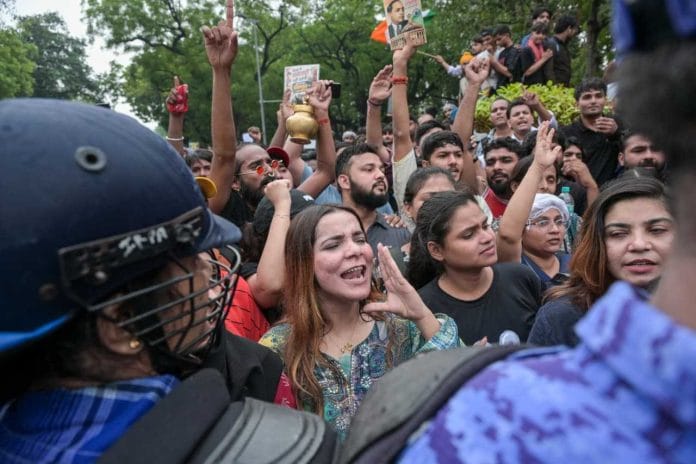
And yet, if you listen to the soundtrack of the ongoing student protests, you hear almost none of it.
For weeks now, students protesting at Delhi’s Jantar Mantar have sung “Give Me Some Sunshine”. Protest reels have turned to “Khoon Chala”, “Sadda Haq”, and “Aarambh Hai Prachand”. Crowds have broken into “Jai Ho”. In Mizoram, students sang Black Eyed Peas’ “Where Is the Love?”. Michael Jackson’s “They Don’t Care About Us” has found a place too.
The students leading these protests are the generation that came of age with Uri, Article 370, The Kashmir Files, and The Kerala Story. If Bollywood’s new patriotic cinema had reshaped how young Indians expressed love for their country, this should have been its moment. Its music should have travelled from cinema halls to the streets.
It didn’t.
Instead, Gen Z reached back.
Penned for citizens
“Give Me Some Sunshine” is 17 years old. Most of the students singing it today were children when 3 Idiots released in 2009. “Khoon Chala” is 20 years old. Many of the people sharing it in protest reels were not even born when Rang De Basanti first reached theatres.
That isn’t an accident.
“Give Me Some Sunshine” still speaks to students because the frustrations it captured never disappeared. Every generation eventually finds itself arguing with an education system that seems more interested in marks, ranks, and results than the people inside it.
“Khoon Chala” imagines patriotism through disappointment rather than triumph. Rang De Basanti never argued that loving your country meant agreeing with those in power. It argued that love for the country sometimes demands confronting power.
The same is true of “Sadda Haq”. It isn’t tied to one movement or one cause. It is simply the language of someone insisting on being heard. That makes it easy to borrow. A protest in 2026 can make as much sense of it as a film released in 2011.
Those songs outlived their films because they were never written only for their characters. They were written for citizens.
That is where Bollywood’s patriotic cinema changed.
Also read: Meet Drawnk. He saw a shell hit a protester and turned it into artwork
An about-turn
When Uri entered popular culture, what escaped the theatre wasn’t the song “Challa”. It was “How’s the josh?” The slogan had a much longer afterlife than the song itself.
That wasn’t a coincidence.
Over the last decade, Bollywood’s patriotic films have increasingly shifted their attention from the citizen to the state. Article 370 finds its emotional high in the successful execution of a government policy. Dhurandhar folds Narendra Modi’s swearing-in and demonetisation into another story of national strength. The heroes are soldiers, intelligence officers, and governments. Their victories belong to institutions.
The music changed with them.
Older songs invited people in. They were written in voices that could belong to anyone. A student could sing them. A protester could sing them. Decades later, they could leave the film behind entirely and acquire new meanings.
The newer films rarely ask that of their music. Their emotional payoff comes from a mission accomplished, an operation completed or a political victory secured. The songs reinforce those moments. They rarely outgrow them.
That is what this protest unexpectedly reveals about Bollywood.
Somewhere along the way, Bollywood stopped writing songs for citizens.
It started writing slogans for the state.
Views are personal.
(Edited by Aamaan Alam Khan)
Very true – a well written article by Tarini reflecting today’s youth and their dreams as well as their frustrations . They have found their voice and are no longer going to be quiet. Songs are a reflection of this reality.