



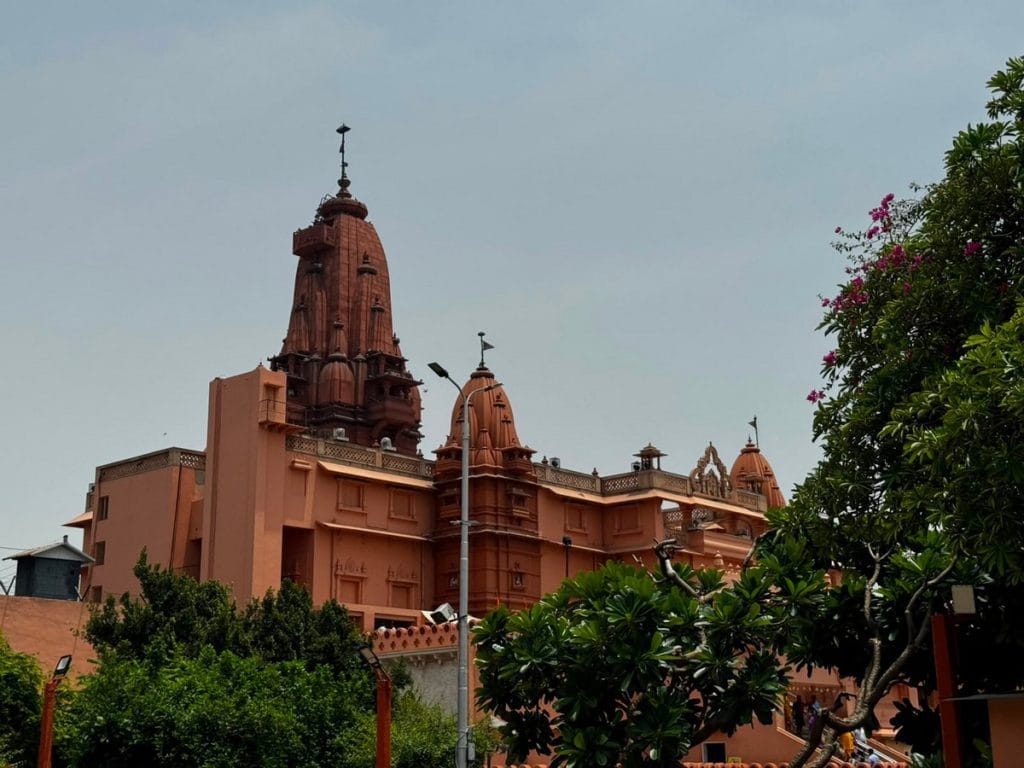
Mathura: Emergency telephonic meetings, tighter scrutiny of donation boxes and additional personnel overseeing every stage of cash counting—the Shri Krishna Janmabhoomi Temple in Mathura has been overhauling its safeguards over the past fortnight. For priests and societies managing temples, protecting the donation boxes is now directly tied to protecting their own reputations.
The trigger is the alleged multi-crore fraud at the Ram Mandir in Ayodhya, where eight people have been arrested and an SIT formed over the siphoning of donations; the temple trust has also announced a management overhaul.
“The Ram Temple incident has not only damaged the reputation of one temple but has shaken the confidence of temple managements across the country,” said Kapil Sharma, secretary of the Shri Krishna Janmasthan Seva Sansthan, the private society that manages the temple complex.
Across Mathura, Vrindavan, Prayagraj and Varanasi, the scandal has revived an old contest over who should control UP’s revenue-rich temples: religious custodians who have managed them for generations or a government that argues greater oversight is necessary as pilgrimage expands into a major economic enterprise.
Many priests and mahants view the scandal as both a betrayal of faith and a threat to their autonomy. Their fear is that the controversy will give the state greater room to intervene in temple affairs.
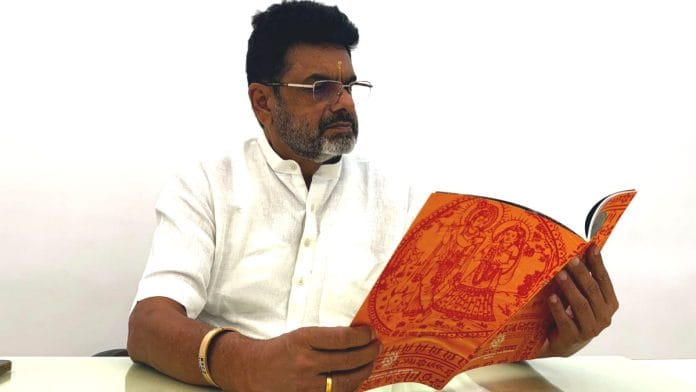
Wearing a crisp white kurta with a chandan tilak on his forehead, Sharma has worked for over 25 years with the trust, and says he has never witnessed a crisis of this magnitude.
“Mahants and trustees are now concerned not just about preventing fraud but also protecting their credibility,” he added. According to its management, the Shri Krishna Janmabhoomi Temple receives about Rs 1 crore in donations every month.
From the Banke Bihari Temple in Vrindavan and the Bade Hanuman Temple in Prayagraj to the Kaal Bhairav Temple in Varanasi and the Shri Krishna Janmabhoomi Temple in Mathura, questions are being asked in closed rooms: are donation and cash-counting systems robust enough? Is the management vigilant enough? There’s an acute awareness that in the age of social media, every lapse will be publicly dissected.
Uttar Pradesh is a secular state. None of the temples is under the direct administration of the state. Religious affairs are left to sects and societies.”
– Vishwa Bhushan, joint director of UP’s Department of Religious Affairs
Underneath it all is a larger battle over control, echoing a long-running ‘temple freedom movement’ that has been brewing in states from Tamil Nadu and Karnataka to Uttarakhand and West Bengal. Priests and mahants in UP argue that state oversight has systematically expanded, encroaching on traditional management one policy at a time. While Uttar Pradesh does not have an umbrella law governing Hindu temples, as Tamil Nadu does, the government has nevertheless entered the administration of some major shrines. At the Ram temple in Ayodhya, for instance, the Centre constituted the Shri Ram Janmabhoomi Teerth Kshetra Trust, which includes serving government officials as trustees.
“They want to turn temples into private limited companies. Whenever the government interferes in the matters of the temples, the sanctity is compromised. They are more concerned about VIP treatment and making money, not the rituals. Ram Mandir is a perfect example of that,” said Gopesh Goswami, a mahant at Banke Bihari Temple in Vrindavan.
In recent years, the state’s footprint in temple administration has steadily increased. Under Chief Minister Yogi Adityanath, the Department of Religious Affairs (Dharmarth Karya Vibhag)—created in 1985—has been dusted off and repurposed into a powerful engine for religious tourism. A Rs 1,000 crore budget was proposed for the department in 2022-23 against the Rs 32.52 crore it spent in 2017-18.
To execute its vision, the UP government has also established several Teerth Vikas Parishads (Pilgrimage Development Boards) in major temple towns. Headed by senior officials and retired bureaucrats, these boards carry out large-scale infrastructure projects around holy sites, from corridors to plazas. Last year, a law was enacted to create a government-appointed trust for Banke Bihari temple as well, which opposition leaders such as Akhilesh Yadav termed a bid to “indirectly take control” of temples “under the garb of better administration”.
The department, however, says it has no statutory authority over the administration of temples.
“Uttar Pradesh is a secular state. None of the temples is under the direct administration of the state. Religious affairs are left to sects and societies,” said Vishwa Bhushan, joint director, Dharmarth Karya Vibhag.
He noted that Article 25 of the Constitution permits restrictions on religious freedom only on grounds of public order, morality and health, while the Directorate’s mandate is largely confined to pilgrim “safety and convenience”.
Bhushan, who is CEO of the Kashi Vishwanath Temple, added that the department also provides funds to the state Archaeology Department to maintain religious heritage structures and supports standalone projects, such as work undertaken by the Shri Kashi Vishwanath Special Area Development Board and public amenities in and around Ayodhya, Vindhyachal and the Braj region.
Also Read: ‘We will pray, but not donate’: How Ram Temple donation theft row is affecting Ayodhya’s livelihood
Hope awakens for Banke Bihari Goswamis
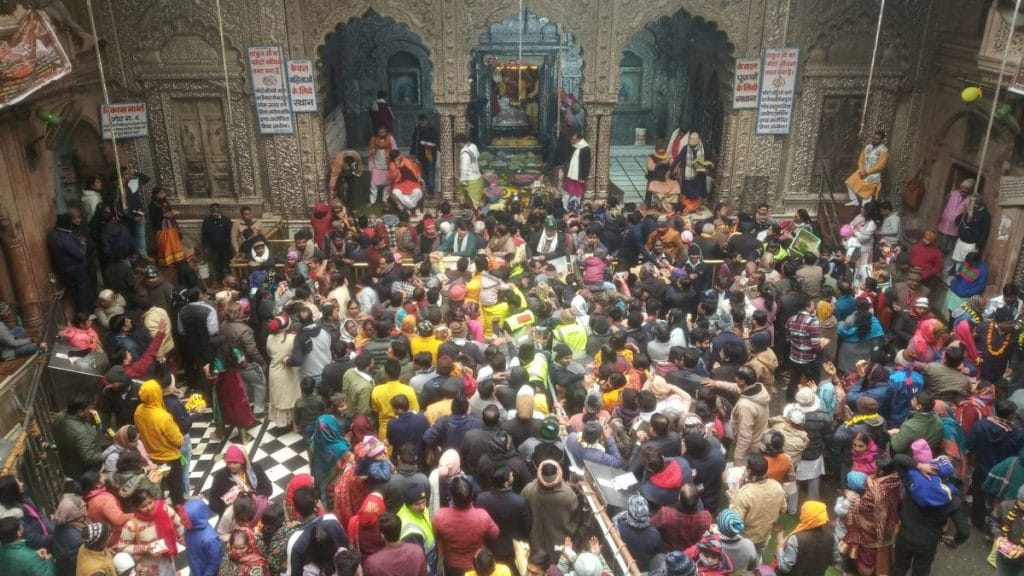
About 500 kilometres from Ayodhya, in Vrindavan, where “Radhe Radhe” echoes through the narrow lanes, the Ram Mandir case has seeded both anxiety and hope.
While priests at Krishna Janmabhoomi fear it could lead to greater government control, the Goswamis of Banke Bihari see it giving them fresh ammunition in their opposition to state intervention. Embroiled in a long court battle with the government, they see the alleged fraud as undermining the state’s central argument—that official oversight guarantees transparent administration.
After decades of managing the temple, serving the god, and the devotees, we now are fighting for our basic right to pray as per our own traditional rituals.”
– Gopesh Goswami, Banke Bihari mahant
Dissatisfaction has been brewing at Banke Bihari for a while. Himanshu Goswami, 36, is one of four recently inducted Goswamis on the committee that has been running the temple since 2025. He says its monthly meetings, meant to focus on facilities and the experience of devotees, often digress to how much revenue the temple has generated.
“The government is secular. It cannot manage a temple. It only thinks about profit and how to treat VIPs,” he said.
The financial stakes are massive. While temple finances are rarely disclosed, management stated in October 2022 that the shrine received Rs 4-6 crore a month and held Rs 248 crore in bank deposits. Banke Bihari had the second-highest tourist rating among Mathura-Vrindavan’s attractions, after Krishna Janmabhoomi, in a 2025 study by the Entrepreneurship Development Institute of India (EDII). The study also noted that the twin cities received 7.9 crore visitors in 2023, up from 76.8 lakh in 2018.

Historically, the hereditary priests controlled those funds. Two branches—Raj Bhog, which tended to the deity’s midday meal, and Shayan Bhog, which oversaw nighttime rituals—formed a seven-member committee formalised in 1939, with a civil judge intervening only during deadlocks. Rifts appeared in 2016, when the two branches fell out over nominations, and the civil judge stepped in to oversee the temple’s affairs. But the power was still in the hands of Goswamis, from the rituals to managing the donations.
Over the last few years, that has changed.
A slipping of control
The beginning of the end for the Goswamis’ reign was a Janmashtami stampede in 2022 that killed two pilgrims. Subsequently, the state announced a dedicated corridor around the temple for wider lanes and safer darshan. But the state sought to fund the Rs 500-crore corridor project from the temple’s coffers, which led to swift resistance from the priests.
Arguing that devotees’ donations could not fund a government infrastructure project, they challenged the move in court, and in August 2025, the Supreme Court agreed that caretakers should have been consulted before funds were pledged.
However, earlier that same year, the state passed an ordinance handing the shrine to a government-appointed trust. The Goswamis fought this too, winning only a partial reprieve: the court stayed the state trust, but placed the shrine under a High-Powered Management Committee instead.
We have been writing to the DM. We cannot check balance sheets, we cannot check vouchers. When we are part of the committee and have equal rights, why don’t we know where the money is going?”
– Rajat Goswami, Banke Bihari mahant
Chaired by Justice Ashok Kumar, a retired Allahabad High Court judge, who is reportedly drawing Rs 2 lakh a month from temple funds, the committee is largely staffed by Mathura officials—including the district judge, DM, SSP, and municipal commissioner. The Goswamis were allocated just four seats out of 14. It was a galling demotion for a community that had managed the temple for generations.
Gopesh Goswami, a mahant from the Raj Bhog sect, claims conditions deteriorated rapidly under the committee. Darshan timings were altered, and mahants were asked to extend the hours so that more devotees could see the deity in a day.
For the priests, this went against the centuries-old belief that the deity is a living child whose daily rhythms of food, rest and worship must be respected.
“Our Laddu Gopal is eight years old. He gets tired, he has to sleep, he has to eat. He cannot be available for darshan at the whims of the administration,” he said in his soft voice.
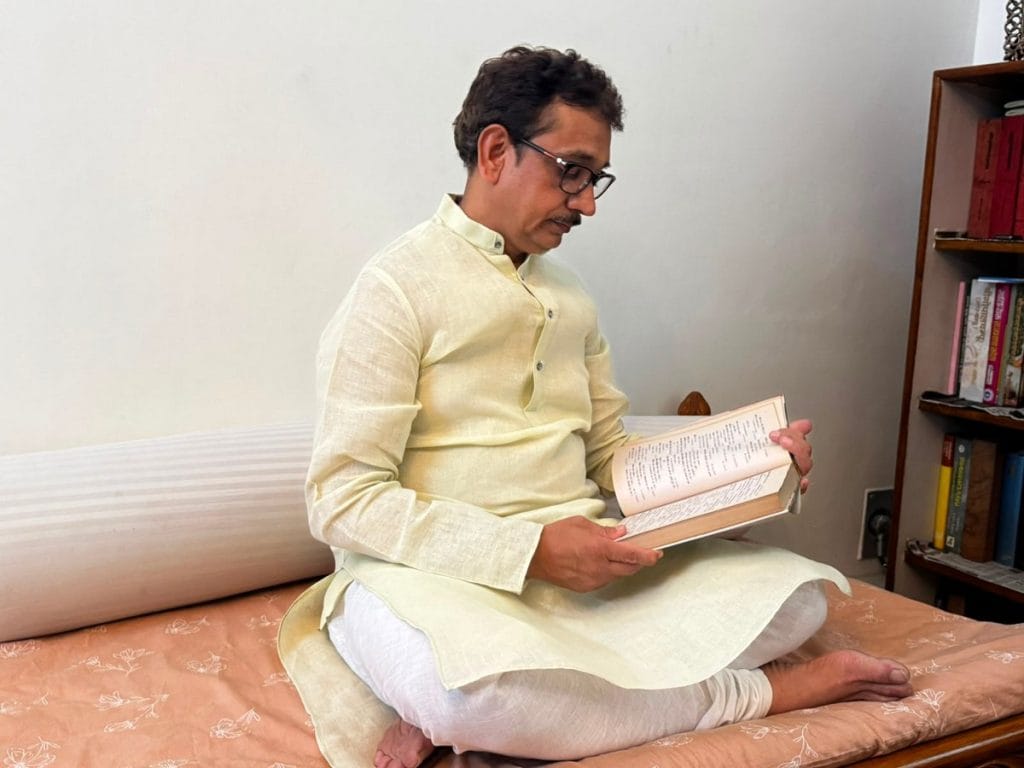
The committee also discontinued the traditional Dehri Pooja and altered the schedules for Shayan and Raj Bhog. Today, Gopesh performs these rituals at home. Inside a separate room dedicated to the deity, Laddu Gopal is fed, dressed and put to rest through the day. Gopesh performs the shringar and places the idol in a wooden cradle with a plush mattress, where it rests in the afternoon and night.
“After decades of managing the temple, serving the god, and the devotees, we now are fighting for our basic right to pray as per our own traditional rituals,” Gopesh said, pulling a book on Braj customs from his bookshelf.
In May 2026, while hearing petitions over these disruptions, the Supreme Court ruled that “traditional religious practices may be restored but by ensuring that, under those traditional ritual practices, there is no malpractice of taking (anything) in the name of donation or any hefty amount.” The court also replaced the existing Goswami appointees on the panel with Gopesh, Himanshu, Rajat, and Shailendra, and directed the committee to consider their joint suggestions on restoring customary rites.
Yet the battle over money remains unresolved. Goswamis report financial opacity under the committee.
“We have been writing to DMs. We cannot check balance sheets, we cannot check vouchers. When we are part of the committee and have equal rights, why don’t we know where the money is going?” said Rajat Goswami, another committee member.
He fears that the Banke Bihari Temple could face the same fate as Ayodhya.
“Soon, you will hear about the fund fraud at Banke Bihari,” he predicted pensively.
Rajat said the Goswamis are currently questioning other members on the committee about the temple’s finances during meetings and will decide their future course of action accordingly.
ThePrint visited the office of District Magistrate and committee member Chandra Prakash Singh, and also tried to contact him through phone calls and text messages, but received no response.
Bade Hanuman, little government
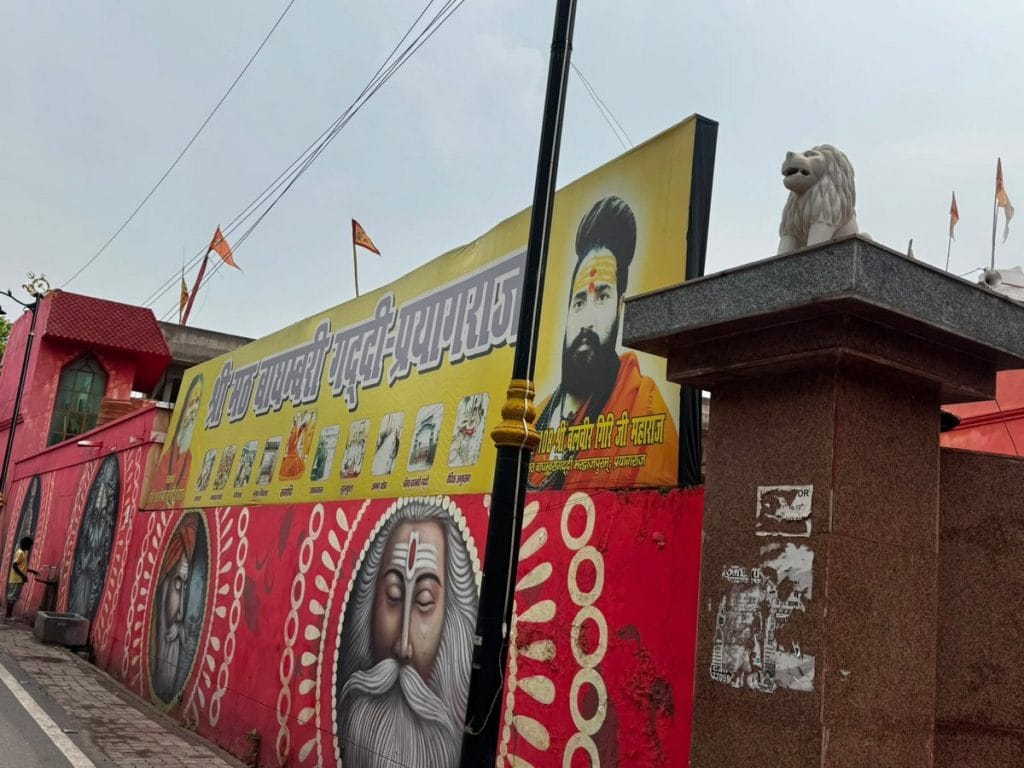
In Prayagraj, the Ram Mandir scandal has bolstered the resolve of the city’s most powerful monastic order to keep government oversight at bay.
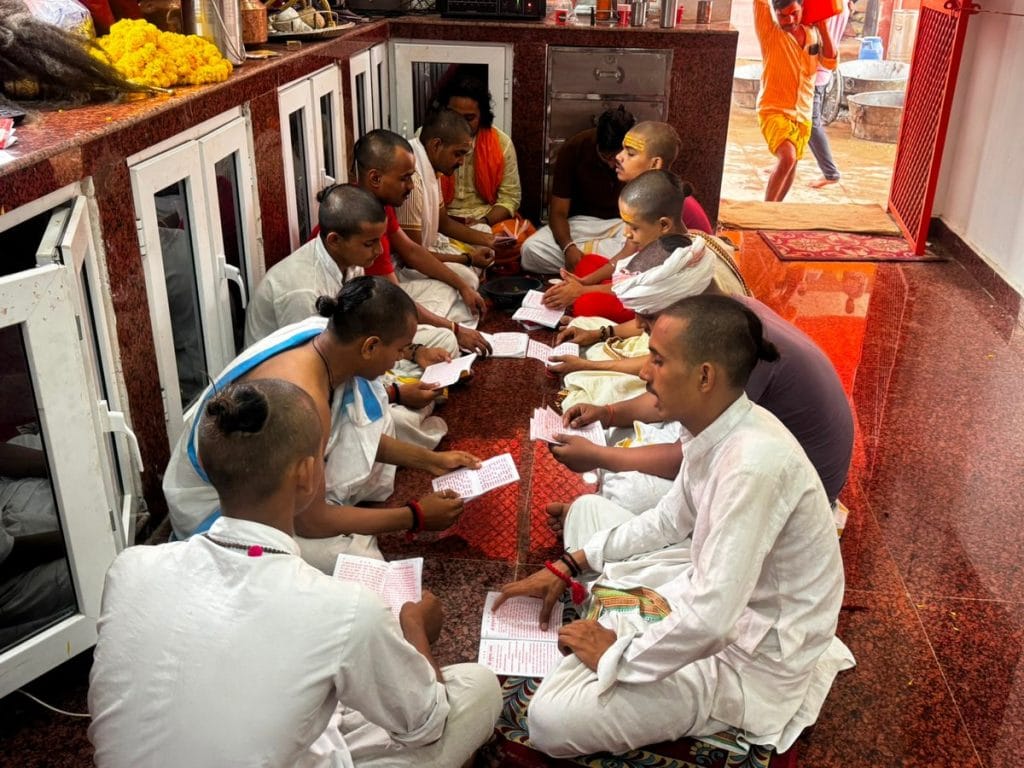
At the office at the Bade Hanuman Temple, one of Prayagraj’s most popular shrines, two women with saree pallus draped over their heads bow to a saffron-clad mahant. They want his permission to decorate Lord Hanuman with flowers. He nods, directing them to a hall where a dozen young Brahmin boys sit cross-legged, chanting the Hanuman Chalisa in loud unison. A man in a white lungi issues a Rs 11,000 receipt. A date is fixed, flowers are chosen, and the women depart smiling with a cheerful “Siya Ram”.
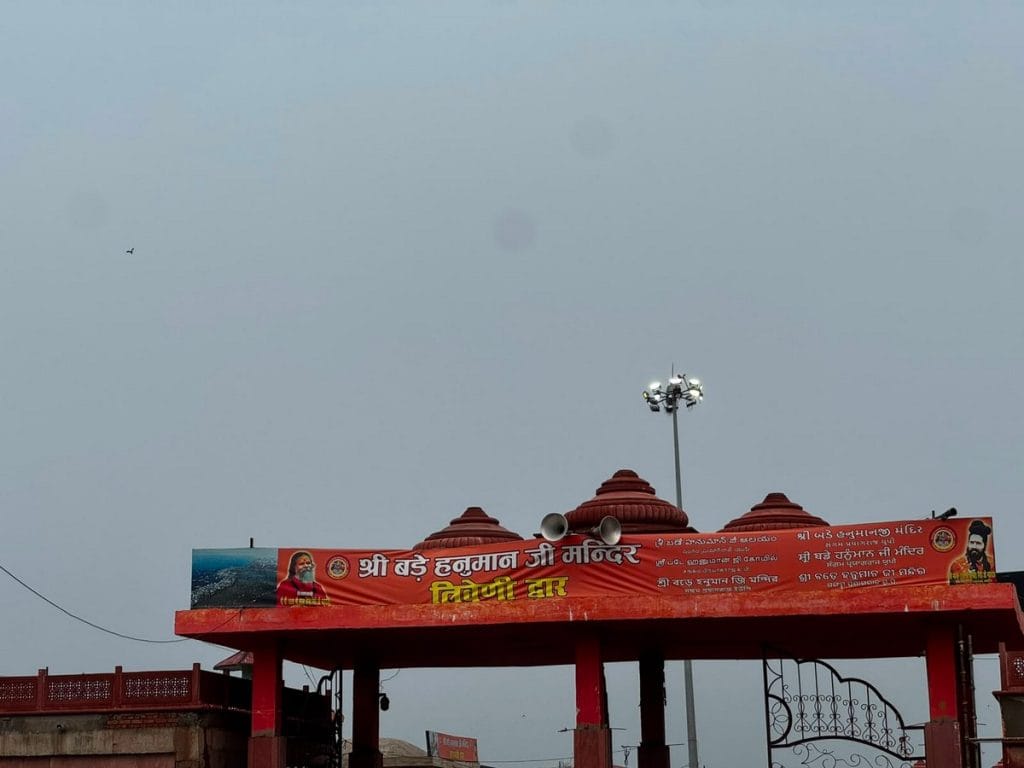
The temple—where the queue to offer prayers stretches for hours on Tuesdays and weekends—is overseen by Mahant Balveer Giri, who resides at the nearby Baghambari Math. One of the country’s wealthiest monastic complexes, its 10 acres encompass a Sanskrit mahavidyalaya, a gaushala, agricultural land and living quarters for sadhus. He is also the head, or pithadhishwar, of the Math Baghambari Gaddi, which manages the temple.
Like many traditional shrines in Uttar Pradesh, donations are managed through the math parampara—a centuries-old system in which the presiding mahant oversees the temple’s finances and decides how the money is spent.
It has been this way [with the math managing the donations] for generations. The funds are used not just for the temple but for public welfare. We run a gurukul, maintain over 100 cows, support the lives of sadhus. The entire system survives on these donations.
-Balveer Giri, mahant of the Bade Hanuman Temple
“It has been this way for generations,” said Balveer Giri in his office, where he holds court from a simple wooden bed with cylindrical pillows as a television screen displays live CCTV feeds from across the temple complex. “The funds are used not just for the temple but for public welfare. We run a gurukul, maintain over 100 cows every day, provide food, and support the lives of sadhus. The entire system survives on these donations.”
While Giri is occasionally pictured with BJP leaders, including applying tilak to Yogi Adityanath and sitting with him in the sanctum, he maintains that the math keeps its distance from the government. For him, the Ayodhya case demonstrates the flaws of state intervention.
“Such incidents of fraud are not part of our tradition. What happened at Ram temple is an example of what happens with greater government controls,” Giri said, adding that hundreds of staff members are involved in running the temple and donations sustain them all.
Another sanyasi recalled his visit to the Ram Temple in Ayodhya last year. What stayed with him, he said, was a sense of disappointment.
“Sadhus and Sanyasis were sidelined unless they are very popular,” he said on condition of anonymity.
Also Read: Ayodhya isn’t new. Chola kings were probing temple scams a thousand years ago
Corridors to control?
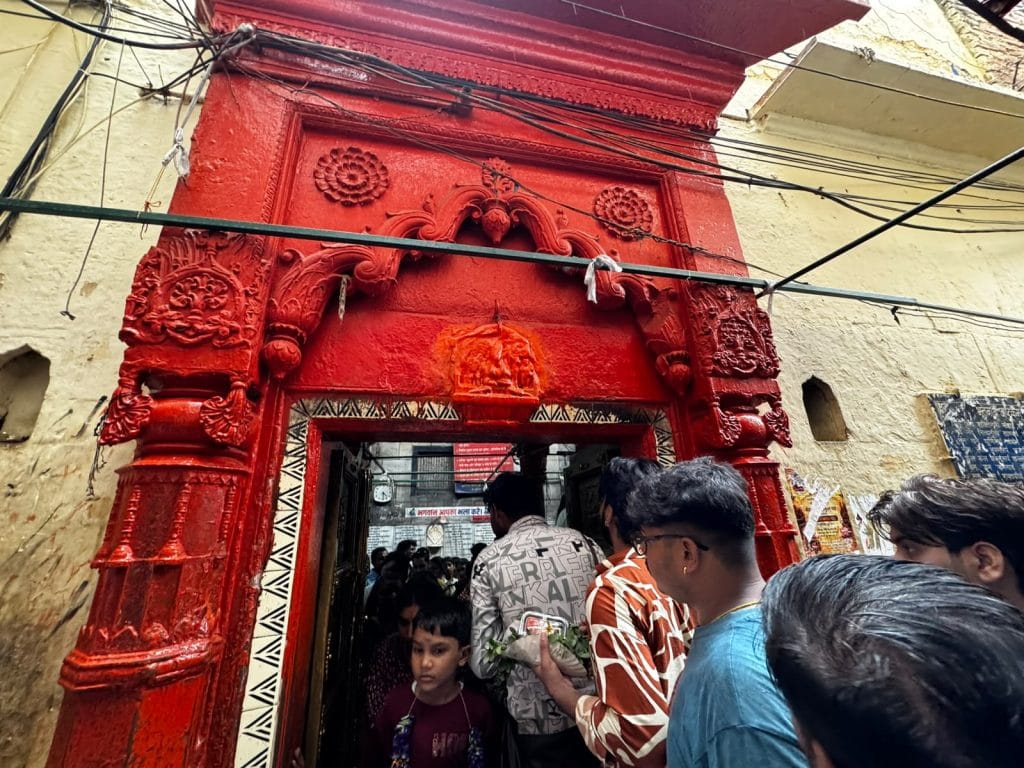
At the Kaal Bhairav Temple in Varanasi, a long queue snakes through the narrow lane. Devotees inch forward as police personnel work to keep the crowd in check. But not everyone has to wait. Temple staff escort a few visitors through the rear entrance after a priest instructs them: “They are known to me. Let them skip the queue and go inside.”
Inside, the sanctum is compact, and devotees barely get a minute before they are asked to make way for the next person. Seated beside the deity, a priest receives offerings from worshippers. One devotee hands over ten Rs 500 notes. The priest places a garland around the devotee’s neck, smears tilak on the forehead and then places the cash at the deity’s feet before moving on to the next person.
“We also have to run our family. We are praying for your success. At least offer us something. This way success will come sooner,” one of the women tells a devotee as he offers a paltry Rs 100.
Here, too, government intervention, including redevelopment, has long been looked upon with distrust, and it has only intensified with the Ram Mandir case.
We have started looking at everyone with scepticism. Such are the times.
– Kapil Sharma, secretary of the Shri Krishna Janmasthan Seva Sansthan
In 2019, Chief Minister Yogi Adityanath directed officials to prepare a redevelopment plan for the Kaal Bhairav area, modelled on the Kashi Vishwanath Corridor. The idea was to widen the narrow approach lanes leading to the shrine in Varanasi’s old city.
A joint survey by tourism and municipal officials was completed in 2020 for the state government. But the plan remains stuck. The reason: resistance from the Kaal Bhairav Seva Samiti, which represents the hereditary mahants and devotee families managing the sanctum.
“Mahants want to be with the government but they are sceptical,” said the mahant. Here, the consensus is that infrastructure projects are a Trojan horse for a power grab.
“The government wants to take over temples. In the name of corridors and redevelopment, they enter the temple premises, gradually increase their control and slowly take over,” the mahant added, declining to reveal the donations received by the temple.
Back at the Shri Krishna Janmabhoomi in Mathura, where calls for an Ayodhya-style temple complex have grown louder in recent years, trust secretary Kapil Sharma has more immediate concerns.
In June, a litigant alleged irregularities in the temple’s donation management and sought a CBI probe, citing the Ayodhya fraud case. Sharma rejected the allegations as “baseless” but vigilance is nevertheless at an all-time high. He wants to ensure there is no Tinu Yadav—the primary accused in the Ayodhya fraud—inside their walls.
Those entering the strong room, where donations are counted, are required to wear pocketless clothing and work under constant CCTV surveillance. Another layer of oversight will now be added: each CCTV feed will be monitored by two people instead of one.
“We have started looking at everyone with scepticism. Such are the times,” said Sharma.
(Edited by Asavari Singh)