


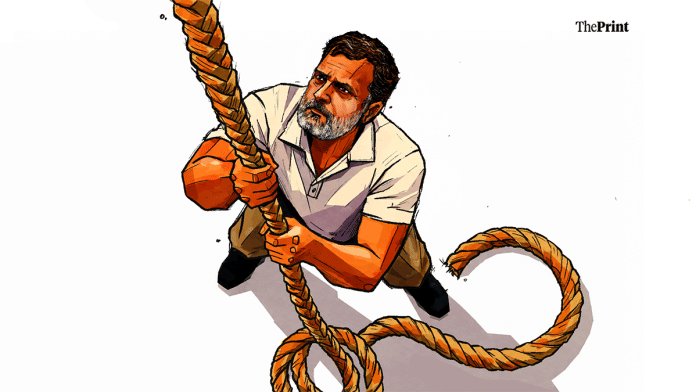
If Rahul Gandhi is the flavour of the political season for adversaries and fans alike, two interesting trends dominate all talk over his future. Both are contradictory.
On the one hand, it’s quite remarkable that there’s disagreement between Prime Minister Narendra Modi and his mass base, on Rahul’s future potential. On the other hand, Rahul and his base are in complete agreement on this subject.
BJP followers are dismissive of Rahul. For them, he’s the ‘pappu’, or an object of derision. Often enough, even senior BJP leaders boast that he’s no threat but their biggest strength. Modi, however, has always held the opposite view. He sees Rahul, and the Gandhis, as the only potential threat.
That’s why his campaigns are so fixated on Rahul. Even in a state election where the Congress hardly counts, Modi targets him. This week, he also fielded Union Home Minister and BJP ‘Kautilya’ Amit Shah to launch a vicious attack on Rahul. While the base may laugh it away, BJP seniors know who the real threat is. That’s the rare contradiction between the leader and the base.
For the Congress, Rahul and his base are unanimous in believing that power is his for the taking, if only elections were fair. Implicit in this is the insinuation that all elections were stolen by the BJP 2019 onwards. First, by ‘mass-fixing’ of Electronic Voting Machines (EVMs), and now with a combination of CEC Gyanesh Kumar and his SIR. Just fix these and the next election is yours.
Unlike their devoted base, Modi and Shah are realistic about Rahul because they know their politics. Rahul’s followers and Modi agree on one thing, and they’re both right: that however consistently Rahul may have faltered in the past, the Congress under him poses the only credible challenge to the BJP.
Also Read: Modi at 25 is staring at a cascade of crises. A perfect storm is building
See it this way. From its lowest Lok Sabha tally of 44 seats in 2014 through 52 in 2019 to 99 in 2024, the Congress vote share has been steady in the 19-21 percent range. That’s one in five Indians instinctively voting for the ‘hand’ symbol. Looking at data from 1996 across 1998, 1999 until 2009, the BJP floated within the 25 percent ballpark. That’s one in four voters. It was the coalition era.
Modi changed that equation in 2014. The BJP has floated in the 37-40 percent range since. A jump of 12-15 percentage points over the baseline is phenomenal and devastating in a multi-party system. We can safely call this top-up the Modi vote.
It’s unrealistic to imagine Rahul taking the Congress vote share to 37 percent in the foreseeable future. But, if he simply adds another 5-6 percent to his core vote, national politics changes. He’s been routinely losing nine out of ten direct fights against the BJP. You can then presume that most of this vote will come from the BJP in regions it routinely sweeps. The 2024 election was a limited, coalition exception. As the Opposition vote consolidated, BJP’s strike rate declined. It won only seven out of every ten direct contests against the Congress.
A BJP at 32 percent will still dominate, but its Lok Sabha numbers could fall to low-200s or even below that. It may still form a government, but it will be a genuine NDA coalition with all the attendant leadership complications.
That’s the threat Modi and Shah have never taken lightly. They don’t believe Rahul is their best asset in the Opposition. They know that the Congress, with its one-in-five vote base, is their only challenger. And the Congress, like it or not, can’t stay intact without the Gandhis.
Also Read: Since Indira, govts drift in the 3rd year. Modi must restore EC image to get out of it
Now, the key point: Where does this take Rahul? At this time, he’s totally focused on building the ‘street’ against Modi. He’s willing to partner anybody, from mostly apolitical CJP to hard-Left AISA, from Abhijeet Dipke to Neha Bora.
Having been through the school of hard knocks since he joined politics in 2004, Rahul should know that political change in India is brought about either by those who win an election, or combine with others to defeat an incumbent. A “regime change” on the streets is an empty hard-Left fantasy because they can never win an election.
The combined might of Jayaprakash Narayan (Navnirman Andolan) and George Fernandes (Railway Strike), backed by the RSS and Lohiaite street power, and armed with that Allahabad High Court order, couldn’t topple Indira Gandhi. They had to wait for the 1977 election. In 2010-12, a dead-in-the-water UPA wasn’t thrown out by the Anna movement and RSS/BJP. It took the 2014 election to settle the issue.
The next general election, 2029, will mark 25 years in politics for Rahul. He will still be only 59, young by the standards of Indian politics. But, presuming that the Congress and the BJP retain their ideologically frozen vote, Modi’s add-on voters won’t shift to Rahul out of boredom. He has to offer them a better, constructive, optimistic proposition.
What will he do differently from Modi/BJP if elected? Let me list just a dozen short questions:
● How would he want Election Commissioners to be picked and the impartiality of ECI restored? Return to the Congress/UPA era isn’t inspiring. His late father had tried in 1989 to weaken the EC by making it a three-member body. Further, how will he ensure that non-citizens (those the BJP has labelled ghuspethiyas) don’t become voters?
● The same for the judiciary, CBI and the other key agencies.
● How will he handle a Trump-like challenge? How will his policy towards the US be any different?
● What’s his plan to deal with the Chinese? How will his treatment of Pakistan and terrorism emanating from there be different? Softer than Modi’s, or harder?
● How will his approach to West Asia and Israel differ from Modi’s?
● What’s his vision for managing India’s chronic and crippling triple-shortage of energy, capital and gold? We can add AI/software services to this now. How will he make India a magnet for investors?
● Chhatron ki Goonj is resonating. But, how will he create more jobs? Further, for the less educated, will he continue MGNREGA, or bring in a ‘new, improved’ version? Will he continue giving away free foodgrain?
● Is caste census still his idea of social justice? How will it create more jobs? Revanth Reddy doesn’t know what to do with his caste census. Will he ask D.K. Shivakumar to at least release his caste census data?
● What changes does he plan for the education system to end corruption and profiteering, improve quality, and make the young more employable?
● He says he isn’t anti-business or anti-capital. He just wants no monopoly and a level playing field. How will he ensure that? What’s his concept of economic reform?
● Since he and his ‘secular’ partners complain that the minorities are marginalised, how would he mainstream them?
● And finally, who is, or will be on his team?
To look like a credible challenger and not just a street fighter, Rahul needs to answer these questions and offer voters in the ‘middle’ new ideas. Modi started promising “Achche Din” by late 2012. At about the same distance from 2029, what’s Rahul promising?
If he were to think out of the box, he can set up a UK-style shadow cabinet. His ‘ministers’ could then start answering these questions in their respective domains. Of course, if I were to be only part facetious, it could unleash mighty infighting even for these non-jobs. Whatever Rahul Gandhi chooses, he can’t go into 2029 again riding on his ecosystem’s clamour over Modi’s ‘falling’ popularity. That has failed thrice already.
Also Read: 20% ethanol, 80% anger: BJP’s core voter is furious and looking for answers
Sadly, Rahul has no answers to your questions.
If he did, he would have highlighted various models that Congress has implemented across the states it rules – despite the alleged vote chori.
Incidentally, he may not have to answer your questions too.
That is because the country knows that the so-called vote chori, if it happens only in states where the opposition lost is no vote-chori at all. it is simply finding an advanced excuse for the losses in 2028 (UP) and 2029 (National) elections.
Mr. RJ has has made a couple of interesting observations against your ardent cry here…sire. His specific examples are mostly real and pointed, especially the CEC demand…removal requires the same process as a Supreme Court judge, so demanding a resignation through the streets was always futile.
Also, he did make a as to how that Raoul cannibalises his own allies’. That indeed is a sharp observation, I say.
Why should he answer these questions.Throughout these protests he has not once asked for votes.Not once has he said he will be PM.He is just asking for regime change of this curropt govt.Whoever forms the next gove will answer.Why Rahul.Next you will say Neha and Dipke should answer.Doesnt make sense to me.
Good questions sir, very interesting. hope one day you will find enough guts in yourself to address even a single question to Modi. the simple fact that you can dare to frame a set of questions for Rahul to answer, marks a sea-change in your area of work and in our country’s polity.
Modi wons because Rahul Gandhi is the opponent. Otherwise, BJP loses, wherever Rahul doesn’t campaign.
And Rahul Gandhi is too entitled to let go of control of the party. But he doesn’t want to promise any development.
In addition, it should be a fair question to ask how Mr.Rahul’s Congress party acted with these institutions when they were in power and why people should expect anything different this time.
Thirteen years out of power at the national level, the talent pool of the Congress party has been depleted. Senior leaders like Shri P Chidambaram have aged. The next generation, represented by men like Mr Scindia, have crossed the aisle. Difficult to groom the next generation of leaders without the fishes and loaves of office to distribute. The South is an area of strength, resource mobilisation. It had stood by Mrs Gandhi in 1977 as well. 2. The leader of the opposition has a well defined position in a parliamentary democracy. After a slow start, hard to make the case that Indians do not take Shri Rahul Gandhi seriously. As, the column argues, senior political opponents do as well.
Modi and Shah know that the only central party that can challenge BJP is the Congress party. Rahul Gandhi hardly matters, in fact as long as Rahul is at the helm, BJP most certainly wins. As a citizen I do not want Congress to win at the center in the next two decades. Because it cannot handle the pressure the West, especially the USA is putting. And terrorism may come back and who knows Jammu and Kashmir may get article 370 back. With regime changes in Nepal, Bangladesh, the massive unrest in Pakistan, economic woes in Srilanka, all of India’s neighbors are chaotic now. Add to this the wars in the middle east, the Russia-Ukraine war have made many countries unstable. India is mostly unimpacted due to the current govt. Congress will make everything go away. So it is good that BJP stays at the center for another two decades at least.
Cometh the hour, cometh the man. 2. Stating the obvious. Challengers do not win elections. Incumbents lose them. That is what the government and the ruling party need to face squarely. They should simply dust off the promises made to Indians on the eve of coming to power in 2014. Some are meant for the galleries. With a rhetorical flourish. The substance which merited serious delivery. If not in one term – You gave them sixty years, give us sixty months – certainly over two and a half, getting on for three now. 3. For a developing country, the economy has to be the central focus. Job creation above all. Education, healthcare, which improve people’s lives and are the building blocks for development. Good governance in all its dimensions, women’s safety, law and order of concern to all. National security which was expected to be flying on afterburner. Institutions, Parliament, above all. The judiciary. Regulatory bodies. A vibrant media, as befits the largest democracy. India’s place in the world, which a lot of store was set by. 4. A cool, calm, appraisal, within closed doors. Mr Rahul Gandhi, as leader of the opposition, an exalted post in a parliamentary democracy, knows the score. As do the young people, intelligent, aspirational, many from modest economic backgrounds, who are protesting at Jantar Mantar and all over the country.